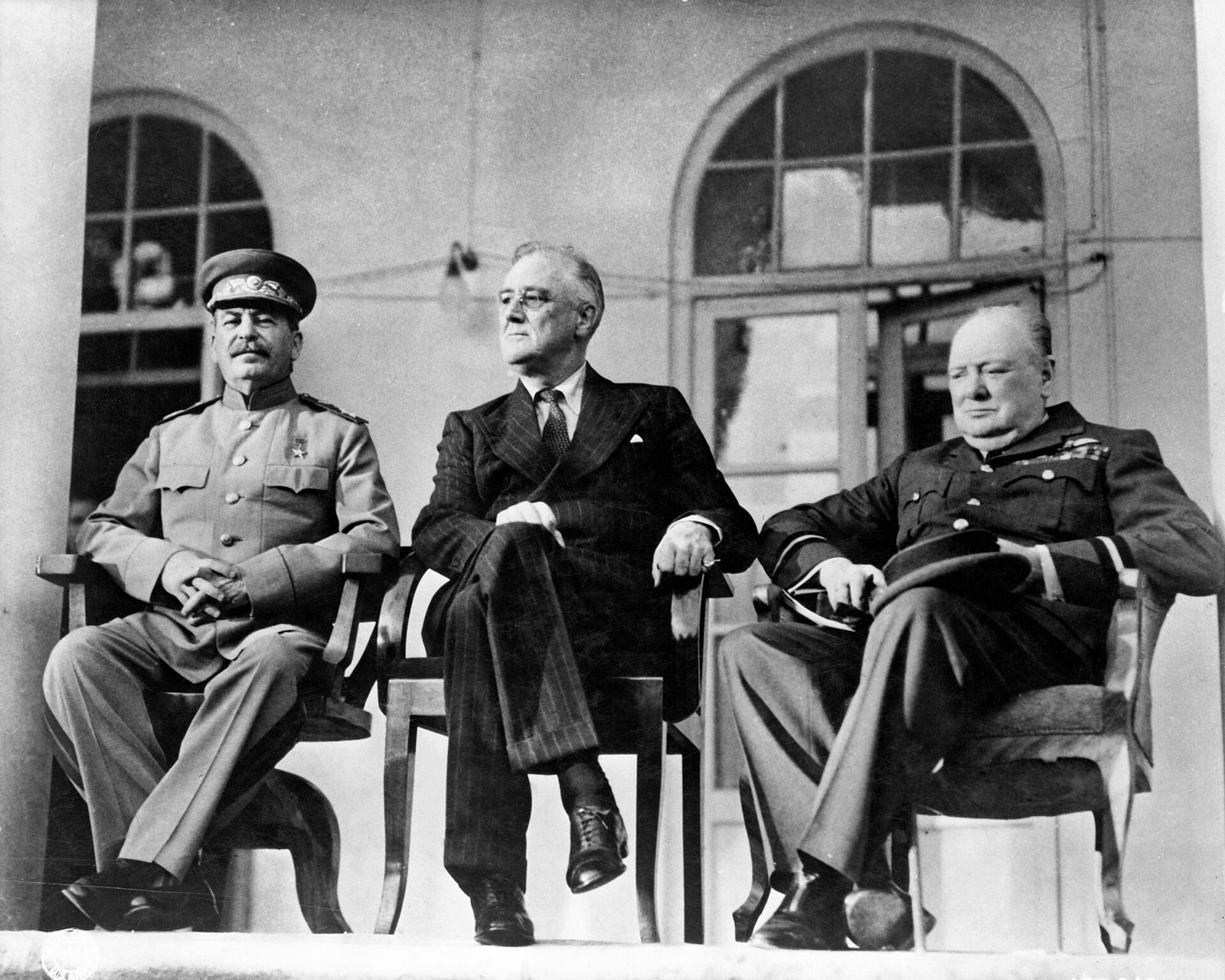
The Tehran Conference coordinated plans for an invasion of France with Soviet attacks and called for Turkey to join the Allies before the end of 1943. Meeting from 28 November to 1 December 1943, Franklin D. Roosevelt, Winston Churchill and Josef Stalin also addressed Iran’s sovereignty and the postwar international order. Turkey did not enter the war on their requested schedule.
Why did a conference that planned operations in France also put pressure on Turkey? The answer connects landing craft, Soviet military commitments and Turkish demands for protection. If you are exploring Turkey’s wartime position, the path from Tehran to the subsequent Cairo talks shows how an Allied objective met specific Turkish security concerns.
What was the Tehran Conference?
The conference took place at the Soviet Embassy in Tehran, Iran’s capital. Its military code name was Eureka. It was the first wartime summit attended jointly by American President Roosevelt, British Prime Minister Churchill and Soviet leader Stalin.
Their discussions covered both immediate operations and future arrangements. The military conclusions dated 1 December addressed France, Yugoslavia and Turkey. Other discussions concerned Germany’s possible division, a future international security system and Soviet participation in the war against Japan.
What did the leaders decide about the invasion of France?
The military conclusions scheduled Operation Overlord, the invasion across the English Channel into France, for May 1944. That date was the timetable recorded at Tehran. When you read the conference decisions, it matters to recognize May as the planned starting month in that document.
The leaders also agreed on a landing in southern France in conjunction with Overlord. Its scale depended on the landing craft available. This qualification connected the agreed military objective to a concrete equipment constraint: the southern operation’s size could not be fixed independently of transport capacity.
Stalin said Soviet forces would launch an offensive at approximately the same time as the invasion of France. Its stated purpose was to prevent German troops from moving from the Eastern Front to the Western Front. The commitment therefore linked the timing of separate operations to the movement of German forces.
Think of coordinating a shared calendar in everyday life: one commitment affects what someone else can do. At Tehran, that connection had a precise military purpose. The Soviet offensive was intended to restrict German transfers while the invasion of France opened another front.
What other military commitments emerged?
The three leaders agreed to support the Partisans in Yugoslavia to the greatest possible extent. The specified assistance included supplies, equipment and commando operations. Their military conclusions therefore covered support for forces already fighting as well as preparations for new landings.
The Soviet Union also committed during the Tehran discussions to enter the war against Japan. This commitment extended the conference’s military scope beyond the planned European operations. It belonged to the wider set of agreements reached alongside the decisions concerning France and Turkey.
Why did the Allies want Turkey to enter the war?
The military conclusions described Turkey’s entry on the Allied side before the end of 1943 as highly desirable from a military standpoint. The wording recorded the three powers’ objective. It did not establish that Turkey had accepted their timetable.
Stalin offered a specific assurance concerning Bulgaria. If Turkey entered the war against Germany and Bulgaria consequently declared war on Turkey or attacked it, the Soviet Union would immediately enter a state of war with Bulgaria. The assurance depended on those stated circumstances.
The leaders also agreed that Roosevelt and Churchill should meet Turkish President İsmet İnönü. Their purpose was to persuade Turkey to enter before the end of 1943. The effort to secure Turkish participation thus required further discussions with Turkey’s president after the Tehran meeting.
Why did Turkey resist the proposed timetable?
In November 1943, Turkish military leaders rejected requests to enter the war and provide air bases to the Allies. They cited inadequate military assistance and the danger of a German-Bulgarian attack. These were concrete objections concerning equipment and exposure to attack.
Those concerns help you understand the difference between the Allied request and Turkey’s response. Tehran’s military conclusions expressed a desire for Turkish entry before the year ended. Turkish military leaders had already challenged participation on the grounds of insufficient assistance and security risks.
Roosevelt also placed a limit on the relationship between Turkey’s participation and the invasion of France. During the Tehran discussions on 1 December, he insisted that Turkish entry should not compromise the programme for opening a second front in France. Bringing Turkey into the war could not displace that programme.
What happened when İnönü met Roosevelt and Churchill?
Roosevelt, Churchill and İnönü discussed Turkish participation at the Second Cairo Conference on 4–6 December 1943. The meeting followed Tehran and carried its pressure for Turkish entry into direct talks with the Turkish president.
In Cairo, İnönü and his advisers indicated that they were open in principle to entering the war. They requested Allied air protection and substantial military assistance. Their position combined a willingness to discuss participation with demands addressing Turkey’s ability to withstand the consequences.
Turkey did not enter the war before the end of 1943. It declared war on Germany in February 1945. For students following the diplomacy, these dates distinguish the deadline sought at Tehran from the timing of Turkey’s eventual declaration.
What did Tehran promise Iran and discuss for the postwar world?
The declaration concerning Iran, dated 1 December 1943, supported Iran’s independence, sovereignty and territorial integrity. The United States, United Kingdom and Soviet Union also affirmed commitments to economic assistance during and after the war.
The declaration acknowledged Iran’s contribution to the common war effort. It specifically recognized Iran’s role in facilitating the passage of overseas supplies to the Soviet Union. The host country therefore appeared in the conference documents as a contributor to wartime supply arrangements.
In private discussions with Stalin, Roosevelt proposed that the United States, United Kingdom, Soviet Union and China serve as four major protecting powers in a future international security system. The proposal concerned the organization of security beyond the immediate military campaigns.
Germany’s postwar division was also discussed. However, the leaders did not establish a common implementation plan specifying how many parts the country would have. Discussion of division should therefore be distinguished from an agreed operational settlement.
Timeline
- November 1943: Turkish military leaders rejected requests for war entry and Allied air bases, citing inadequate aid and attack risks.
- 28 November 1943: Roosevelt, Churchill and Stalin began their first joint summit in Tehran.
- 29 November 1943: Churchill presented Stalin with an honorary sword for the people of Stalingrad.
- 30 November 1943: The three leaders attended Churchill’s birthday dinner.
- 1 December 1943: The conference ended; the declaration concerning Iran and military conclusions bore this date.
- 4–6 December 1943: İnönü discussed Turkish participation with Roosevelt and Churchill in Cairo.
- May 1944: This was the starting month envisaged for Overlord in Tehran’s military conclusions.
- February 1945: Turkey declared war on Germany.
Details you won’t find in guidebooks
The military conclusions included an agreement that the three countries’ military staffs should prepare a joint deception plan for the forthcoming operations in Europe. Coordination at Tehran thus extended to misleading the enemy about the approaching campaigns.
Ceremony accompanied the military discussions. On 29 November, Churchill presented Stalin with King George VI’s honorary sword for the people of Stalingrad at the Soviet Embassy, with Roosevelt present. The three leaders were also photographed together at Churchill’s birthday dinner on 30 November.
Security produced a more disputed story. Soviet reports alleged that German agents planned to assassinate the three leaders, but that the operation was cancelled during planning. American ambassador Averell Harriman doubted the plot’s existence. Americans suspected the account might have been devised to move Roosevelt into the Soviet Embassy.
Roosevelt’s own explanation appears in his confidential letter of 10 January 1944. He described his main reason for leaving the American legation as avoiding exposure of visiting leaders to possible attacks by Axis agents. The letter documents his stated security concern; the alleged assassination plot remained disputed.
FAQ
When and where was the Tehran Conference held?
The conference met from 28 November to 1 December 1943 at the Soviet Embassy in Tehran, Iran.
What did the Tehran Conference decide about France?
The military conclusions scheduled Operation Overlord for May 1944, alongside a landing in southern France whose size would depend on available landing craft. Stalin promised a Soviet offensive at approximately the same time.
Did Turkey agree to enter the war at Tehran?
The three powers wanted Turkey to enter before the end of 1943. Subsequent talks with İsmet İnönü in Cairo addressed military aid and air protection, but Turkey did not enter on the requested schedule.
Was the alleged assassination plot against the leaders proven?
Soviet reports described a German assassination plan, but American ambassador Averell Harriman doubted its existence. The allegation should be distinguished from Roosevelt’s documented explanation that security concerns influenced his accommodation.
Sources
- Vikipedi — Tahran Konferansı tr.wikipedia.org
- Wikipedia — Tehran Conference en.wikipedia.org
- Yale University, Avalon Project — The Tehran Conference avalon.law.yale.edu
- U.S. Department of State, Office of the Historian — The Tehran Conference, 1943 history.state.gov
- U.S. Department of State — Historical review of Turkey’s wartime role 1997-2001.state.gov
- U.S. Department of State, FRUS — The question of Turkey’s entry into the war history.state.gov
- Yuluğ Tekin Kurat, Belleten — Kahire Konferansı Tutanakları ve Türkiye’yi Savaşa Sokma Girişimleri belleten.gov.tr
- The National WWII Museum — The Cairo and Tehran Conferences nationalww2museum.org
- New Bulgarian University — Who dropped the sword of Stalingrad? ojs.nbu.bg
- Australian War Memorial — Birthday dinner photograph, Tehran awm.gov.au
- U.S. Department of State, FRUS — Roosevelt’s letter to Patrick Hurley, 10 January 1944 history.state.gov
Image: Teheran conference-1943.jpg — U.S. Signal Corps photo., Public domain