Ancient Pergamon is in Bergama, in Turkey’s İzmir province, where its Acropolis rises above the Bakırçay Plain. Its western slope holds a theatre for about 10,000 spectators, while the separate Asclepieion developed as a sanctuary and treatment centre dedicated to Asclepios. Together, these sites reveal the city’s royal, religious and healing institutions.
Pergamon also connects places that you might initially confuse: a royal hill, a healing sanctuary and a museum in Berlin. The Asclepieion has its own theatre, separate from the larger Acropolis building. Following those distinctions helps you understand the city before turning to the Great Altar and the sculptures now incorporated into its Berlin reconstruction.
Where is Pergamon in Turkey?
Pergamon lies in the Bergama district of İzmir, in Turkey’s Aegean region. Its Acropolis occupies a hill approximately 335 metres above sea level. From this elevated position, the upper city overlooks the Bakırçay Plain. The height gives a concrete setting to the palaces, temples and military stores that occupied the summit.
Two waterways help define the ancient city’s geography. To the west runs the ancient Selinus, now called Bergama Çayı. To the east is the ancient Ketios, today Kestel Çayı. These paired names connect the ancient landscape with the place names you encounter around Bergama today.
Pergamon’s setting also belongs to a wider protected landscape. In 2014, UNESCO inscribed Pergamon and its Multi-Layered Cultural Landscape on the World Heritage List. The inscribed property covers 332.5 hectares.
What does Pergamon mean?
The Metropolitan Museum of Art’s Pergamon catalogue explains the city’s name as a word of pre-Greek origin meaning “fortress.” That meaning offers a useful starting point for understanding the Acropolis. Its upper city contained royal palaces, arsenals and major temples, bringing government, stored weapons and worship onto the commanding hill.
Pergamon became the centre of the Attalid dynasty after Philetairos established independent rule around 281 BCE. The dynasty’s rule continued until the death of Attalos III in 133 BCE. Between those dates, the city served as the centre of a kingdom whose territory expanded substantially through its relationship with Rome.
The Peace of Apameia in 188 BCE enlarged the Anatolian territories of Pergamon, Rome’s ally. The kingdom then reached its greatest extent. Attalos III later left his kingdom to Rome in his will. His death in 133 BCE marks the transition recorded in Pergamon’s political chronology.
What can you understand from the Acropolis?
The upper city grouped royal palaces, arsenals and large temples within the Acropolis. These buildings explain why the hill matters beyond its elevation. You are looking at the setting of royal authority and religious institutions, with the Bakırçay Plain below and the theatre built into the western slope.
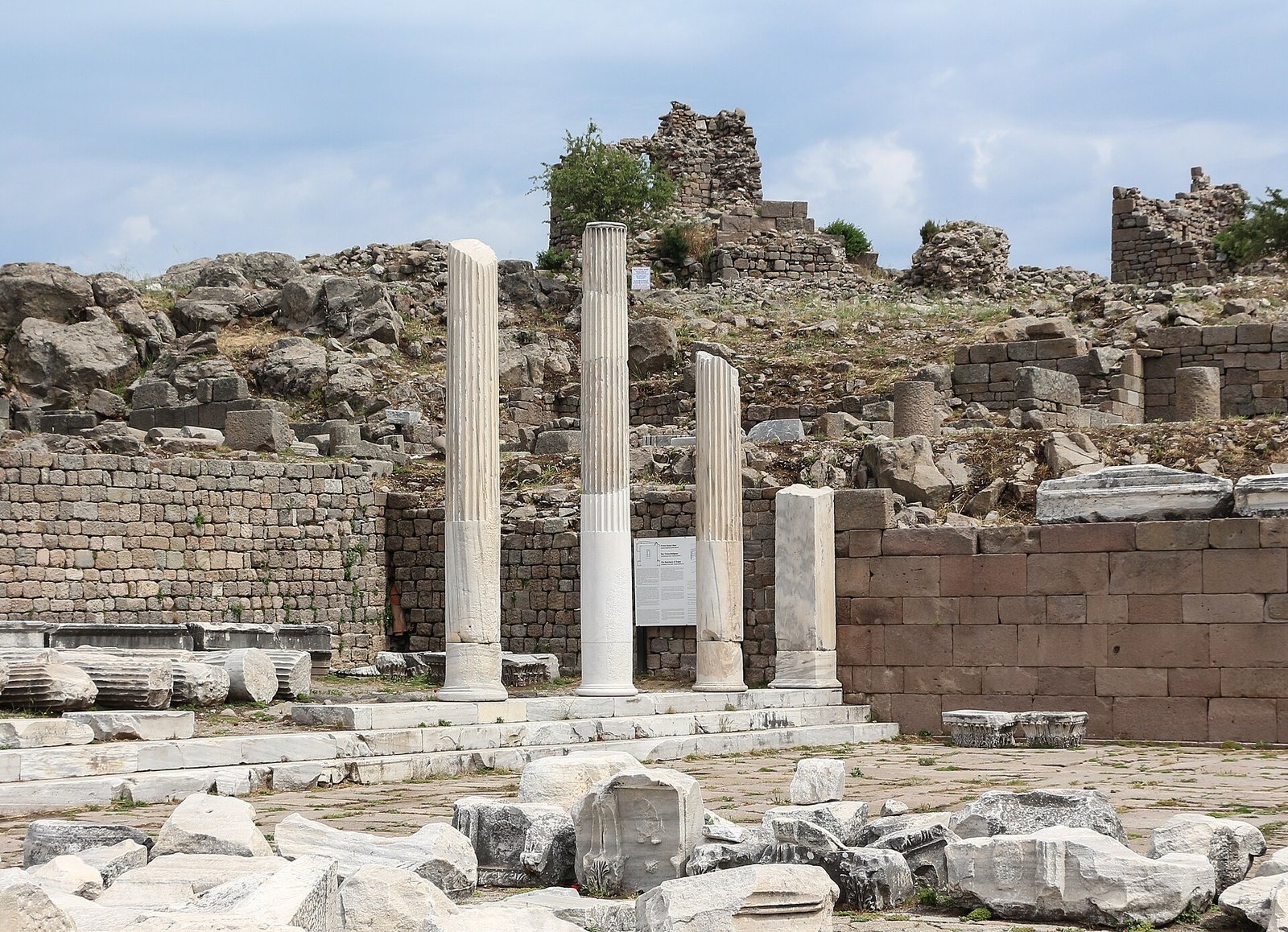
The Acropolis also preserves a Roman imperial chapter. The Temple of Trajan was built in the second century CE for the emperors Trajan and Hadrian. Its presence distinguishes the hill’s later monumental development from the earlier period when Pergamon was the centre of the Attalid kingdom.
Dionysos had a temple north of the theatre terrace. His associations with wine and theatre place the sanctuary beside a building devoted to performance. Here, the relationship between temple and theatre is visible in their positions: the temple stood at the northern end of the terrace serving the hillside theatre.
How large was Pergamon’s Acropolis theatre?
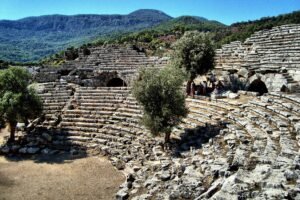
The Hellenistic theatre on the western slope of the Acropolis accommodated approximately 10,000 spectators. Its seating comprised 78 rows and extended through a vertical difference of about 36 metres. Those measurements explain the scale of the seating more clearly than a general description of a steep hillside could.
The theatre’s capacity also helps distinguish it from the Asclepieion theatre. Pergamon had both a large theatre on the royal hill and a smaller one within the healing sanctuary. If you encounter photographs or descriptions of a Pergamon theatre, its location and capacity are useful clues to which building is being discussed.
What was the Asclepieion?
The Asclepieion stood outside the Acropolis. It began developing in the fourth century BCE as a sanctuary and treatment centre dedicated to Asclepios, the god of healing. Its beginnings therefore preceded the independent rule established by Philetairos around 281 BCE. The sanctuary has a history extending across several phases of the city.
Much of the monumental arrangement visible today comes from changes made under Hadrian in the second century CE. This distinction matters when you consider the sanctuary’s age. Its fourth-century BCE beginnings and its later Roman monumental form belong to different stages of development at the same healing site.
The sacred approach, called the Via Tecta, was approximately one kilometre long. The sanctuary also contained a theatre northwest of its courtyard. With room for about 3,500 people, this was a substantial performance building, though smaller than the approximately 10,000-seat theatre on the Acropolis.
Treatment practices included sacred sleep, water and mud applications, dietary regimens and musical performances. The orator Aelius Aristides received treatment there and described his experiences and the practices in his work Hieroi Logoi. His account connects the sanctuary’s buildings and treatment traditions with the experiences of a named patient.
Pergamon also figures in the history of Galen, the physician, surgeon and philosopher. He studied in the city, and his writings spread from it. Alongside the sanctuary’s treatment practices and Aristides’ account, Galen’s connection gives Pergamon a place in the history of medical learning as well as religious healing.
Where is the Pergamon Altar, and what did it depict?
The Great Altar was built at Pergamon during the second century BCE. Its base measured approximately 36.8 metres across and 34.2 metres deep. An outer frieze, about 2.3 metres high, depicted the mythological battle between the Olympian gods and the Giants.
The precise construction date remains debated. Berlin’s State Museums date the altar to approximately 170–160 BCE. The Museum of Classical Archaeology at Cambridge gives a possible range of 180–159 BCE. Both place the monument in the second century BCE, while offering different limits for its construction.
Its dedication also requires care. Although often called the Altar of Zeus, Berlin’s State Museums explain that it may have been dedicated to Zeus and Athena, or to all the gods. The familiar name therefore does not settle which divine recipients the monument originally honoured.
Pergamon Museum Berlin: how does it connect to Turkey?
The Pergamonmuseum stands on Museum Island in the historic centre of Berlin, Germany’s capital. Surviving sculptural pieces from the Great Altar have been incorporated into a reconstruction there. The ancient city and the museum are thus in different countries, connected through the altar’s surviving sculpture.
For you as a reader planning around Pergamon, the distinction is straightforward. Bergama in Turkey contains the ancient city, its Acropolis and the Asclepieion. Berlin contains the Pergamonmuseum and its reconstruction incorporating the altar sculptures. The name Pergamon can refer to the ancient place or appear within the museum’s name.
Details you won’t find in guidebooks
The Acropolis theatre used an assembly that could change: its stage structure was made of wood and could be dismantled and reassembled. It did not have a permanent stone stage structure. That detail adds another dimension to the theatre’s 78 seating rows and approximately 10,000-person capacity.
Shops selling votive objects lined both sides of the colonnaded approach to the Asclepieion. There is an everyday-life connection here: shopping formed part of the route to a destination. In this case, the goods were offerings, and the destination was a sanctuary dedicated to the god of healing.
The Asclepieion’s sacred spring still flows, according to UNESCO’s description of the site. Water therefore belongs both to the sanctuary’s recorded treatment practices and to its present physical landscape. The surviving spring provides a direct connection with a resource that mattered within the ancient healing centre.
Bergama Museum has an architectural connection with the Great Altar. The plan of its building, opened on 30 October 1936, was inspired by the monument commonly called the Altar of Zeus. The altar’s influence can therefore be followed through both the reconstruction in Berlin and the museum building in Bergama.
Pergamon in the Bible
Pergamon appears in the New Testament’s Book of Revelation as the city of one of the Seven Churches of Asia. This biblical connection adds another historical reference to a place also associated with Attalid kings, Roman imperial temples and the sanctuary of Asclepios.
Timeline
- Fourth century BCE: The Asclepieion dedicated to Asclepios began to develop.
- Around 281 BCE: Philetairos established independent rule, beginning Attalid power.
- 188 BCE: The Peace of Apameia brought the kingdom to its greatest territorial extent.
- Second century BCE: The Great Altar was built; its precise date remains debated.
- 133 BCE: Attalos III died, activating his will leaving the kingdom to Rome.
- Second century CE: Much of the Asclepieion’s monumental arrangement dates to changes under Hadrian, and the Temple of Trajan was built on the Acropolis.
- 30 October 1936: Bergama Museum’s present building opened.
- 2014: UNESCO inscribed Pergamon and its Multi-Layered Cultural Landscape.
FAQ
Where is ancient Pergamon?
Ancient Pergamon is in Bergama, a district of İzmir in Turkey’s Aegean region. Its Acropolis stands on a hill approximately 335 metres above sea level.
Where is the Pergamon Altar?
The Great Altar was built at ancient Pergamon. Its surviving sculptural pieces are incorporated into a reconstruction in the Pergamonmuseum on Museum Island in Berlin.
Are Pergamon’s two theatres the same building?
No. The Acropolis theatre held about 10,000 spectators. The separate theatre at the Asclepieion held about 3,500.
What does Pergamon mean?
The Metropolitan Museum of Art’s Pergamon catalogue explains the name as a word of pre-Greek origin meaning “fortress.”
Sources
- Wikipedia — Pergamon en.wikipedia.org
- Vikipedi — Pergamon tr.wikipedia.org
- The Metropolitan Museum of Art — Pergamon and the Hellenistic Kingdoms of the Ancient World resources.metmuseum.org
- Republic of Türkiye Ministry of Culture and Tourism — İzmir Bergama Museum Directorate kvmgm.ktb.gov.tr
- Republic of Türkiye Ministry of Culture and Tourism — Bergama Asklepion Archaeological Site muze.gov.tr
- UNESCO — Pergamon and its Multi-Layered Cultural Landscape whc.unesco.org
- Berlin State Museums — Der Große Altar von Pergamon search.smb.museum
- Cambridge Museum of Classical Archaeology — Great Altar of Zeus at Pergamon, Giant museum.classics.cam.ac.uk
- Wikipedia — Pergamon Museum en.wikipedia.org
Image: Temple of Trajan, Pergamon 01.jpg — Bernard Gagnon, CC BY-SA 3.0