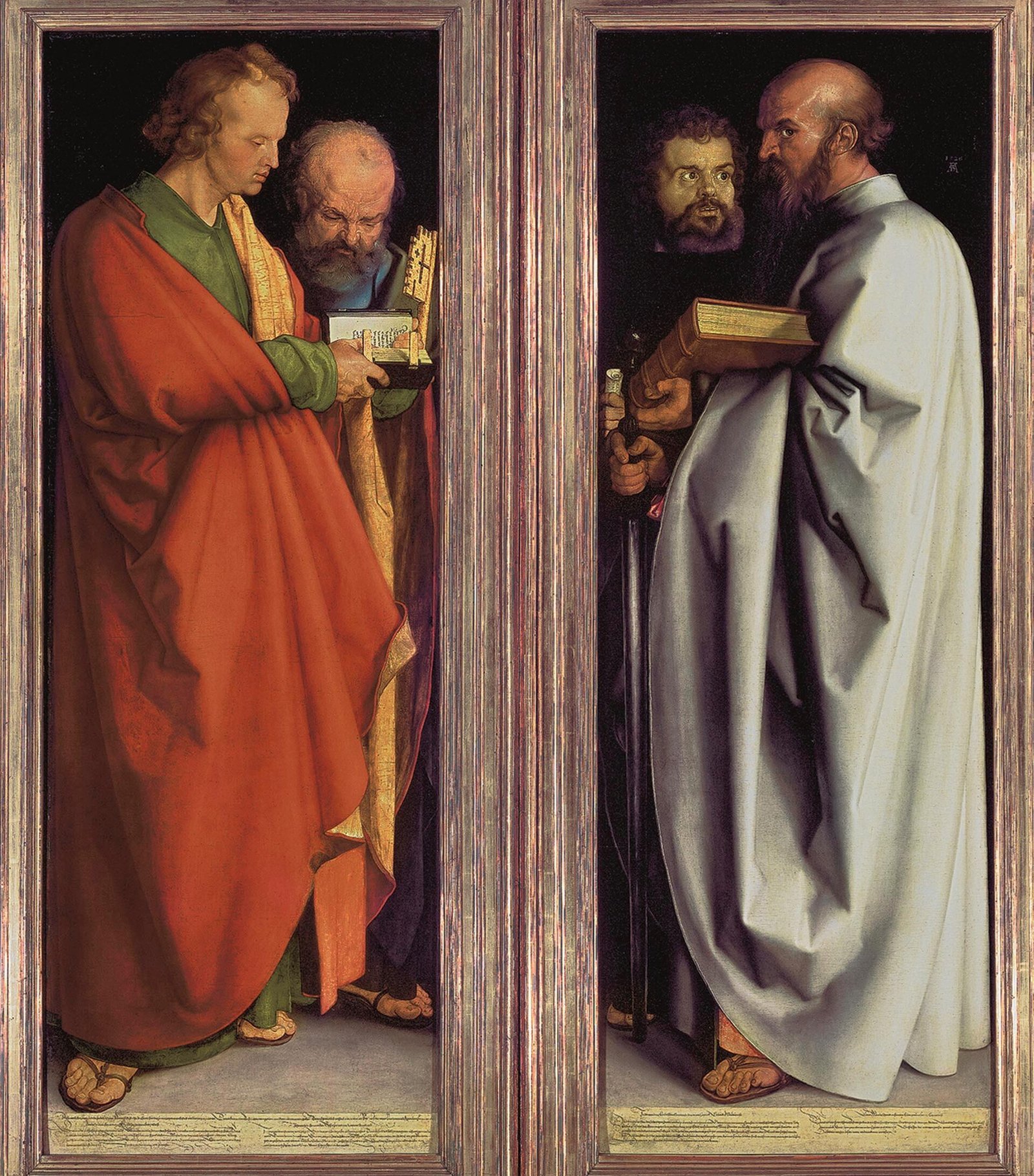
John the Apostle was the son of Zebedee, the brother of James, and one of Jesus’ twelve apostles. Early church writers connect him with Ephesus, where tradition places his residence and burial. Church tradition also identifies him as the author of the Gospel of John, but the Gospel’s anonymous text and possible editing stages make that attribution disputed.
At Ayasuluk in Selçuk, you can connect this question with a physical place: the ruins of a basilica built over a tomb attributed to John. Yet the monument, the accounts of his life, and the Gospel’s authorship belong to different kinds of evidence. Following each separately explains why Ephesus matters without making its basilica settle a literary debate.
What do New Testament texts say about John the son of Zebedee?
The Synoptic Gospel accounts introduce John and James as brothers working with their father, Zebedee. They are fishing on the Sea of Galilee when Jesus calls them to become his disciples. This family relationship anchors John’s identity before the later questions about books bearing his name.
John also appears within a smaller group alongside Peter and James. Mark 5:37 places the three at the raising of Jairus’s daughter. Matthew 17:1 includes them at Jesus’ Transfiguration. Matthew 26:37 brings them together again at Gethsemane. These passages repeatedly associate John with the same two disciples.
Acts continues that association with Peter. Chapters 3–4 show John beside him in Jerusalem, including an arrest. Acts 8:14 names Peter and John as those sent to Samaria. John therefore appears in accounts of the community’s activities as well as in narratives about Jesus.
Paul provides another reference in Galatians 2:9. He names James, Cephas, and John as people regarded as pillars of the community. Together, these passages establish a New Testament profile: Zebedee’s son, James’s brother, a disciple close to Peter, and a recognized figure in the community.
Which sources support the tradition that John lived in Ephesus?
Irenaeus supplies an explicit connection between John, Ephesus, and a Gospel. In Against Heresies III.1.1, he states that John, who leaned against Jesus’ breast, published a Gospel while living at Ephesus in Asia. His account links residence and literary activity in the same statement.
A separate strand concerns John’s burial. Eusebius preserves a letter from Polycrates, bishop of Ephesus, to Victor, bishop of Rome. In Church History III.31, Polycrates identifies John, again described through his closeness to Jesus, as buried in Ephesus. This is a burial tradition, distinct from Irenaeus’s statement about publishing a Gospel.
Eusebius also records a tradition about the length of John’s residence. In Church History III.23, drawing on Irenaeus, he says that John remained in Ephesus until the reign of Trajan. These accounts form important written supports for the Ephesian association.
If you are visiting Ephesus, keep those claims separate: living there, publishing there, and being buried there are related assertions, but each has its own wording and source. Irenaeus and Polycrates support different parts of the tradition that later found monumental expression at Ayasuluk.
Were John the Apostle, John the Evangelist and John of Patmos the same person?
Church tradition brings these identities together. It attributes the Gospel of John, the three Johannine letters, and Revelation to John the Apostle. That identification gathers five New Testament books under the apostle’s name. The texts themselves, however, do not all identify their writers in the same way.
The Gospel does not explicitly name its author. John 21:24 connects its account with the disciple described as the one Jesus loved. It presents that disciple as a witness and writer, but does not supply his personal name. Calling him John the son of Zebedee therefore involves an identification beyond the verse’s explicit wording.
Revelation takes a different approach. Its author calls himself John and states in 1:9 that he was on Patmos. He does not call himself Zebedee’s son or identify himself as one of the twelve apostles. The shared name supports the traditional connection, but does not establish it by itself.
The disagreement also has ancient roots. Irenaeus accepted the identification of Revelation’s author with the apostle. Dionysius of Alexandria opposed it. The question is therefore older than modern scholarship, even though modern discussions also examine differences in vocabulary, grammar, and style.
Eusebius introduces another complication through his reading of Papias. He interprets two mentions of John as references to separate people: the apostle and John the Presbyter. The Catholic Encyclopedia rejects that reading. It argues that Papias could mention the same person twice because he received information both indirectly and directly.
Why do church tradition and modern scholarship differ on the Gospel’s authorship?
The disagreement concerns how to connect testimony, personal identity, and the finished book. Church tradition identifies the beloved disciple with the apostle. Modern discussions also ask whether the person behind the testimony necessarily produced every part of the Gospel in its surviving form.
The Gospel’s anonymity matters here. A familiar everyday comparison is reading an unsigned account: recognizing a witness within the story does not automatically identify everyone who prepared the text. In John 21:24, the beloved disciple supplies a connection to testimony and writing, while his personal name remains unstated.
The USCCB introduction dates the Gospel’s final editing to approximately AD 90–100. It also discusses reasons for proposing several stages of composition. John 20:30–31 reads as a conclusion, yet chapter 21 follows it. Differences in style provide another reason for examining how the book reached its final form.
Eric D. Huntsman’s 2019 study explains how the beloved disciple’s testimony could have been developed by a later writer or editor. This approach distinguishes the source of the testimony from the person responsible for the completed text. It allows an authorship discussion to involve more than one role.
Other scholarship favors the traditional candidate. A Zondervan Academic article adapted from Gary Burge’s teaching argues that John the son of Zebedee is the most likely author. It draws on early church testimony and the disciple’s recurring association with Peter. Scholarly discussion therefore includes arguments supporting apostolic authorship as well as questioning it.
The proposed place of composition also varies. Tradition favors Ephesus, while modern scholarship has suggested Syria, especially Antioch. You should therefore read “written at Ephesus” as a traditional attribution, rather than as a conclusion shared by every interpretation of the Gospel.
What connects John with the basilica at Ayasuluk?
The Ministry of Culture and Tourism states that a basilica with a wooden roof was built in the fifth century over the tomb attributed to John at Ayasuluk. The attribution is central: the building marks a remembered burial place associated with him.
After earthquakes early in the sixth century made the earlier structure unusable, Justinian I and Theodora commissioned a replacement. The new basilica had a cross-shaped plan and domes. Its construction represents a later architectural expression of the tradition connecting John with Ephesus.
The ruins stand on the slopes of Ayasuluk Hill in Selçuk, İzmir, near the İsa Bey Mosque. UNESCO specifically mentions the Basilica of Saint John when explaining Ephesus’s Christian importance. Ephesus entered the World Heritage List in 2015.
Timeline
- New Testament accounts: New Testament narratives present John as Zebedee’s son, James’s brother, and an apostle of Jesus.
- Approximately AD 90–100: The USCCB introduction places the Gospel’s final editing in this period.
- Irenaeus’s account: Irenaeus records the tradition that John published a Gospel while living in Ephesus.
- Polycrates’s letter: Polycrates writes to Victor that John was buried in Ephesus.
- Eusebius’s account: Eusebius records Ephesian traditions and his interpretation of two figures named John.
- Fifth century AD: A wooden-roofed basilica is built over the tomb attributed to John at Ayasuluk.
- Sixth century AD: Justinian and Theodora commission the replacement domed basilica.
- 2015: Ephesus enters the UNESCO World Heritage List.
Details you won’t find in guidebooks
Mark 3:17 gives James and John the name Boanerges, meaning “sons of thunder.” Luke 9:51–56 supplies a striking episode involving the brothers: they propose calling down fire on a Samaritan village that refuses to receive Jesus. Jesus rebukes them.
The Gospel bearing John’s name mentions the sons of Zebedee together only in 21:2. It does not give James’s and John’s individual names there. That restrained wording is especially relevant when you compare the named apostle in other narratives with the unnamed beloved disciple.
John 21:23 also corrects a rumor that the beloved disciple would not die. The passage explicitly says that Jesus had not promised this. Separately, Eusebius records a report in Church History III.39.6 of two tombs at Ephesus, both called John’s. He includes that report in his discussion of the two Johns.
FAQ
Who was John the Apostle?
The New Testament identifies John as the son of Zebedee, the brother of James, and one of Jesus’ twelve apostles. Acts also presents him working alongside Peter.
Why is John associated with Ephesus?
Irenaeus states that John published a Gospel while living in Ephesus. Polycrates, in a letter preserved by Eusebius, says that John was buried there.
Did John the Apostle write the Gospel of John?
Church tradition attributes the Gospel to him, but the text does not explicitly name its author. Scholars differ over whether the apostle wrote its final form or supplied testimony later shaped by others.
Was John of Patmos the same person as John the Apostle?
Church tradition identifies them, but Revelation’s author calls himself John without identifying himself as Zebedee’s son. Differences in vocabulary, grammar, and style also make the identification disputed.
Sources
- Catholic Encyclopedia — St. John the Evangelist newadvent.org
- USCCB — Luke 9 bible.usccb.org
- Brigham Young University — Eric D. Huntsman, The Gospel of John rsc.byu.edu
- USCCB — John 21 bible.usccb.org
- Irenaeus — Against Heresies, III.1 newadvent.org
- Eusebius — Church History, Book III newadvent.org
- USCCB — Introduction to Revelation bible.usccb.org
- USCCB — Introduction to the Gospel of John bible.usccb.org
- Zondervan Academic — Who Wrote the Gospel of John? zondervanacademic.com
- Ministry of Culture and Tourism, DÖSİMM — İzmir dosim.ktb.gov.tr
- UNESCO World Heritage Centre — Ephesus whc.unesco.org