You may know the word “Byzantine” from guidebooks, museum labels or Istanbul street signs. But the people behind it never used that word for themselves. This guide explains who they were, where they lived, what they believed, and how their world ended.
Byzantine Empire definition: Rome, continued in the East
The Byzantine Empire is the name given to the continuation of the Roman Empire’s eastern half. Its center was Constantinople. It lasted through Late Antiquity and the Middle Ages.
The people we call Byzantines called themselves Rhomaioi. That is Greek for “Romans.” They regarded themselves as heirs of the ancient Roman Empire. Their Muslim neighbors saw them the same way. Muslim contemporaries used the name Bilâdü’r-Rûm, meaning “the land of the Romans.”
So “Byzantine” is a label, not a self-description. It is a historian’s term for a state whose own citizens said they were Roman.
Why do we call them Byzantines?
The name comes from Byzantion. This was an old Greek settlement on the site where Constantinople was later founded. The Latin form of the name is Byzantium, and “Byzantine” grew out of it.
When did the habit start? The common view ties the term to Hieronymus Wolf and his 1557 publication, the Corpus Historiae Byzantinae. Not everyone agrees. In a 2024 article, Krasimir S. Krastev argues that there are older medieval examples of the terms being used for the state. The debate is still open.
Byzantine Empire vs Roman Empire
There is no clean break between the two. The Byzantine state was the Roman state, continued from its eastern capital.
Some things did change over time:
- Language. Greek gradually replaced Latin in official use.
- Religion. Christianity replaced the cults of the old gods as the official religion in the late 4th century.
- Capital. Power centered on Constantinople, which was also called “New Rome.”
The empire also kept Roman law. Justinian I standardized it in a large compilation known as the Corpus Juris Civilis. It was issued during his reign, 527–565.
Byzantine Empire timeline
The start date depends on who you ask. The usual count runs from 330, when the capital was opened, to the conquest of 1453. That is a span of 1,123 years. The Ministry of Culture and Tourism of Türkiye uses a 395–1453 framework. It treats the eastern rule passing to Arkadios after Theodosius I’s death in 395 as the beginning.
Some historians place the real transformation in the 7th and 8th centuries. Geoffrey Greatrex argues that a firm founding date cannot be set at all.
Timeline
- 330: Constantinople becomes the imperial capital.
- 395: After Theodosius I dies, the eastern government passes to Arkadios.
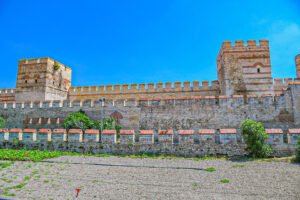
- 447: The second defensive line of the Theodosian land walls is created.
- 527–565: Justinian I rules. The empire reaches its widest borders.
- 532–537: The present Hagia Sophia is built.
- 630s–640s: Arab conquests take Syria and Egypt from the empire.
- 843: The veneration of icons is restored.
- 1054: Mutual excommunications between Rome and Constantinople mark a turning point in the split of the churches.
- 1071: The Battle of Malazgirt takes place.
- 1204: Fourth Crusade armies take Constantinople.
- 1261: Constantinople is recovered from the Latins.
- 29 May 1453: The Ottoman conquest ends the empire.
Byzantine Empire capital
The capital was Constantinople. In 330, Constantine I turned Byzantion into the imperial capital under that name. People also called the city New Rome.
Today it is Istanbul. The old city grew on the Historic Peninsula. The Golden Horn lies to its north, the Bosphorus to its east and the Sea of Marmara to its south.
Byzantine Empire where was it located? A map in words
No single modern country matches the Byzantine Empire. Its borders moved a great deal over the centuries.
By 565, it held land in Anatolia, Palestine and Greece. It also held parts of Italy, Sicily, Sardinia and Dalmatia. It had territory in parts of North Africa and in southern Spain.
If you want a quick map in your head, think of the shores of the Mediterranean, run from Constantinople. The map later shrank. The Arab conquests of the 630s and 640s cost the empire Syria and Egypt. After the Battle of Malazgirt in 1071, the losses in the east became a defining problem.
Byzantine Empire at its peak
The empire reached its greatest extent under Justinian I, who ruled from 527 to 565. His reconquests in Italy and along the western Mediterranean coast created those borders.
His reign left two other lasting marks. One is the legal compilation mentioned above. The other is Hagia Sophia, designed by Anthemius of Tralles and Isidore of Miletus. It was built between 532 and 537.
Byzantine Empire religion
Christianity became the official religion in the late 4th century, replacing the cults of the old gods. The empire still held communities of different cultures and faiths.
Two dates stand out in church history:
- 843: The restoration of icon veneration closed the period of Byzantine iconoclasm.
- 1054: Mutual excommunications between the patriarchate of Constantinople and the papacy became a main turning point in the split between Eastern and Western churches.
Byzantine Empire flag
There was no single modern-style national flag. What people call the Byzantine flag belongs to the late period. It shows a cross with four B-shaped marks. From the 14th century, this design appears both in Byzantine depictions and in Western portolan charts and heraldic books.
The double-headed eagle is often added to the picture. But Andrea Babuin says the eagle was not a Byzantine invention. Its link to the Palaiologos family can be documented with confidence only from 1301.
Byzantine Empire fall
The empire did not fall in one blow. It lost land in stages.
In 1204, Fourth Crusade armies took Constantinople, and Latin rule lasted until 1261. After that break-up, Byzantine successor states appeared at Nicaea, Epirus and Trebizond. In 1261, under Michael VIII Palaiologos, Constantinople was won back from the Latins.
The end came on 29 May 1453. The Ottoman army under Mehmed II took Constantinople. The last Byzantine emperor, Constantine XI, died during the defense of the city.
Byzantine Empire pronunciation
The Cambridge Dictionary records two English pronunciations of “Byzantine”:
- /bɪˈzæn.taɪn/
- /ˈbɪz.ən.tiːn/
Either one is fine.
Details you won’t find in guidebooks
The walls had a second line. UNESCO describes the Theodosian land walls as 6,650 metres long. It dates the second defensive line to 447.
Their neighbors called them Romans. Muslim contemporaries used the name Bilâdü’r-Rûm, “land of the Romans.”
The eagle is younger than you think. The double-headed eagle was not a Byzantine invention. Reliable links to the Palaiologos family start only in 1301.
The palace floor shows everyday life. Mosaics from the Great Palace were uncovered by excavations that began in 1935. The Ministry dates them to 450–550. They show scenes of daily life, nature and mythology instead of religious scenes. Across 90 themes, the mosaics hold 150 human and animal figures. You can find a griffin eating a lizard, children herding geese and bears eating apples.
Seeing it yourself in Istanbul
Hagia Sophia and the land walls are also part of the same story. Each one belongs to the city that its builders called New Rome.
FAQ
Did the Byzantines call themselves Byzantines?
No. They called themselves Rhomaioi, which is Greek for Romans. They saw themselves as heirs of the ancient Roman Empire. The word “Byzantine” comes from Byzantion, the old Greek town where Constantinople was founded.
When did the Byzantine Empire begin and end?
The traditional start is 330, when Constantine I made Constantinople the capital. Some historians prefer 395 or the 7th and 8th centuries, and Geoffrey Greatrex argues that no exact founding date can be fixed. The end is clear: 29 May 1453, when Ottoman forces under Mehmed II took Constantinople.
How do you pronounce “Byzantine”?
The Cambridge Dictionary lists two pronunciations: /bɪˈzæn.taɪn/ and /ˈbɪz.ən.tiːn/.
Where can you see Byzantine sites in Istanbul?
Hagia Sophia, built in 532–537, stands on the Historic Peninsula. The Great Palace Mosaics Museum is inside the Arasta Bazaar in Sultanahmet. UNESCO also lists the Theodosian land walls, which are 6,650 metres long.
Sources
- Wikipedia, “Byzantine Empire” en.wikipedia.org
- Metropolitan Museum of Art, “Byzantium (ca. 330–1453)” metmuseum.org
- Krasimir S. Krastev, “Use of the Terms ‘Byzantium’ and ‘Byzantine Empire’ during the Middle Ages” (academic abstract) ceeol.com
- T.C. Kültür ve Turizm Bakanlığı, “Doğu Roma İmparatorluğu” kulturportali.gov.tr
- T.C. Kültür ve Turizm Bakanlığı, “Doğu Roma (Bizans) İmparatorluğu” kulturportali.gov.tr
- Khan Academy, Evan Freeman, “Chronological periods of the Byzantine Empire” khanacademy.org
- UNESCO, “Historic Areas of Istanbul” whc.unesco.org
- Getty Research Institute, “Byzantine Empire”, TGN record getty.edu
- Metropolitan Museum of Art, “The Arts of Byzantium” (chronology) resources.metmuseum.org
- Open University, “The Byzantine icon”, Appendix 1 open.edu
- TDV İslâm Ansiklopedisi, “Bizans” islamansiklopedisi.org.tr
- T.C. Kültür ve Turizm Bakanlığı, “Büyük Saray Mozaikleri Müzesi” muze.gov.tr
Image: Byzantine Empire 395 to 1262.png — Shuaaa2, CC BY-SA 4.0