Ephesus, Turkey: where it is and how to read the map
Ephesus is in western Türkiye. It sits in the Selçuk district of İzmir province, in the ancient region of Ionia. The site’s coordinates are about 37.94° N and 27.34° E. Type those into any map app and you land on the ruins.
The Hellenistic and Roman city centre lies between two hills. Bülbüldağ rises to the south. Panayırdağ rises to the north. Keep those two hills in mind when you walk the site. They explain how the city is laid out.
The coast has not stayed still. The Küçük Menderes River carried silt, and that silt pushed the shoreline westward. This forced Ephesus to move its settlement areas and harbours several times over the centuries. So the sea you might expect near the ruins is no longer there.
The ministry’s 2026 night-museum programme (1 June to 1 October) listed Ephesus among the sites open until 23:00 on Wednesday, Thursday, Friday and Saturday. That season has ended. Check the current opening hours before you plan your visit.
How to pronounce Ephesus
Merriam-Webster gives the English pronunciation as ˈe-fə-səs. That is three syllables, with the stress on the first. Say it as EH-fuh-sus.
What does the name Ephesus mean?
Nobody can give you a firm translation. Scholars link the name to Apaša, a place that appears in Hittite records. The Austrian Archaeological Institute treats that link as a strong possibility, not a certainty. So the safest answer is that the name’s origin is probably Bronze Age, and the exact meaning is unknown.
Ephesus, the ancient city: a short history
People lived here long before the famous ruins. At Çukuriçi Höyük, about 1 kilometre southeast of the Hellenistic-Roman city limit, traces of settlement go back to the 7th millennium BC.
In the Classical Greek period, Ephesus was one of the twelve member cities of the Ionian League. The city you walk through today is a later foundation. The Ministry of Culture and Tourism links it to Lysimachos, a general of Alexander the Great, who resettled the site around 300 BC.
The Austrian excavations at Ephesus began in 1895 and are a long-running research effort. In 2015 UNESCO inscribed Ephesus on the World Heritage List under cultural criteria (iii), (iv) and (vi).
The Great Theatre
Start with the theatre if you want a sense of scale. The Ministry of Culture and Tourism gives its capacity as about 25,000 people. Picture a modern stadium crowd in one stone bowl.
The theatre also appears in the New Testament. In Acts 19, a protest began with Demetrios, who made silver shrines of Artemis. It grew into a crowd gathered in the Ephesus theatre.
The Library of Celsus
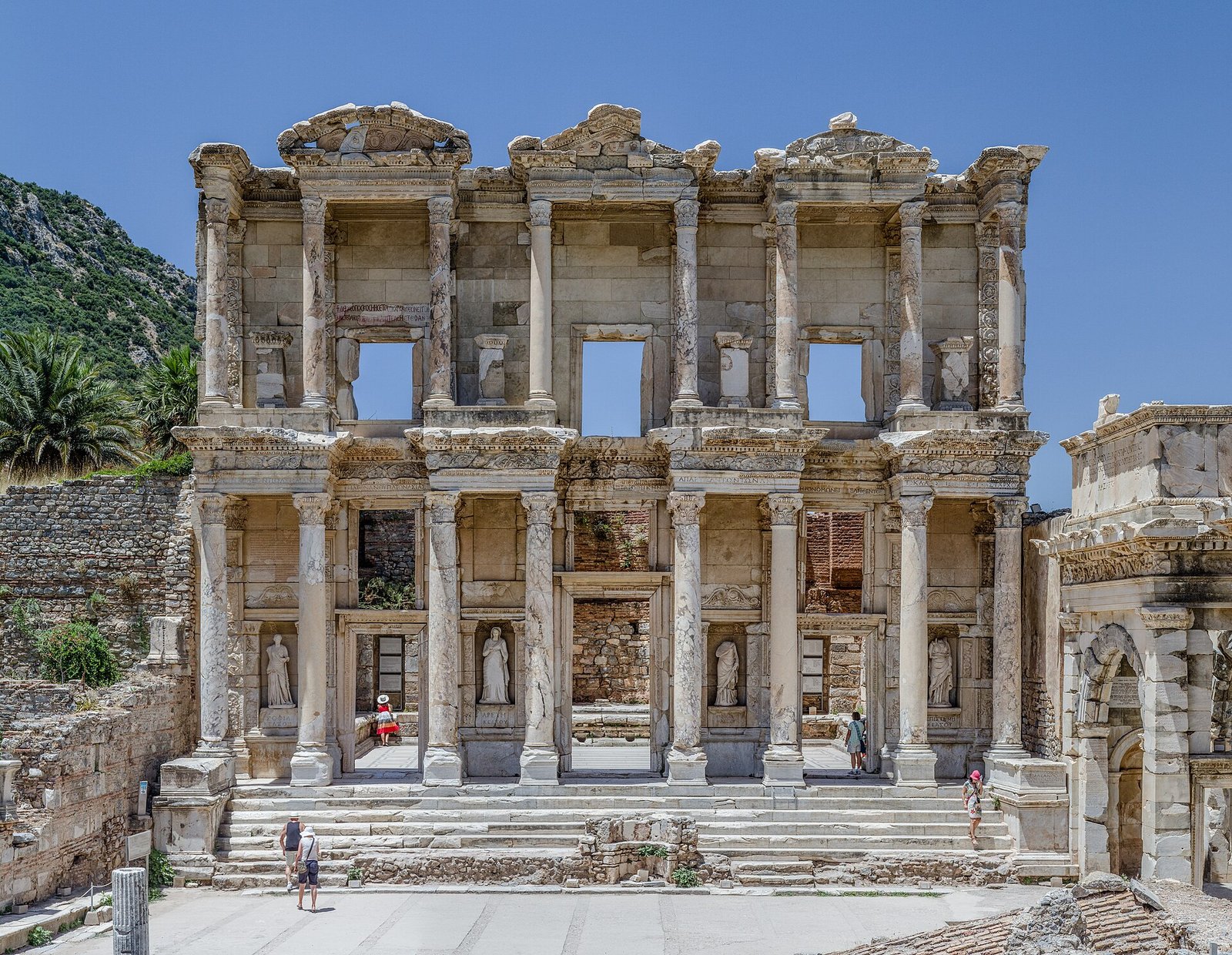
The Library of Celsus is the image most visitors carry home. It was built in the 2nd century AD. Gaius Iulius Aquila paid for it in honour of his father, the Roman senator Tiberius Iulius Celsus Polemaeanus.
The numbers are concrete. The library held about 10,000 papyrus scrolls. Its two-storey marble façade is 21 metres wide and more than 16 metres high.
Think of 10,000 scrolls as a city’s whole reading shelf in one building. Today a single phone holds more text than that. In its day, this room was a serious store of knowledge.
The façade you photograph is not entirely original. Between 1970 and 1978 it was raised again, using original pieces and supplementary material. So you are looking at a careful reconstruction built on ancient fragments.
The Temple of Artemis
The Temple of Artemis at Ephesus was counted among the Seven Wonders of the ancient world.
The marble temple of the 6th century BC is associated with the architect Khersiphron. The ancient writer Herodotos records that Croesus, king of Lydia, donated columns for it.
Pliny the Elder describes the building at huge scale. He gives 127 columns, each 60 Roman feet high.
The temple burned in 356 BC. The Ephesians then began work on a larger and more splendid one.
Vitruvius preserves a method for moving the heavy stone. Column drums and architraves were fitted into large wheel frames and pulled by oxen. Think of a farm cart, scaled up for marble.
The temple later vanished under marsh. John Turtle Wood searched for six years. On 31 December 1869 he found the temple’s pavement about 6 metres below the swampy ground.
Ephesus in the Bible
Ephesus appears twice in the sources used here. First, Acts 19 places the silversmith protest at the theatre. Second, the Book of Revelation addresses seven churches in Asia, and Ephesus is one of them.
Ephesus also matters for church history. The Church of Mary at Ephesus is where a council met in 431. It confirmed the title Theotokos for Mary, meaning “God-bearer”.
There is a debate here you should know about. Religious tradition holds that Mary spent her last years in Ephesus. The 4th-century writer Epiphanios objected. He noted that Scripture does not say she went to Asia with John, and he argued that she was buried in Jerusalem. The sources here do not settle the question.
Timeline
- 7th millennium BC: Settlement traces appear at Çukuriçi Höyük.
- 6th century BC: The marble Temple of Artemis is built, with support from Croesus.
- 356 BC: The temple burns and is then rebuilt.
- About 300 BC: Lysimachos refounds the city you visit today.
- 2nd century AD: The Library of Celsus is built in honour of Celsus Polemaeanus.
- About AD 270: An earthquake ends the building’s life as a library.
- 431: The Council of Ephesus meets at the Church of Mary.
- About 614/615: A great fire destroys the shop quarter at Domitian Square.
- 31 December 1869: John Turtle Wood finds the temple floor.
- 1895: Austrian excavations begin.
- 1970–1978: The Library of Celsus façade is re-erected.
- 2015: Ephesus joins the UNESCO World Heritage List.
- 2022: Excavators uncover early Byzantine shops and food remains in Domitian Square.
Details you won’t find in guidebooks
The library is also a tomb. The Library of Celsus doubles as a funerary monument. Celsus’s sarcophagus lies in a burial chamber beneath the library hall.
The façade became a fountain wall. After the earthquake of about AD 270, the building stopped working as a library. In late antiquity its façade served as the showy back wall of a fountain.
Salted mackerel under the ash. In 2022, archaeologists dug an area of shops of about 170 square metres in Domitian Square. Under a burnt layer dated to around AD 614/615, they found amphorae containing salted mackerel. Think of a tinned-fish shelf in a supermarket. This was the same kind of everyday stock, frozen in time by a fire.
Souvenirs for pilgrims. The same dig produced about 600 small pilgrim flasks. They were sold to Christian pilgrims and could be carried around the neck. Today’s souvenir stalls have a very old ancestor.
Frequently asked questions
The answers to your most common questions are in the FAQ block of this page’s data: location, pronunciation, the Bible, the library’s builder and the temple’s fate.
FAQ
Where is Ephesus?
Ephesus is in western Türkiye, in the Selçuk district of İzmir province. It lies in the ancient region of Ionia. The site’s coordinates are about 37.94° N and 27.34° E.
How do you pronounce Ephesus?
Merriam-Webster gives ˈe-fə-səs: three syllables, with the stress on the first. Say it as EH-fuh-sus.
Is Ephesus in the Bible?
Yes. Acts 19 tells of a crowd gathering in the Ephesus theatre after Demetrios, a maker of silver shrines of Artemis, stirred up opposition. Ephesus is also one of the seven churches of Asia addressed in the Book of Revelation.
Who built the Library of Celsus?
Gaius Iulius Aquila had it built in the 2nd century AD. It honoured his father, the Roman senator Tiberius Iulius Celsus Polemaeanus.
Can you still see the Temple of Artemis?
The sources used here describe how the temple was found, not what stands today. John Turtle Wood located its floor on 31 December 1869, about 6 metres below the marshy ground. Check on site what is visible now.
Sources
- Wikipedia — Ephesus en.wikipedia.org
- Austrian Archaeological Institute — The History of Ephesos oeaw.ac.at
- Merriam-Webster — Ephesus merriam-webster.com
- Ministry of Culture and Tourism — İzmir Efes Örenyeri turkishmuseums.kprod.kultur.gov.tr
- UNESCO World Heritage Centre — Ephesus whc.unesco.org
- Ministry of Culture and Tourism — Ephesus ktb.gov.tr
- Austrian Academy of Sciences — Celsus Library restoration announcement oeaw.ac.at
- Ephesos Foundation — Completed projects ephesos.at
- University of Chicago — Temple of Artemis at Ephesus penelope.uchicago.edu
- Austrian Archaeological Institute — CELSUS: Digital Ephesos Library oeaw.ac.at
- Vikipedi — Efes tr.wikipedia.org
- Ministry of Culture and Tourism — Efes (İzmir) kvmgm.ktb.gov.tr
- Austrian Archaeological Institute — 1,400-year-old shop quarter oeaw.ac.at
- General Directorate of Cultural Heritage and Museums — 2026 Night Museums kvmgm.ktb.gov.tr
Image: Ephesus Celsus Library Façade.jpg — Benh LIEU SONG, CC BY-SA 3.0