Sultan Ibrahim was the eighteenth Ottoman sultan. He ruled from 9 February 1640 to 8 August 1648, succeeding his elder brother Murad IV. His reign ended when janissaries and religious scholars acted against him amid war, shortages, heavy taxes and political conflict. Ten days after losing his throne, he was strangled because those in power feared his restoration.
If you know Ibrahim through the nickname “Deli,” or “Mad,” you have encountered a disputed description. Some historians argue that his opponents spread allegations of madness. His fall becomes clearer when you examine the pressures on his government alongside the stories about his personality.
Who was Sultan Ibrahim?
Ibrahim was born in 1615 at Topkapı Palace in Istanbul. His father was Sultan Ahmed I. His mother was Kösem Sultan, also known as Mahpeyker. He belonged to a dynasty whose succession had already brought lethal consequences for his brothers before he became sultan.
Murad IV ordered the deaths of Bayezid and Süleyman in 1635. Another brother, Kasım, was killed in 1638. When Murad himself died, Ibrahim was the Ottoman dynasty’s only surviving male member. His accession therefore placed the throne in the hands of a prince who had survived the deaths of his brothers.
Why did Ibrahim hesitate to take the throne?
Ibrahim initially refused to leave his room because he suspected that he would be killed. He accepted the throne only after seeing Murad IV’s body. The episode connects his accession to a specific fear: an announcement about the succession did not immediately convince him that it was safe to emerge.
The executions of Bayezid, Süleyman and Kasım give that fear a concrete context. If you picture Ibrahim simply stepping forward to claim power, his hesitation changes the scene. His reign began only after he had seen his elder brother’s body.
Who were his consorts and children?
Ibrahim’s hasekis included Turhan Hatice, Saliha Dilaşub and Hatice Muazzez. He also formally married Hümaşah Sultan, known as Telli Haseki. These names belong to his family history alongside the political events that dominate accounts of his reign.
Three of Ibrahim’s sons later became Ottoman sultans: Mehmed IV, Süleyman II and Ahmed II. Mehmed was the son who immediately succeeded him. On 8 August 1648, the deposition of Ibrahim placed six-year-old Mehmed IV on the throne.
How did war weaken Ibrahim’s government?
The Ottoman fleet left Istanbul for the Cretan campaign on 30 April 1645. The campaign began during Ibrahim’s reign, bringing war into the explanation of his eventual fall. His government faced pressures that extended beyond disputes within the palace.
Venice’s blockade of the Dardanelles caused shortages and discontent in Istanbul. Heavy taxes imposed during the wartime economy also increased public dissatisfaction toward the end of his reign. These pressures weakened a government already facing political conflict.
You can connect this part of the story to an everyday household budget. Shortages and heavier taxes both affect what a household can afford. In Ibrahim’s Istanbul, scarcity and taxation were concrete sources of discontent, giving the crisis a dimension beyond arguments over the sultan’s conduct.
Why was Sultan Ibrahim deposed?
In 1648, janissaries and members of the ulema, the religious scholarly establishment, jointly conducted the uprising against Ibrahim. Their action brought military and religious participants into the same challenge to his rule. The deposition followed mounting economic dissatisfaction and struggles over power.
A specific grievance appears in Kâtib Çelebi’s account. Janissary commanders blamed Grand Vizier Ahmed Pasha for demands that they provide sable furs. They moved against him over those demands. This detail places an identifiable dispute within the wider crisis, rather than reducing the confrontation to general hostility toward Ibrahim.
Ibrahim was deposed on 8 August 1648. His six-year-old son Mehmed IV replaced him. The throne passed to another member of his family, while Ibrahim himself remained alive for ten more days. His removal and his execution were separate events with different immediate explanations.
Why was he executed ten days later?
Fear of an attempt to restore Ibrahim accelerated the decision to kill him. The grand vizier and the şeyhülislâm, the chief religious authority, took that decision. The danger they feared concerned Ibrahim’s possible return to power after Mehmed IV had already become sultan.
Ibrahim was strangled on 18 August 1648. His execution followed his deposition by ten days. This sequence matters when you ask why he died: economic and political pressures explain his removal, while fear of restoration explains the urgency behind his subsequent killing.
What role did Kösem Sultan play?
Kösem Sultan’s role in the deposition is contested. She has been described as influential behind the scenes. Yet accounts also report that she opposed her son’s removal while events were unfolding. Both strands belong to the discussion of her involvement.
Kösem was Ibrahim’s mother, and the child who replaced him was his son Mehmed IV. Her position placed her within the family at the centre of the succession. The conflicting accounts of her conduct do not support a simple statement that she consistently directed or consistently resisted the deposition.
Was Sultan Ibrahim really “mad”?
The nickname “Deli” remains part of Ibrahim’s reputation, but its historical meaning is disputed. Some historians argue that opponents circulated stories of madness. They interpret the central problem as governmental inadequacy rather than accepting the nickname as a reliable account of his mental condition.
Stories about his attachment to sable furs also face scrutiny. In a 2026 study, Birol Gündoğdu argues that sable in archival records was mostly associated with ceremonial distributions and diplomatic gifts. That interpretation challenges accounts that treat the material chiefly as evidence of Ibrahim’s personal excess.
Kâtib Çelebi’s account of the commanders’ grievance and Gündoğdu’s discussion address different aspects of sable. The former concerns demands blamed on Ahmed Pasha. The latter concerns how archival uses of sable should be understood. Neither requires treating every mention of fur as proof of the same personal obsession.
Details you won’t find in guidebooks
Ibrahim requested that the avârız tax be set at 300 akçe per household instead of five riyal kuruş. This specific intervention belongs beside the broader account of heavy wartime taxation. It shows that an individual tax decision and the overall burden of a reign need to be considered separately.
New coins ordered by Ibrahim began appearing in circulation in January 1641. This places a tangible monetary measure near the beginning of his reign. The coins belong to the same ruler whose final years saw shortages, heavy taxes and deposition.
His burial place has an equally concrete history. Ibrahim was buried beside Hagia Sophia in a tomb shared with Mustafa I. The building had originally been a Byzantine baptistery. Before its conversion into a tomb, it served as a storehouse for Hagia Sophia’s lamp oil.
Timeline
- 1615: Ibrahim was born at Topkapı Palace in Istanbul.
- 1635: Murad IV had Ibrahim’s brothers Bayezid and Süleyman killed.
- 1638: His brother Kasım was killed on Murad IV’s orders.
- 9 February 1640: Ibrahim succeeded Murad IV as sultan.
- January 1641: New coins ordered by Ibrahim appeared in circulation.
- 30 April 1645: The fleet departed Istanbul for the Cretan campaign.
- 8 August 1648: Ibrahim was deposed and replaced by Mehmed IV.
- 18 August 1648: Ibrahim was strangled. His burial place was the tomb beside Hagia Sophia.
FAQ
Who was Sultan Ibrahim?
Ibrahim was the eighteenth Ottoman sultan. Born in 1615 to Ahmed I and Kösem Sultan, he ruled from 9 February 1640 until 8 August 1648.
Why was Sultan Ibrahim deposed?
A Venetian blockade, shortages in Istanbul, heavy wartime taxes and political conflict weakened his government. Janissaries and members of the ulema jointly acted against him in 1648.
Why was Sultan Ibrahim executed after losing his throne?
Fear that Ibrahim might be restored to power accelerated the decision by the grand vizier and chief religious authority to have him killed. He was strangled on 18 August 1648, ten days after his deposition.
Was Sultan Ibrahim really mad?
The label is disputed. Some historians argue that his opponents spread stories of madness and that his difficulties should instead be understood as failures of government.
Sources
- Vikipedi — İbrahim (Osmanlı padişahı)) tr.wikipedia.org
- Feridun Emecen, TDV İslâm Ansiklopedisi — İbrâhim islamansiklopedisi.org.tr
- Wikipedia — Ibrahim of the Ottoman Empire en.wikipedia.org
- Birol Gündoğdu, Mukaddime — Delegitimizing Sultan Ibrahim dergipark.org.tr
- Semavi Eyice, TDV İslâm Ansiklopedisi — İbrâhim Türbesi islamansiklopedisi.org.tr
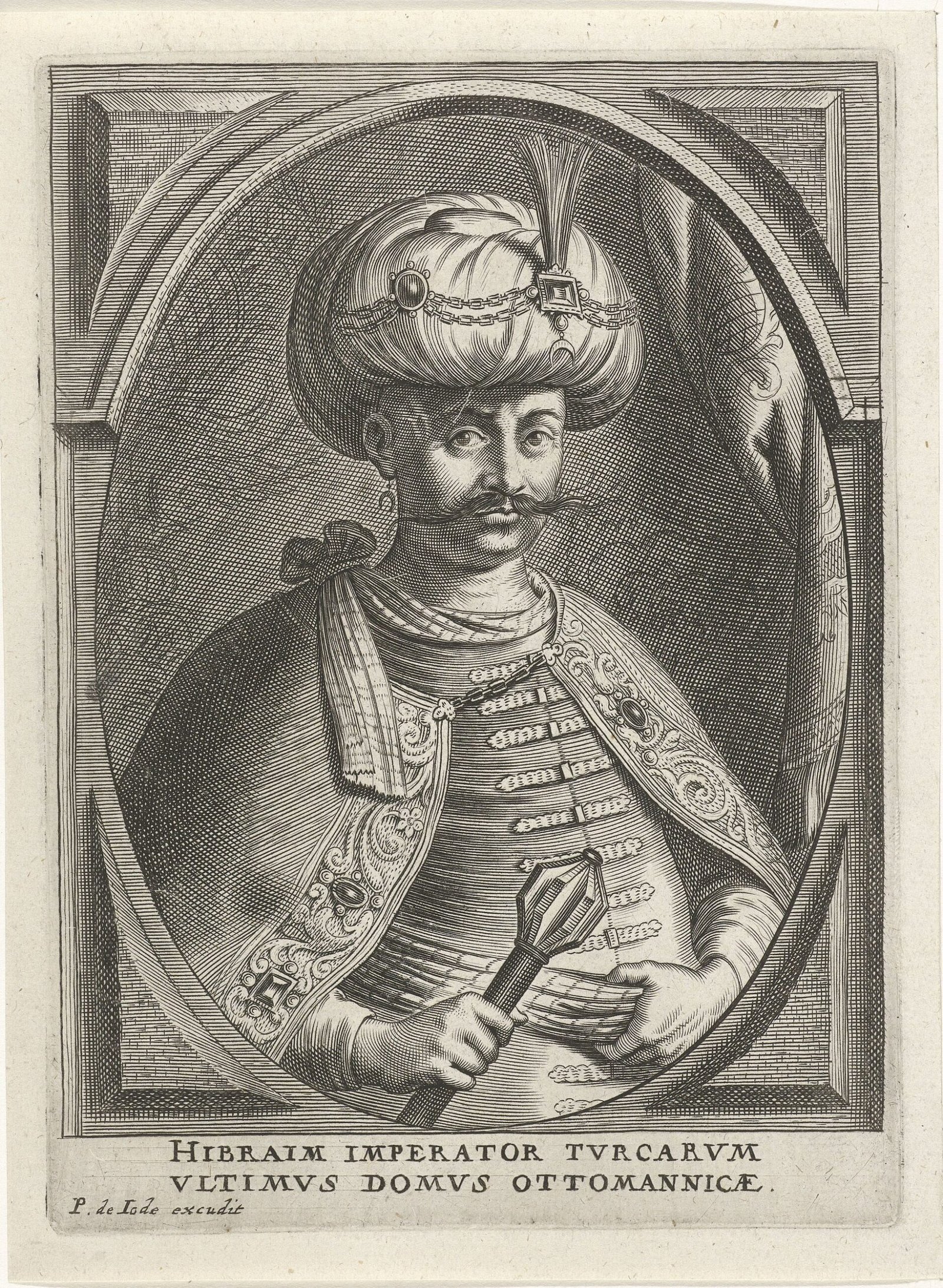
Image: Sultan İbrahim, 17. yüzyıl gravürü.jpg — Sanatçı: Anonim
Yayımcı: Pieter de Jode (II), CC0