Italo-Turkish War summary: what happened in 1911–1912?
The Italo-Turkish War began on 29 September 1911 and ended on 18 October 1912. Italy attacked the Ottoman Empire to seize its remaining North African territories in present-day Libya. Mustafa Kemal joined the resistance as a volunteer officer. The Treaty of Ouchy ended the war with an Ottoman withdrawal.
If you know this conflict as the Trablusgarp War, you are reading about the same struggle. Its main fighting centered on Tripoli and Benghazi. Yet its reach extended to the Adriatic, the Aegean, the Dardanelles, and the Red Sea. A colonial invasion in North Africa became a war across several maritime regions.
Why did the Italo-Turkish War start?
Italy wanted Tripoli and Benghazi to expand its colonial empire. These were the Ottoman Empire’s last territories in North Africa. Seizing them would remove Ottoman authority from the region and place the territory under Italian rule. Colonial expansion was the central purpose of the invasion.
Italy also connected its plans for Libya to problems at home. It intended to create a colony where poor Italians could settle. This was meant to ease unemployment and reduce outward migration. The proposed colony therefore served both territorial ambitions and a plan for population settlement.
Italy justified intervention by claiming that its citizens in Libya faced discrimination. Historian Rachel Simon places that claim within an already prepared policy of colonization. The distinction matters: the stated complaint concerned Italian citizens, while the broader objective was control of Ottoman territory.
On 28 September 1911, Italy delivered a 24-hour ultimatum to the Ottoman government. It declared war the following day. The Ottoman sultan was Mehmed V Reşad, and Italy’s king was Vittorio Emanuele III. The declaration opened a conflict that would last until October 1912.
Italo-Turkish War map: where was the fighting?
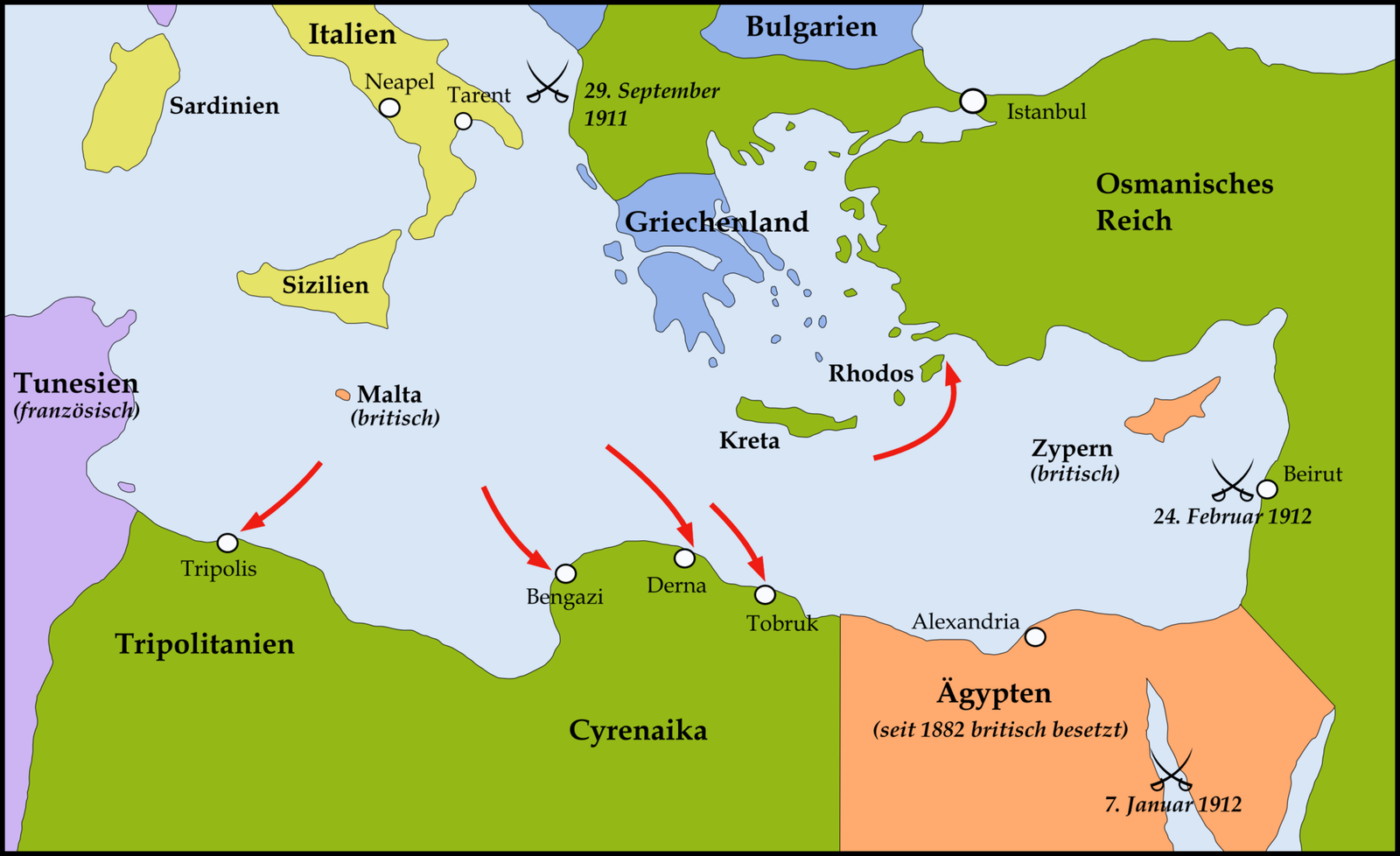
To follow the war on a map, start with Tripoli and Benghazi in present-day Libya. Then locate Tobruk and Derne, where Mustafa Kemal served. These places connect the territorial objective of the invasion with his part in the resistance. They also keep the Libyan campaign distinct from Italy’s attacks elsewhere.
Next, look toward the Adriatic, the Aegean, the Dardanelles, and the Red Sea. Fighting reached all these areas. Immediately after declaring war, Italian forces shelled an Ottoman torpedo vessel at Preveza, in present-day Greece. The war’s opening actions thus already extended beyond Libya.
As when you plan an everyday journey, the available routes mattered. British and French obstacles along the routes through Egypt and Tunisia made Ottoman reinforcements difficult. The weakness of the Ottoman navy added another barrier. Sending large forces to Libya was therefore a central problem for the defenders.
What were the main Italo-Turkish War battles and attacks?
The Italian navy demanded Tripoli’s surrender on 2 October 1911. It bombarded the city on 3 October. Naval force helped Italy attack the coast, but control of coastal positions did not amount to control of the whole territory. Resistance continued beyond those positions.
Volunteer Ottoman officers helped organize and train local people. Mustafa Kemal, Enver, Fethi, Nuri, and Fuat were among them. Senussi forces led by Seyyid Ahmed Şerif also supported the Ottoman defense. Resistance therefore depended on both Ottoman officers and forces drawn from the region.
Italy proclaimed sovereignty over Libya on 5 November 1911. Its military control remained limited to the coast. That gap between a declaration and actual control is essential to understanding the campaign. Italy could claim the territory while still facing organized resistance within it.
On 18 April 1912, the Italian navy attacked the Dardanelles fortifications. The aim was to pressure the Ottoman government into making peace. Italy then turned to occupying the Dodecanese, including Rhodes. These operations connected the Libyan war to places travelers encounter around Turkey and the Aegean.
What was Mustafa Kemal’s role in the Italo-Turkish War?
Mustafa Kemal left Istanbul on 15 October 1911 to reach Libya. He joined the volunteer officers who organized local resistance and provided military training. His role combined preparation with battlefield command. He received promotion to staff major on 27 November 1911, during the campaign.
On 22 December 1911, Mustafa Kemal attacked Italian forces at Tobruk with troops under his command. The attack inflicted losses on the Italians. Tobruk is therefore a specific battlefield in his wartime service, rather than simply a place associated with his journey to Libya.
On 16 January 1912, he suffered an injury to his left eye during fighting. He received treatment at the Hilâl-i Ahmer Hospital. In March 1912, he assumed command at Derne. There he directed Ottoman troops and local resistance forces against the Italian occupation.
If you are tracing Mustafa Kemal’s role, keep Tobruk and Derne together. Tobruk marks his December attack. Derne marks the command he assumed in March. His service took place within a wider defense supported by volunteer officers, local fighters, and Senussi forces.
Italo-Turkish War planes: what happened in the air?
Italy sent nine aircraft to Tripoli at the beginning of the war. The group comprised two Blériots, three Nieuports, two Farmans, and two Etrich Taubes. These aircraft became part of the same campaign in which Italian naval forces attacked the coast and Ottoman officers organized resistance on land.
On 23 October 1911, Captain Carlo Piazza flew a Blériot XI on the first airplane reconnaissance mission under wartime conditions. On 1 November, Giulio Gavotti dropped bombs from an Etrich Taube. His flight carried out the first aerial bombardment from an airplane. Reconnaissance and bombing were separate milestones within the war.
Timeline
- December 1908: Mustafa Kemal began an earlier posting in Tripoli.
- 28 September 1911: Italy issued its 24-hour ultimatum.
- 29 September 1911: Italy declared war.
- 3 October 1911: The Italian navy bombarded Tripoli.
- 15 October 1911: Mustafa Kemal left Istanbul for Libya.
- 23 October 1911: Carlo Piazza conducted wartime airplane reconnaissance.
- 1 November 1911: Giulio Gavotti carried out airplane bombing.
- 5 November 1911: Italy proclaimed sovereignty over Libya.
- 27 November 1911: Mustafa Kemal became a staff major.
- 22 December 1911: Mustafa Kemal attacked Italian forces at Tobruk.
- 16 January 1912: Mustafa Kemal suffered an injury to his left eye.
- March 1912: He assumed command at Derne.
- 18 April 1912: Italy attacked the Dardanelles fortifications.
- 8 October 1912: The First Balkan War began.
- 18 October 1912: The Treaty of Ouchy ended the war.
- 1923: The Treaty of Lausanne recognized Italian sovereignty over Rhodes and the Dodecanese.
Details you won’t find in guidebooks
Mustafa Kemal traveled under the name Mustafa Şerif, presenting himself as a journalist. He used this identity on the journey that began in Istanbul on 15 October 1911. His arrival in the campaign followed a journey undertaken with an assumed name and occupation.
Libya was already familiar territory to him. From December 1908, Mustafa Kemal had spent about two months on duty in Tripoli. That earlier posting preceded his return as a volunteer officer during the war. His connection with the region therefore began before Italy’s invasion.
What did the Treaty of Ouchy decide?
The First Balkan War began on 8 October 1912. It made peace with Italy urgent for the Ottoman government. Ten days later, on 18 October, the Treaty of Ouchy was signed at Ouchy, near Lausanne in Switzerland. The agreement ended the Ottoman-Italian war.
The settlement provided for Ottoman forces to withdraw from Tripoli and Benghazi. In return, Italy was to evacuate Rhodes and the other islands it had occupied. The arrangement addressed both the North African territories at the center of the invasion and the islands taken during Italy’s wider campaign.
A related sultanic decree dated 15 October 1912 granted autonomy to Tripoli and Benghazi. It provided for the appointment of a sultan’s representative and a judge. These provisions formed part of the Ouchy settlement, alongside the withdrawal of Ottoman forces.
Who won the Italo-Turkish War?
Italy won the war. The Ottoman Empire lost the province of Tripoli and the district of Benghazi. It withdrew from its last North African territories. Yet Italy did not control all of Libya in 1912. It completed the occupation only in the early 1930s.
Italy also retained Rhodes and the Dodecanese instead of returning them under the Ouchy arrangement. Turkey recognized Italian sovereignty over those islands in Article 15 of the 1923 Treaty of Lausanne. The 1912 settlement and the 1923 recognition belong to different stages of this territorial outcome.
FAQ
Why did the Italo-Turkish War start?
Italy wanted to expand its colonial empire by taking Ottoman Tripoli and Benghazi. It also intended to settle poor Italians in Libya to ease unemployment and outward migration.
What did Mustafa Kemal do in the Italo-Turkish War?
Mustafa Kemal helped organize local resistance, attacked Italian forces at Tobruk on 22 December 1911, and took command at Derne in March 1912.
Who won the Italo-Turkish War?
Italy won. The Ottoman Empire withdrew from its last North African territories, although Italy did not control all of Libya in 1912.
What did the Treaty of Ouchy require?
The settlement provided for Ottoman withdrawal from Tripoli and Benghazi in exchange for Italy evacuating Rhodes and the other occupied islands. Italy did not return those islands.
Sources
- Wikipedia — Italo-Turkish War en.wikipedia.org
- Vikipedi — Trablusgarp Savaşı tr.wikipedia.org
- TDV İslâm Ansiklopedisi — Trablusgarp Savaşı islamansiklopedisi.org.tr
- Rachel Simon — Italo-Turkish War 1911–1912 encyclopedia.1914-1918-online.net
- Millî Savunma Bakanlığı — Millî Mücadele Öncesi Dönemi ata.msb.gov.tr
- Atatürk Ansiklopedisi — Trablusgarp Savaşı’nda Atatürk ataturkansiklopedisi.gov.tr
- Smithsonian Air & Space — The World’s First Warplane smithsonianmag.com
Image: Bellum1911.png — Memnon335bc, CC BY 3.0