Who was Anne Bonny?
Anne Bonny was a pirate who sailed in the Caribbean with John “Calico Jack” Rackham in 1720. She belongs among the women whose participation in piracy is documented in historical records. Her story includes a stolen vessel, armed attacks, capture off Jamaica, and a trial alongside Mary Read.
If you want to understand Anne Bonny, begin with that documented episode. The most familiar accounts also describe an Irish childhood, family conflict, marriage, and an eventual return to South Carolina. Those details do not all carry the same evidential weight as her prosecution in Jamaica.
The distinction matters because Bonny’s early biography largely comes through A General History of the Pyrates. Published under the name Captain Charles Johnson in 1724, the book became a major source for the story of her life before piracy.
Anne Bonny’s history: where does fact meet legend?
Bonny is often said to have been born around 1698 in the Cork area of Ireland. Treat that as a reported origin rather than a settled birth record. The familiar Irish childhood belongs to a biographical tradition whose details require caution.
One account identifies her father as a lawyer named William Cormac. Another says that he acquired a large plantation in South Carolina. The Dictionary of Irish Biography questions both stories. It reports no documentary support for the proposed identity and says that the plantation account has not been substantiated through the land records.
Johnson’s narrative also describes a marriage to a sailor named James Bonny. That marriage belongs to the received account of her early life. It should not be presented with the same certainty as the dated proceedings against her in 1720.
This problem extends beyond individual anecdotes. In a 2026 academic study, Helen Audrey Rodriguez argues that the familiar biographies of Bonny and Read are only loosely connected to verifiable evidence. Repeated fictional treatments have helped expand those biographies.
For you as a reader, the useful dividing line is between a recorded event and a repeated story. Bonny’s conviction has a specific date and place. The accounts of her father and plantation childhood require explicit qualification.
How did Anne Bonny become a pirate?
Nassau, on New Providence Island in the Bahamas, is identified as the place where Bonny met Rackham. It is also the departure point for the stolen vessel that carried their crew into its documented piracy in 1720.
On 22 August 1720, a group including Bonny, Read, and Rackham took the William from Nassau. The vessel belonged to John Ham. This theft gives their shared expedition a concrete starting point, rather than the open-ended career suggested by some versions of the legend.
The voyage took the crew from Harbour Island in the Bahamas towards the coast of Cuba and Jamaica. These places form the geographical outline of Bonny’s documented activity aboard the William. Her story at sea can therefore be followed through named locations as well as court proceedings.
The expedition ended in October 1720. Jonathan Barnet captured Rackham’s crew off Negril in western Jamaica. The theft in August and capture in October frame the episode that brought Bonny before the court.
Anne Bonny and Mary Read: what connected them?
Anne Bonny and Mary Read sailed with Rackham and were tried together. Witnesses at their trial said that the women participated willingly in piracy. That testimony challenges any account that treats them simply as unwilling passengers aboard the vessel.
Dorothy Thomas gave particularly direct evidence. She told the court that Bonny and Read each carried a pistol and a cutlass. She also testified that they wanted her killed. Her statement places both women within the violence of the crew’s activities.
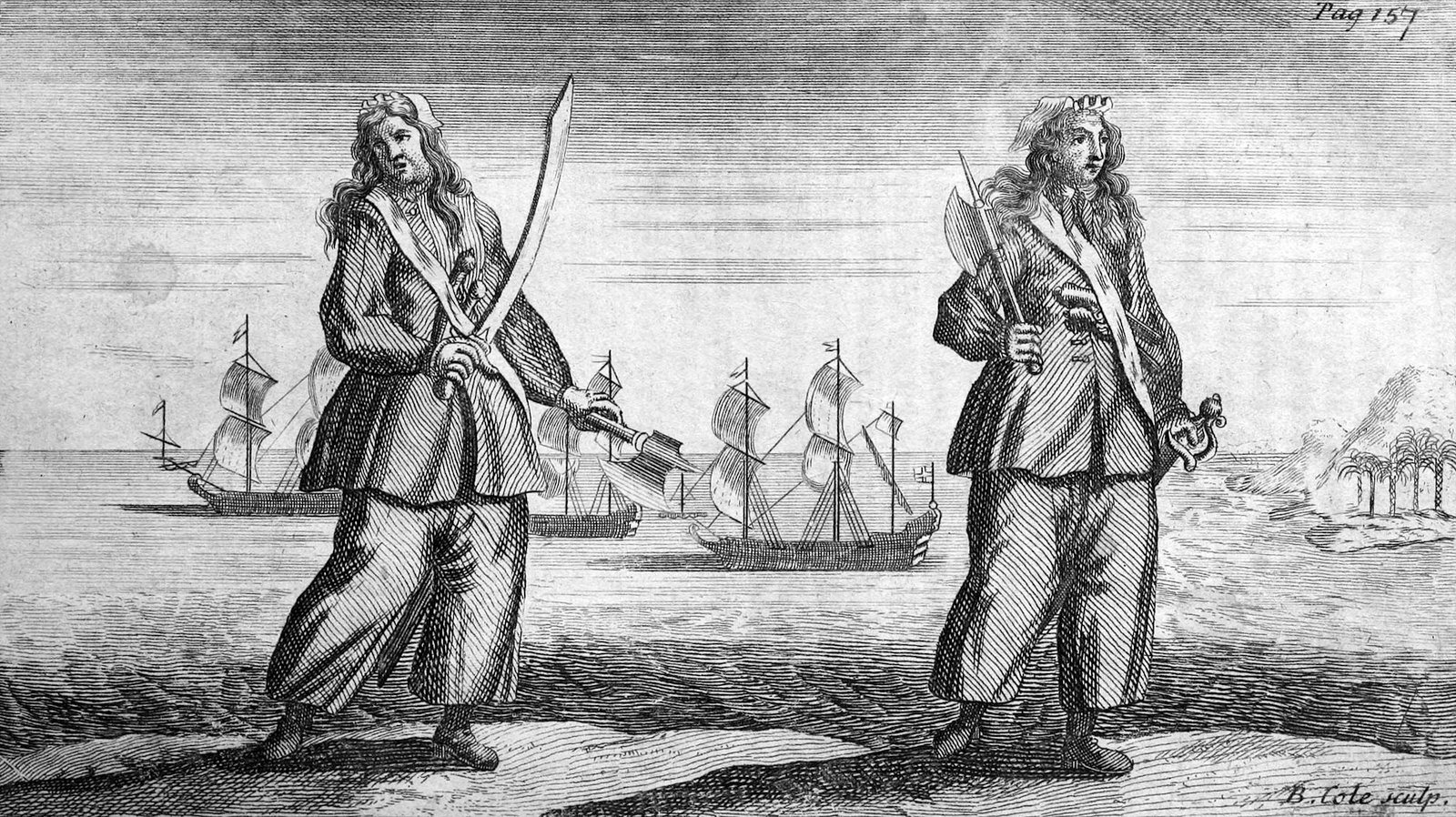
Their clothing has attracted a different kind of attention. Museum historian Robert Blyth suggests that wearing men’s clothes may have been a practical choice for work at sea. That explanation gives you an everyday-life connection: choosing clothing to suit a task can explain an outfit without making concealment its only purpose.
The interpretation that Bonny and Read were lovers goes beyond what their trial establishes. The 1720 transcript contains no statement confirming that relationship. Their shared piracy and prosecution can be described directly; a romantic relationship needs to remain an interpretation.
Johnson also tells a dramatic capture story in which Bonny and Read resisted while the men hid. The court transcript does not corroborate that scene. It belongs to the literary account of their resistance rather than the established details of their capture.
What happened at Anne Bonny’s trial?
Bonny and Read stood trial on 28 November 1720 in St Jago de la Vega, the Jamaican town now called Spanish Town. Their prosecution concerned attacks on other vessels and the theft of goods from their crews.
The charges covered seven fishing boats, three sloops, and a schooner. Those details give substance to the word “piracy.” The proceedings concerned specific attacks and stolen property, alongside witness statements about the women’s conduct.
The court offered both defendants the opportunity to question witnesses and present a defence. Neither woman used those opportunities. The court then unanimously convicted Bonny and Read of piracy and sentenced them to hang.
After the sentences were announced, both women declared that they were pregnant and requested a delay. They received temporary stays of execution on that basis. The postponement changed the immediate outcome of the trial, but it did not reverse their convictions.
Anne Bonny’s death: how should you read the competing stories?
The postponement of Bonny’s execution is an established event. The later burial entry often associated with her is a different kind of evidence. On 29 December 1733, a person named “Ann Bonny” was recorded as buried in Saint Catherine, Jamaica.
That entry may refer to the pirate, but the shared name does not establish identity. You should therefore read 1733 as a possible connection, rather than a confirmed death date for Anne Bonny.
Another account sends Bonny back to South Carolina and places her death in 1782. Royal Museums Greenwich presents this as a claim. It should remain qualified when attached to her biography.
Mary Read’s burial provides a firmer endpoint for her own story. She died in prison and was buried in Saint Catherine on 28 April 1721. Her recorded burial should not be confused with the later entry naming Ann Bonny.
Timeline
- Around 1698: Bonny is said to have been born in the Cork area of Ireland; neither the date nor the place has been confirmed by contemporary documents.
- 22 August 1720: The group including Bonny, Read, and Rackham took John Ham’s vessel, the William, from Nassau.
- 5 September 1720: Governor Woodes Rogers named “Ann Fulford, alias Bonny” in a piracy proclamation.
- October 1720: Jonathan Barnet captured Rackham’s crew off Negril, Jamaica.
- 28 November 1720: Bonny and Read were tried, convicted, and sentenced to death. Both received temporary stays because of pregnancy.
- 28 April 1721: Mary Read was buried in Saint Catherine.
- 1724: A General History of the Pyrates appeared under the name Captain Charles Johnson.
- 29 December 1733: A Saint Catherine burial entry recorded an Ann Bonny; identification with the pirate remains uncertain.
Details you won’t find in guidebooks
The name in Woodes Rogers’s proclamation was “Ann Fulford, alias Bonny.” Dated 5 September 1720, the document preserves a form of her name that differs from the familiar Anne Bonny. That wording is a small but concrete detail of her recorded identity.
The same proclamation described the stolen armed vessel as a sloop of about 12 tons. This gives the William a documented scale and vessel type. It also adds a practical detail to the route through the Bahamas, Cuba, and Jamaica.
The 1951 film Anne of the Indies also drew loosely on Bonny for its central character.
FAQ
Who was Anne Bonny?
Anne Bonny was a historically documented female pirate who served with John “Calico Jack” Rackham in the Caribbean in 1720.
Sources
- Royal Museums Greenwich — Anne Bonny and Mary Read rmg.co.uk
- Royal Irish Academy, Dictionary of Irish Biography — Bonney (Bonny), Anne dib.ie
- Helen Audrey Rodriguez, World History Connected — To Memories Now I Can’t Recall journals.gmu.edu
- Wikipedia — Anne Bonny en.wikipedia.org
Image: General History of the Pyrates – Ann Bonny and Mary Read.jpg — Engraved by Benjamin Cole[2] (1695–1766), Public domain