Bluetooth is named after Harald Bluetooth, a Viking Age king who ruled Denmark and Norway in the tenth century. His reputation as a unifier inspired a temporary name for a short-range radio standard. That temporary name became permanent.
When you see the Bluetooth logo in everyday life, you are looking at two combined runes representing Harald’s initials. The name and symbol therefore preserve separate links to the king: one recalls his unifying role, while the other spells out H and B.
Why is Bluetooth called Bluetooth?
According to Bluetooth SIG’s official account, Jim Kardach of Intel proposed the name in 1996. Intel, Ericsson, and Nokia were discussing a short-range radio standard. Bluetooth was initially a code name for that work.
Kardach drew a comparison between Harald’s unifying role and the project’s aim. The technology would bring the computer and mobile phone industries together through short-range wireless connections. A king associated with bringing territories together supplied the historical analogy.
The eventual name also depended on practical obstacles. PAN was considered, but that name was already widespread on the internet. A trademark search for another candidate, RadioWire, could not be completed in time. Bluetooth stayed.
Who was Harald Bluetooth Gormsson?
Harald’s Old Norse name was Haraldr Blátǫnn Gormsson. He was a Viking Age ruler whose Danish reign is usually dated to approximately 958–986. His rule over Norway is dated to approximately 970–985/986.
His father was Gorm the Old, and his mother was Thyra. His own successor on the Danish throne was his son, Sweyn Forkbeard.
The name Haraldr is associated with the roots hari, meaning army, and wald, meaning to rule. Bluetooth belongs to a different part of his name: it is the familiar rendering of his nickname, Blátǫnn.
Harald’s Norwegian kingship also needs a distinction between royal authority and practical government. From around 970, Haakon Sigurdsson exercised the actual administration of Norway during Harald’s rule. The king’s authority over both countries did not mean he personally managed both in the same way.
Why was Harald Bluetooth called Bluetooth?
The traditional explanation connects Blátǫnn with a dark or decayed tooth. It offers a physical explanation for the nickname. The actual reason, however, remains uncertain.
The date of the surviving written evidence matters. The earliest known written record of the Bluetooth nickname appears in Chronicon Roskildense around 1140. That was roughly 150 years after Harald’s death.
If you encounter the tooth explanation as a settled fact, keep that gap in mind. A nickname recorded around 1140 does not by itself establish the condition of a king’s teeth in the tenth century. The traditional explanation and the surviving written record are different kinds of evidence.
What does the Harald Bluetooth symbol mean?
The Bluetooth logo combines two characters from the Younger Futhark alphabet. Hagall, ᚼ, represents H. Bjarkan, ᛒ, represents B. Together, they stand for Harald Bluetooth’s initials.
This gives the symbol a more precise connection to Harald than a general association with Vikings. Its components represent the letters of his name. The combined design and the technology’s name both refer to the same historical ruler.
The logo’s runes also connect this modern naming story with Harald’s surviving monument at Jelling. The logo uses runes for initials; the great Jelling Stone uses a runic inscription to commemorate his parents and announce his royal achievements.
What does Harald Bluetooth’s runestone say?
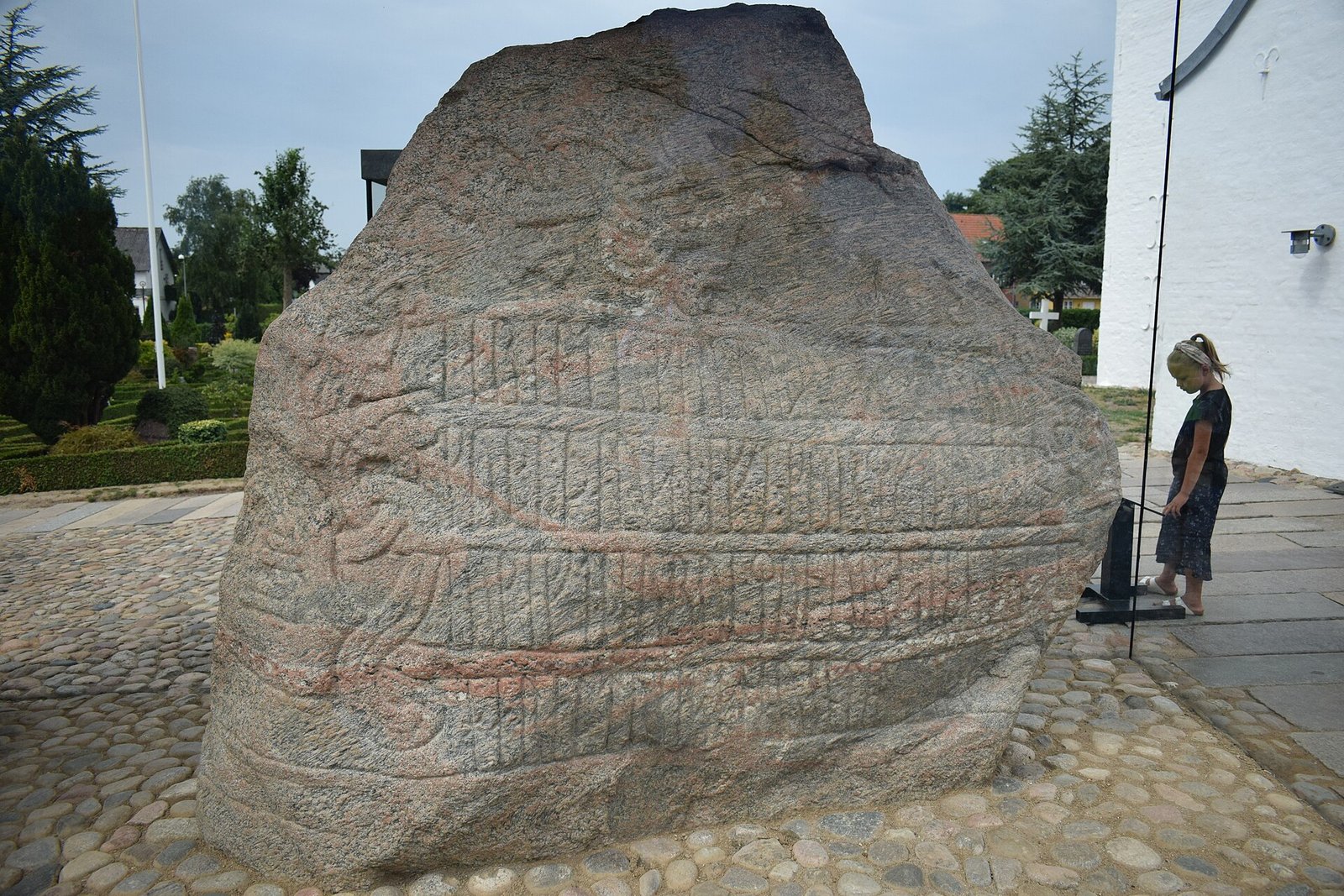
Around 965, Harald had the great Jelling Stone erected in memory of Gorm and Thyra. The monument therefore records a family relationship as well as a statement of kingship. His parents are central to its purpose.
In the inscription, Harald declares that he won all Denmark and Norway and made the Danes Christian. These are the king’s claims on his own monument. Reading them as declarations preserves the distinction between what the stone announces and how authority operated across his territories.
The stone also carries images. One face contains Scandinavia’s earliest known depiction of Christ. Another shows an animal with a serpent wrapped around it. The monument combines its written message with these carved figures.
Harald’s declaration about Christianity does not mark the first presence of Christians in Denmark. The National Museum of Denmark points to Christian metal finds that predate his announcement around 965. Christianity was already present before the king proclaimed that he had made the Danes Christian.
How does Harald Bluetooth fit into Viking history?
Harald’s reign brings together Viking Age kingship, territorial authority, and Christian conversion. His Jelling inscription places Denmark, Norway, and the Christianization of the Danes within one royal statement. It presents these achievements alongside the commemoration of his parents.
A conversion legend recorded by Widukind around 970 gives a different kind of account. It connects Harald’s conversion with Poppo carrying heated iron without being burned. This is a recorded legend, rather than an established explanation of the king’s decision.
The Danish heritage authority also presents a possible political explanation involving pressure from the German emperor. That explanation remains uncertain. The Jelling Stone supplies the public declaration of Christianization, while the accounts of Harald’s conversion offer different explanations for it.
What can you see at Jelling?
Jelling’s two great mounds are approximately 70 metres in diameter and reach heights of 11 metres. According to UNESCO, Harald’s great runestone stands exactly between them. Its position places the inscription within a much larger monumental setting.
If you picture the stone by itself, those dimensions help restore its surroundings. The two mounds frame the location of a monument that names Harald’s parents and announces his authority over Denmark and Norway.
The church site also preserves a sequence of buildings. Harald’s first wooden church stood where the present stone church now rises. At least three wooden churches were destroyed by fire before the stone church was built.
What does Harald Bluetooth’s family tree show?
Harald’s immediate royal family includes his father, Gorm the Old; his mother, Thyra; and his son and successor, Sweyn Forkbeard. Gorm and Thyra are the parents commemorated on the great Jelling Stone.
Another runic inscription identifies Harald through his marriage. At Sønder Vissing, his Slavic wife Tófa, also called Tove, is described as Mistivir’s daughter and the wife of Harald, Gorm’s son. The inscription links her parentage with her husband’s family.
Together, the Jelling and Sønder Vissing inscriptions record different family connections. Harald commemorated his parents at Jelling. The Sønder Vissing inscription identifies Tófa through both her father and her marriage to Harald.
When did Harald Bluetooth die?
Harald is generally considered to have died around 985–986. His son Sweyn Forkbeard succeeded him on the Danish throne. His burial place remains unknown.
Writing around 1072, Adam of Bremen stated that Harald was buried in a church he had built at Roskilde. The Danish heritage authority does not treat that account as confirmation of the grave’s location. Roskilde is therefore a recorded burial claim, rather than an established tomb site.
Timeline
- Around 958: Harald’s reign as king of Denmark began.
- Around 965: He erected the great Jelling Stone, commemorating his parents and announcing his royal achievements and the Christianization of the Danes.
- Around 970: His Norwegian kingship began, with Haakon Sigurdsson exercising actual government.
- Around 985–986: Harald died, and Sweyn Forkbeard succeeded him in Denmark.
- Around 1072: Adam of Bremen recorded the account of Harald’s burial at Roskilde.
- Around 1140: Chronicon Roskildense recorded the earliest known written use of his Bluetooth nickname.
- 1996: Jim Kardach proposed Bluetooth as a temporary technology code name.
- May 2011: Conservation work identified the great Jelling Stone’s original support and a later foundation.
Details you won’t find in guidebooks
The great Jelling Stone’s runes run in horizontal lines. Their arrangement resembles Christian manuscripts and differs from many runic inscriptions. The layout is another concrete feature to examine alongside the carved figures.
Conservation work in May 2011 identified the stone’s original support, dated to around 965. It also revealed a foundation added in 1586. These discoveries distinguish Harald’s original setting from a later intervention beneath the monument.
The stone’s imagery has also appeared in Danish passports since 1996–1997. The motifs include Christ, the animal, and the serpent. Harald’s monument thus has a modern connection beyond the runic initials used in the Bluetooth logo.
FAQ
Why is Bluetooth called Bluetooth?
Jim Kardach of Intel proposed the name in 1996 during discussions involving Intel, Ericsson, and Nokia. Harald Bluetooth’s unifying role supplied an analogy for connecting the computer and mobile phone industries through short-range wireless communication.
Why was Harald called Bluetooth?
The traditional explanation connects his nickname with a dark or decayed tooth, but its actual origin is uncertain. The earliest known written record of the nickname appears around 1140, roughly 150 years after his death.
What does the Bluetooth symbol mean?
The logo combines the Younger Futhark runes Hagall ᚼ and Bjarkan ᛒ. They represent H and B, the initials of Harald Bluetooth.
Where is Harald Bluetooth buried?
His burial place is unknown. Adam of Bremen wrote around 1072 that Harald was buried in a church he had built at Roskilde, but the Danish heritage authority does not regard the location as established.
Sources
- Bluetooth SIG — Origin of the name bluetooth.com
- Wikipedia — Harald Bluetooth en.wikipedia.org
- Vikipedi — I. Harald (Danimarka kralı)) tr.wikipedia.org
- National Museum of Denmark — The Jelling Stone en.natmus.dk
- UNESCO — Jelling Mounds, Runic Stones and Church whc.unesco.org
- Danish Heritage Agency — Jelling-monumenterne, English Summary slks.dk
- Danish Agency for Culture and Palaces — Jelling-monumenterne slks.dk
- Martin Schwarz Lausten — A Church History of Denmark api.pageplace.de
Image: Jelling stone.jpg — Ljunie, CC BY-SA 4.0