Saturnalia was a Roman religious festival honoring Saturn, celebrated from December 17 with feasting, gifts, and gambling. Romans understood its pleasures and temporary reversals between masters and enslaved people as a revival of Saturn’s mythical Golden Age of effortless abundance. These freedoms ended with the festival and did not abolish slavery.
Why would masters serve the people they enslaved, while the feet of Saturn’s own statue were untied? If you follow Saturnalia from its temple rituals to its household meals, its apparent contradictions become clearer. Its changing calendar, licensed criticism, and small gifts also help explain why comparisons with Christmas need care.
Which god did Saturnalia honor, and when was it celebrated?
Saturnalia honored Saturn, a god associated with seed and sowing. Its agricultural setting matters. Columella said that autumn sowing should be completed by early December. The festival therefore followed the work of putting seed into the ground, connecting December celebration with the agricultural cycle.
The official festival day was December 17. By Cicero’s time, however, celebrations lasted seven days, through December 23. When you encounter different lengths for Saturnalia, distinguish the official holiday from the longer period of customary celebration. Those calendars did not always match.
Augustus restricted the official holiday to three days so that courts would not remain closed too long. Caligula extended it to five days. Despite these changes, the habit of celebrating for a week continued. The festival’s duration was therefore also a practical question about how long ordinary business could stop.
The Temple of Saturn in the Roman Forum was one of Saturnalia’s ritual centers. Sacrifice there was followed by a public feast. Livy dated a lectisternium arrangement to 217 BC, in which the god’s image participated in the banquet. Feasting thus belonged to the festival’s religious observance as well as its household pleasures.
How did feasting, gift-giving, and gambling feature in the festival?
Public and household meals gave Saturnalia its festive character. Romans interpreted the celebration as a recreation of the Golden Age under Saturn. In that mythical age, the earth supplied abundance without labor. A feast made this idea tangible through food and shared enjoyment.
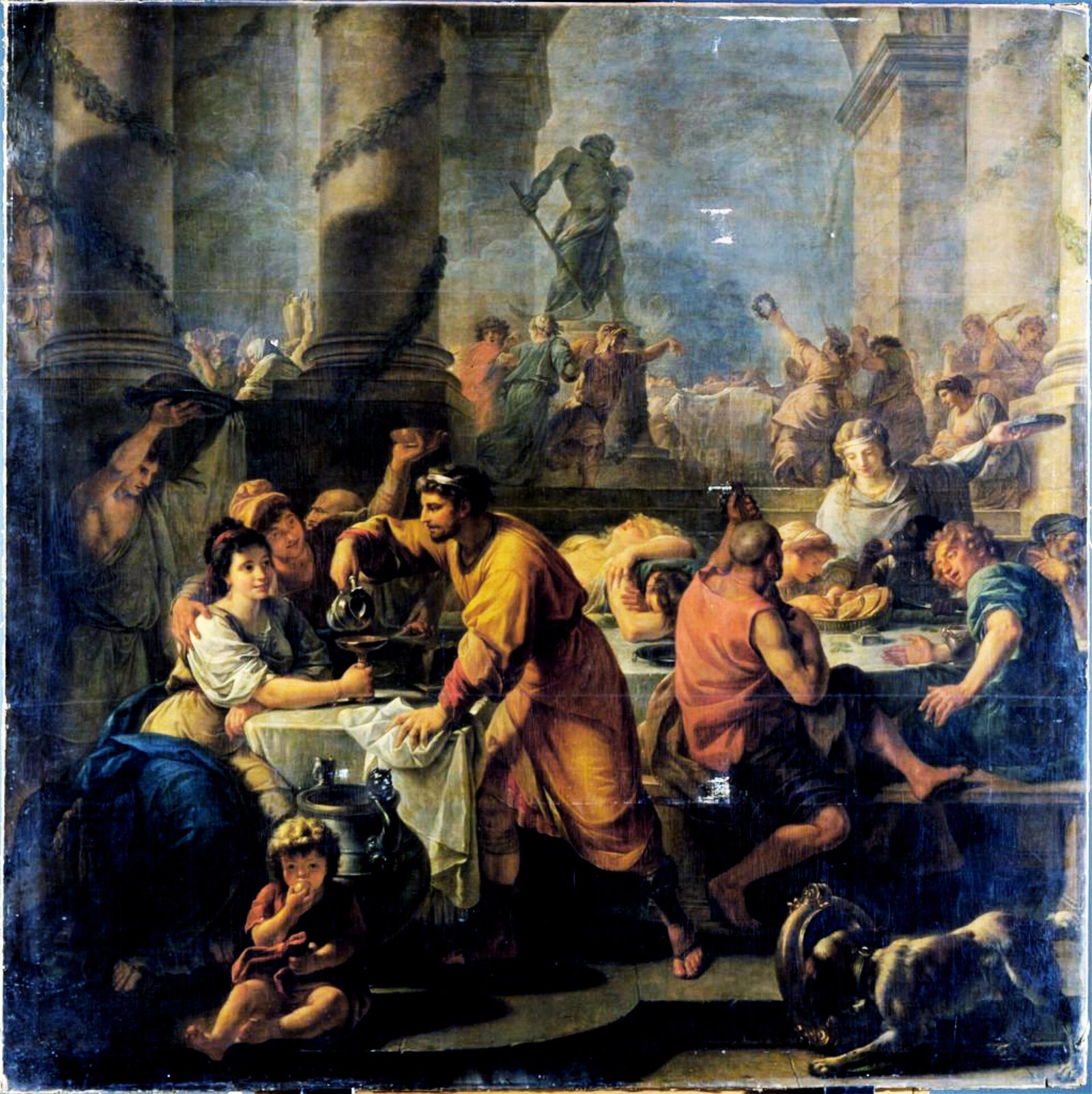
Household accounts describe several arrangements at the table. Masters and enslaved people might eat together. Enslaved people might receive their meal first, or masters might serve them. These variations matter because there was no single dining scene that captures every account of Saturnalia.
Gift-giving included candles called cerei and small terracotta figures called sigillaria. English Heritage explains white cerei as gifts symbolizing the increase of light after the winter solstice. A small candle could therefore carry a seasonal meaning alongside its place in the exchange of presents.
Gambling brought another departure from ordinary restrictions. Dice and gambling, normally prohibited or disapproved of, were permitted during Saturnalia, including for enslaved people. Players wagered money and nuts. The permission to participate was part of the festival’s temporary relaxation of everyday rules.
If you have ever received a disappointing present, Catullus offers a familiar connection to everyday life. His poem 14 responds mockingly to a book of bad poetry sent by a friend as a Saturnalia gift. Gift-giving could produce teasing and irritation as well as pleasure.
What did role reversal between slaves and masters mean, and what were its limits?
Saturnalia’s role reversals gave enslaved people temporary privileges within a society that continued to enslave them. Being served first, sharing a meal with a master, or receiving service from that master changed the festival encounter. It did not permanently change the relationship between them.
Macrobius describes a particularly clear sequence in Saturnalia 1.24.22–23. Enslaved people receive food prepared as though for the master. Only afterward is the master’s table arranged. The reversal concerns both the quality of hospitality and the order in which people are entertained.
Speech could also become less restricted. Horace called the festival’s license “December liberty.” In two satires, he allowed an enslaved speaker to criticize his master. The right to speak sharply was another way the festival temporarily loosened the expected relationship of obedience.
The Golden Age supplied a framework for these reversals. Romans associated Saturn’s reign with effortless abundance, and Saturnalia briefly enacted that imagined world. Shared pleasures and altered behavior belonged to a festival whose freedoms had a defined ending.
You should therefore read the reversal alongside its limit: ordinary social hierarchy returned when Saturnalia ended. The temporary equality described in the celebrations did not dismantle slavery. A master serving a meal remained a master after the holiday, and an enslaved guest remained enslaved.
Timeline
- 217 BC: Livy’s account dates a lectisternium arrangement to Saturnalia, bringing the god’s image into the banquet.
- By Cicero’s time: Celebrations extended from December 17 to December 23.
- Under Augustus: The official holiday was restricted to three days to limit court closures.
- Under Caligula: The official holiday increased to five days, while the custom of a week’s celebration continued.
- AD 354: The Chronography recorded Saturnalia on December 17 and Jesus’s birth on December 25 as separate entries.
- AD 430s: According to the academic dating, Macrobius probably wrote his Saturnalia during this period.
Details you won’t find in guidebooks
The ivory statue of Saturn in his temple had woolen bonds around its feet. These were loosened during the festival. The ritual gives Saturnalia a concrete image of release: even the god’s representation underwent a temporary change for the celebration.
Enslaved people could also wear the pileus during Saturnalia. This felt cap was normally associated with freed people. Wearing it during the holiday belonged to the festival’s altered social appearance, while the return of ordinary hierarchy afterward marked the limit of that freedom.
Festival entertainment could include someone directing the proceedings. According to Tacitus, the young Nero was selected to lead the Saturnalia amusement and ordered Britannicus to sing. This episode adds a commanded performance to the familiar picture of eating, presents, and dice.
Aulus Gellius described a different kind of entertainment in Athens. During Saturnalia, participants asked questions about old poets. When questions went unanswered, they dedicated a laurel wreath to Saturn. Literary knowledge could therefore become part of the festival’s games.
Macrobius’s seven-book Saturnalia turns the festival into the setting for a literary conversation. It places 12 guests in the house of Praetextatus over three festival days. The work was probably written in the AD 430s, while its conversation is set around AD 382–383. Its composition and its imagined gathering belong to different dates.
Why is a direct transformation of Saturnalia into Christmas difficult to establish?
Saturnalia’s December setting, gifts, and feasting invite comparisons with Christmas. Yet the Chronography of AD 354 records Saturnalia on December 17 and Jesus’s birth on December 25 separately. That distinction makes a simple statement that one festival became the other difficult to sustain.
The replacement theory proposes that Christmas’s date was chosen to compete with pagan celebrations. These include Saturnalia and the December 25 festival of Sol Invictus. This is an explanation of the date’s selection, rather than direct evidence that Saturnalia itself was renamed Christmas.
Andrew McGowan emphasizes that early Christian texts do not explain the choice of Christmas’s date as an attempt to replace pagan festivals. Another theory uses calculation. It places Jesus’s conception on March 25, the same date assigned to his death, and counts nine months forward to December 25.
McGowan allows that pagan customs may have entered Christmas after the fourth century. He also stresses that the origin of the December 25 date remains unsettled. You can recognize comparable seasonal practices while keeping that uncertainty intact: shared customs alone do not establish a direct transformation.
FAQ
When did Romans celebrate Saturnalia?
Its official day was December 17. By Cicero’s time, celebrations extended through December 23, although emperors changed the length of the official holiday.
Did masters really serve enslaved people?
Ancient accounts describe masters serving enslaved people, shared meals, and enslaved people being entertained first. These were temporary festival practices, and the normal hierarchy returned afterward.
What gifts were exchanged at Saturnalia?
Gifts included candles called cerei and small terracotta figures called sigillaria. Catullus’s poem 14 also describes a gift of bad poetry.
Did Saturnalia become Christmas?
A direct transformation is difficult to establish. The Chronography of AD 354 recorded Saturnalia on December 17 and Jesus’s birth on December 25 separately, while competing theories explain the choice of Christmas’s date.
Sources
- Türkçe Vikipedi — Saturnalia tr.wikipedia.org
- Encyclopaedia Romana — Saturnalia penelope.uchicago.edu
- English Wikipedia — Saturnalia en.wikipedia.org
- English Heritage — Christmas Lights english-heritage.org.uk
- Cambridge University Press — Saints and Symposiasts, Macrobius chapter cambridge.org
- Andrew McGowan / Biblical Archaeology Society — How December 25 Became Christmas biblicalarchaeology.org
Image: Saturnalia by Antoine Callet.jpg — Themadchopper, Antoine-François Callet, CC0