The Göktürks were the first state to use the name Turk as its official state name. That is why historians treat them as a starting point. Their story begins in 552 on the steppes of Inner Asia and ends, after a long break, in the 740s.
This guide explains who they were, where they lived, what they spoke and believed, and which stone monuments still carry their voice.
What was the First Turkic Khaganate?
The Göktürk Khaganate was a steppe empire. Its ruler was called a khagan. In 552, Bumin Khagan defeated the Juan-Juan and founded an independent khaganate.
The name matters. The Göktürks are the first state to carry the Turk name as its official title.
Before independence, the Göktürks were subjects of the Juan-Juan. They lived on the southern foothills of the Altai Mountains and produced iron. That is a detail most summaries skip: the founders of the khaganate began as iron workers under another power.
They also had diplomatic experience before 552. In 545 they established their first official relations with the Western Wei state in China.
Timeline
- 545: Official relations begin between the Göktürks and Western Wei.
- 552: Bumin defeats the Juan-Juan and founds the independent khaganate.
- 553–572: Mukan Khagan reigns.
- 557: Istemi allies with the Sasanian ruler Khosrow I against the Akhuns.
- 568: The envoy Maniakh reaches Constantinople.
- 572–581: Taspar Khagan reigns.
- 576: Göktürk forces cross into Crimea.
- 582 or 603: Sources give different dates for the east-west split.
- 630: The Eastern Khaganate falls to Tang China.
- 682: Ilteris Kutluğ Khagan restores independence.
- Around 720–725: The Tonyukuk inscription dates to this period.
- 732: The Kül Tigin inscription is erected.
- 735: The Bilge Khagan inscription is erected.
- 744–745: Göktürk rule ends. Sources prefer different final years.
Who ruled the first khaganate?
Bumin Khagan founded the state. After him, Kara Khagan took the throne. Kara Khagan’s death in 553 brought Mukan Khagan to power.
Mukan ruled from 553 to 572. His brother Taspar Khagan followed and ruled from 572 to 581.
Bumin’s brother Istemi Yabgu took a different role. He handled the western conquests and governed the western wing. This split of duties between east and west shaped the whole state.
What was the capital of the First Turkic Khaganate?
The eastern center of the khaganate was called Ötüken. It was the heart of the khagans’ power in the east.
Sources do not describe one fixed capital for the entire realm. A state with a western wing under Istemi worked on two centers of authority. If you are asked for a single place name, say Ötüken.
Where was the First Turkic Khaganate? A map in words
The founding territory lay in the steppes of Inner Asia, around today’s Mongolia and the Altai Mountains.
Then the state grew. At its widest, its sphere of control reached from the area of Korea in the east to the Black Sea in the west.
Two events show how far its power traveled:
- In 557, Istemi made an alliance with the Sasanian ruler Khosrow I against the Akhuns.
- In 576, Göktürk forces crossed the Kerch Strait and entered Crimea.
If you look at a modern map, the span from Mongolia to the Black Sea is a huge belt of land. It crosses the steppe from one end to the other.
How big was the First Turkic Khaganate?
Here you should be careful. No single reliable number exists.
English Wikipedia gives 6 million km² for the First Turkic Khaganate in 557. Turkish Wikipedia gives 9.3 million km² for the Göktürk Khaganate in general, with no year attached.
These two figures describe different things. One is tied to a date and one is not. You cannot set them side by side as if they were two measurements of the same moment.
The safest statement is this: the khaganate was enormous, and any exact area is an estimate.
What was the population of the First Turkic Khaganate?
English Wikipedia, relying on Osman Karatay’s work, puts the sixth-century population at about 3 million.
This is a scholar’s estimate. No census of the time produced it. Use it as a rough scale and nothing more.
Did the Göktürks deal with Byzantium and Persia?
Yes. Their diplomacy reached far beyond the steppe.
The Sogdian envoy Maniakh arrived in Constantinople in 568. He met Emperor Justin II and discussed a Göktürk-Byzantine alliance.
The date is debated. Li Qiang and Stefanos Kordosis place the first Göktürk-Byzantine embassy in 563. They also note that many researchers take Maniakh’s 568 mission as the first contact. When you read a date for this meeting, check which mission the author means.
This fits the earlier alliance of 557, when Istemi joined Khosrow I against the Akhuns. The Göktürks were making treaties from China to the Mediterranean world.
When did the khaganate split?
The sources disagree.
The Türk Maarif Ansiklopedisi places the east-west separation in 582. English Wikipedia puts the definitive division of the First Khaganate in 603.
Both dates agree on one point: the single state did not last as one piece. The east and the west went separate ways.
What happened after 630?
In 630, the independent rule of the Eastern Göktürk Khaganate ended through Tang China’s military intervention.
It was not the end of the story. In 682, Ilteris Kutluğ Khagan re-established Göktürk independence. This is often called the Second Khaganate.
After Ilteris, his brother Kapgan took the throne. Bilge Khagan ruled later.
The end date again depends on the source. The Türk Maarif Ansiklopedisi gives 745 as the end of the Göktürk Khaganate. English Wikipedia gives 744 as the end of the Second Khaganate.
What language did the Göktürks speak?
Their language was Old Turkic.
But it was not the only language of government. Sogdian was also used in the khaganate’s correspondence and administration. Sogdian merchants and envoys, like Maniakh, helped link the khaganate with distant courts.
The Bugut inscription, left from the First Khaganate period, has a Sogdian text. This shows that the history of the Göktürk dynasty was not recorded in Turkic documents alone.
What was the religion of the Göktürks?
Their main belief tradition was Gök Tanrı, the Sky God faith.
Other ideas reached the court too. Taspar Khagan, who ruled from 572 to 581, showed interest in Buddhism. He had a Buddhist temple built at Ötüken.
That is a surprising picture. At the center of a Sky God state stood a Buddhist temple, built by the khagan himself.
What did the Göktürk flag look like?
This is one of the most repeated questions, and the honest answer is: nobody knows the exact color.
The popular image is a blue flag with a wolf. But the color of a blue-ground wolf flag attributed to the Göktürks is not certain.
Elvin Yıldırım’s study notes that Chinese sources describe a banner with a golden wolf head. They do not state a color for the flag.
Here is another small fact. Around 617, during uprisings in China, Shibir Khagan sent horses and standards with golden wolf heads to Liang Shih-tou and Liu Wu-Chou. The wolf head appears again as a golden symbol.
So the safe summary is this: golden wolf heads appear in the records. The popular blue flag is not confirmed by them, and its color remains uncertain.
The inscriptions: voices in stone
The best-known records of the Second Khaganate are its stone inscriptions.
- The Tonyukuk inscription dates to roughly 720–725.
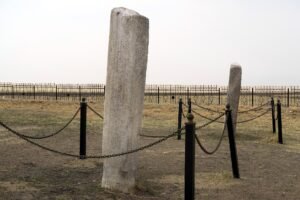
- The Kül Tigin inscription was erected in 732.
- The Bilge Khagan inscription was erected in 735.
The Kül Tigin and Bilge Khagan monuments stand at the Höşöö Tsaydam site in Mongolia. Its coordinates are about 47.56056° north and 102.84111° east.
Here is an everyday trick. Copy those two numbers into the map app on your phone. You will land in the Mongolian steppe, at the spot where a khagan’s words still stand in stone.
The monuments sit inside the Orkhon Valley Cultural Landscape. It covers 121,967 hectares and is on the UNESCO World Heritage List. The listing includes Göktürk monuments.
Details you won’t find in guidebooks
- Iron workers first. Before independence, the Göktürks produced iron on the southern foothills of the Altai Mountains, as subjects of the Juan-Juan.
- Sogdian on a Turkic monument. The Bugut inscription has a Sogdian text. Göktürk history was not told in Turkic documents only.
- A Buddhist temple at Ötüken. Taspar Khagan built it during his reign of 572–581.
- Golden wolf-head standards. Around 617, Shibir Khagan sent horses and standards with golden wolf heads to two leaders in the Chinese uprisings.
- Chinese on the back. The western faces of the Kül Tigin and Bilge Khagan inscriptions carry Chinese texts.
How to visit and what to look for
If you plan a trip, the place to aim for is Mongolia, not Türkiye. The Orkhon Valley is where the monuments stand.
The Höşöö Tsaydam area is the key stop for the Kül Tigin and Bilge Khagan memorials. Remember that the western faces carry Chinese text, so look for it when you stand there.
If you cannot travel, the UNESCO listing for the Orkhon Valley is a good place to start your own reading.
FAQ
Who founded the First Turkic Khaganate?
Bumin Khagan founded it in 552 after defeating the Juan-Juan. His brother Istemi Yabgu ran the western wing and its conquests.
What was the capital of the Göktürks?
The eastern center of the khaganate was called Ötüken. Sources do not describe a single fixed capital for the whole state, so Ötüken is the name to remember.
What language did the Göktürks speak?
They spoke Old Turkic. Sogdian was also used in the khaganate’s correspondence and administration.
What was the Göktürk religion?
Their main belief tradition was Gök Tanrı, the Sky God faith. Taspar Khagan (572–581) showed interest in Buddhism and had a Buddhist temple built at Ötüken.
How big was the First Turkic Khaganate?
No single exact figure exists. English Wikipedia gives 6 million km² for 557, while Turkish Wikipedia gives 9.3 million km² for the Göktürk Khaganate without a date. Treat both as estimates.
Sources
- TDV İslâm Ansiklopedisi — Türk islamansiklopedisi.org.tr
- Wikipedia — First Turkic Khaganate en.wikipedia.org
- Vikipedi — Türk Kağanlığı tr.wikipedia.org
- Türk Maarif Ansiklopedisi — Göktürkler turkmaarifansiklopedisi.org.tr
- Türk Maarif Ansiklopedisi — Göktürk Yazıtları turkmaarifansiklopedisi.org.tr
- Li Qiang and Stefanos Kordosis — The Geopolitics on the Silk Road medievalworlds.net
- Encyclopaedia Iranica — Sogdian Trade iranicaonline.org
- Elvin Yıldırım — Türk Kültüründe Renkler ve İfade Ettikleri Anlamlar (İstanbul Üniversitesi), p. 69 nek.istanbul.edu.tr
- Mehmet Tezcan — Orhun Yazıtları Diplomatik Bakımdan Hangi Gruba Girer? dergipark.org.tr
- UNESCO — Orkhon Valley Cultural Landscape whc.unesco.org
- Wikipedia — Orkhon inscriptions en.wikipedia.org
Image: Map of the First Turkic Khaganate in Eurasia circa 576 CE.png — naturalearthdata.com, offered to the Public Domain per Terms, CC0