Attila ruled the Huns from 434 to 453. In those years he put military and diplomatic pressure on both the Eastern and the Western Roman Empire.
Who was Attila the Hun?
Attila was a Hun ruler whose reign lasted from 434 to 453. He did not start alone. His uncle Rugila died in 434, and Attila took over the Hun leadership together with his brother Bleda. Bleda died around 445. From that point Attila ruled by himself.
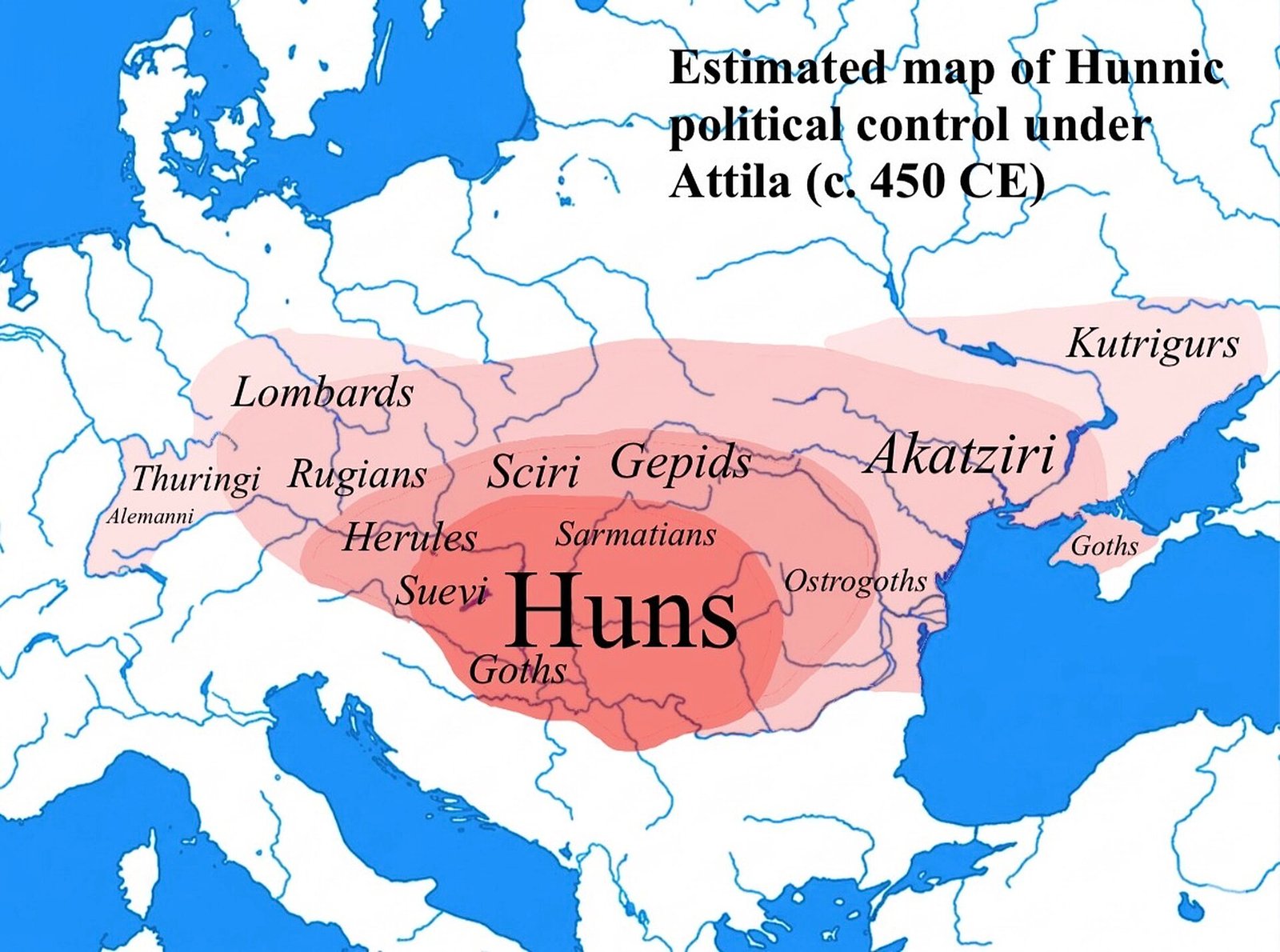
His realm was not a single people. The political union under Attila included Ostrogoths, Alans, Gepids, Rugii and Heruli alongside the Huns. The Oxford Classical Dictionary reads his campaigns as the military arm of a diplomatic policy. The goal, in that reading, was money.
Where is Attila from?
The honest answer is that nobody knows for sure. Attila’s birth date and birthplace are not known with certainty. You will see ‘around 406’ and ‘Pannonia’ repeated online. These figures should not be presented as a confirmed birth record.
What is better documented is his center of power. It lay on the wide plains between the Danube and the Tisza rivers, in today’s Hungary.
The question ‘was Attila Turkish?’ comes up constantly in Turkey. The debate turns on the Hun language. Scholars have proposed kinship with Turkic, Iranian and Finno-Ugric languages. Historian Peter Heather states that the surviving language evidence is not enough for a firm conclusion.
The name itself is also contested. One theory explains Attila through the Gothic word atta plus the diminutive ending -ila. Omeljan Pritsak proposed a Turkic origin instead. Gerhard Doerfer made a point that still matters: the origin of a name does not prove the ethnic identity of the person who carried it.
In 2025 a study in PNAS added genetic data to this debate. The researchers compared genomes from 370 ancient individuals. They found direct ancestry links between some European Hun-period individuals and Xiongnu elites. The same study showed high genetic diversity in the Hun-period population. So the picture is mixed, not a single origin story.
The campaigns against Rome
Attila and Bleda attacked the Balkan provinces of the Eastern Roman Empire in 441. Attila campaigned in the region again in 447.
In 451 he turned west into Gaul. The campaign was stopped on the Catalaunian Plains. The resistance came from Roman forces under Flavius Aetius and, above all, from their Visigoth allies.
In 452 Attila invaded Italy. He sacked Aquileia and Milan. He did not take the city of Rome.
Why did he withdraw? The traditional account credits his meeting with Pope Leo. Modern historians add other causes. Famine and the difficulty of supplying the army appear among them.
Attila the Hun death
Attila died in 453, after the night of his wedding to Ildico. The sources disagree on the cause. The Priscus tradition reports a hemorrhage. Marcellinus Comes, writing about 80 years later, recorded a claim that his wife killed him. Most researchers do not find the murder story reliable.
If you hope to visit his tomb, you cannot. The location of Attila’s grave is unknown. No burial confirmed as his can be visited today. Jordanes wrote that Attila’s coffins were bound with gold, silver and iron. Because the grave has never been found, that account remains unverified by archaeology.
Hun dominance did not survive him for long. In 454 an alliance led by the Gepid ruler Ardaric defeated the Huns at the Battle of Nedao. Attila’s son Ellac died in that battle.
Timeline
- 434 Rugila dies. Attila and Bleda take over joint rule of the Huns.
- 441 Attila and Bleda attack the Balkan provinces of the Eastern Roman Empire.
- Around 445 Bleda dies. Attila becomes sole ruler.
- 447 Attila campaigns in the Balkans again.
- 451 The Gaul campaign is stopped on the Catalaunian Plains.
- 452 Attila invades Italy and sacks Aquileia and Milan, but does not take Rome.
- 453 Attila dies on the night of his wedding to Ildico.
- 454 An alliance led by the Gepid ruler Ardaric defeats the Huns at Nedao. Attila’s son Ellac dies in the battle.
Details you won’t find in guidebooks
Priscus attended a banquet at Attila’s court and wrote down what he saw. His report is the closest thing we have to an eyewitness portrait.
The banquet began at three in the afternoon. Seating followed a strict rank order. The seats on Attila’s right carried more honor than the seats on his left.
The guests received gold and silver cups. Attila drank from a wooden cup and ate his meat from a wooden plate. Think of a host today who serves guests on the good china and eats from a plain plate. The message was the same: the ruler did not need to show off.
Priscus also noticed what was missing. Other Hun leaders decorated their swords, shoe straps and horse bridles with gold and precious stones. Attila’s sword, shoe straps and bridle carried no such ornament.
On the same journey Priscus met a Greek-speaking merchant. The man had been captured at Viminacium. He fought for Onegesius, handed over his share of the loot, and won his freedom. Then he chose to stay and live among the Huns.
One modern footnote for travelers. A structure photographed under the name Attila Gate is linked to the Kurultáj event held in Bugac, Hungary. It belongs to a modern event, not to Attila’s own time.
The 2001 Attila film
The film most people mean is the 2001 television adaptation titled Attila, directed by Dick Lowry.
FAQ
How did Attila the Hun die?
Attila died in 453, after the night of his wedding to Ildico. The Priscus tradition reports a hemorrhage. Marcellinus Comes, writing about 80 years later, recorded a claim that his wife killed him, but most researchers do not consider that account reliable.
Where is Attila from?
His birth date and birthplace are not known with certainty. The figures ‘around 406’ and ‘Pannonia’ should not be presented as a confirmed birth record. His power base was the plains between the Danube and the Tisza in today’s Hungary.
Can you visit Attila’s grave?
No. The location of his grave is unknown, and no tomb that is confirmed as his can be visited today. Jordanes’ story of coffins bound with gold, silver and iron has not been verified by archaeology.
Was Attila Turkish?
The question is unresolved. Theories link the Hun language to Turkic, Iranian and Finno-Ugric languages, but historian Peter Heather states that the surviving language evidence is not enough for a firm answer. Gerhard Doerfer also stressed that the origin of the name Attila cannot prove his ethnic identity.
Sources
- Türkçe Vikipedi — Attila tr.wikipedia.org
- Smithsonian Associates — David Gwynn, The Huns smithsonianassociates.org
- Store norske leksikon — Attila snl.no
- World History Encyclopedia — Attila the Hun worldhistory.org
- English Wikipedia — Attila, Etymology and Death en.wikipedia.org
- Gnecchi-Ruscone et al. — PNAS, 2025 pubmed.ncbi.nlm.nih.gov
- Oxford Bibliographies — Ralph W. Mathisen, Attila And The Huns academic.oup.com
- Oxford Classical Dictionary — Peter Heather, Attila academic.oup.com
- HISTORY — Attila history.com
- Live Science — Who were the Huns? livescience.com
- Georgetown University — Priscus at the court of Attila faculty.georgetown.edu
- Wikimedia Commons — Kurultáj Attila 1 commons.wikimedia.org
- TRT Haber — Attila İlhan trthaber.com
- Atatürk Ansiklopedisi — Attila İlhan ataturkansiklopedisi.gov.tr
- Century Media Records — Mayhem centurymedia.com
- AllMusic — Thom Jurek, Attila Biography allmusic.com
- Steam — Total War: ATTILA store.steampowered.com
Image: Estimated map of Hunnic political control under Attila (c. 450 CE).jpg — Squeaks 41, CC BY 4.0