The declaration of Northern Cyprus on November 15, 1983, followed two decades of conflict, political division, and negotiations. The Turkish Cypriot Federated State’s assembly approved independence unanimously. Turkey recognized the new state that day. Three days later, the UN Security Council declared the proclamation legally invalid and called for its withdrawal.
If you want to understand that contrast, begin with the Republic of Cyprus established in 1960. The road to November 1983 passed through intercommunal violence, a coup, Turkey’s military intervention, and an earlier Turkish Cypriot administration. Independence changed the claim made by that administration. It also brought a direct international response.
Northern Cyprus: where is it, and what is its capital?
Northern Cyprus administers approximately 3,355 square kilometres in the northern part of Cyprus, an island in the eastern Mediterranean. Its capital is North Nicosia, the northern section of Nicosia. These geographical facts locate the territory whose declaration became the subject of Security Council Resolution 541.
The northern administration’s retrospective population estimate puts the region’s population at 155,521 in 1983. That figure refers to the founding year. If you are reading a Northern Cyprus map alongside this history, keep the date in view: the island’s de facto division followed the events of 1974, before the independence declaration.
How did the 1960 settlement give way to conflict?
The Republic of Cyprus formally proclaimed independence during the night of August 15–16, 1960. Turkey, Greece, and the United Kingdom became guarantor states under the 1960 arrangements. Those arrangements remained central to the legal disagreement over the proclamation made in 1983.
Intercommunal fighting between Turkish Cypriots and Greek Cypriots began on December 21, 1963. Turkish Cypriot historical accounts call these events Bloody Christmas. On March 4, 1964, Security Council Resolution 186 recommended establishing a United Nations peacekeeping force in Cyprus, UNFICYP.
The conflict therefore had an international dimension long before November 1983. The guarantor arrangements dated from independence. A UN peacekeeping response followed the violence of 1963. Both the 1960 settlement and the United Nations would feature in the later dispute over statehood.
What changed in 1974 and 1975?
On July 15, 1974, a coup supported by the junta in Greece overthrew President Makarios and brought Nikos Sampson to power. Turkey began its military intervention on July 20. In the period that followed, Cyprus became divided in practice between north and south.
The Turkish Cypriot Federated State was established on February 13, 1975. Its proclamation did not formally claim independence. This distinction matters: the administration created in 1975 preceded the Turkish Republic of Northern Cyprus by eight years, but the two declarations made different claims about its status.
A population agreement reached in Vienna under UN supervision on August 2, 1975, regulated movements between the two parts of the island. It covered Turkish Cypriots moving from south to north and Greek Cypriots moving from north to south. The road to 1983 thus involved arrangements affecting where people lived, alongside changes in political institutions.
What negotiations preceded the declaration?
On February 12, 1977, Makarios and Rauf Denktaş agreed on principles for intercommunal talks in Nicosia. The meeting took place under the supervision of the UN Secretary-General. These principles provided a framework for negotiations after the establishment of the federated administration.
Another high-level meeting followed in Nicosia on May 18–19, 1979. Spiros Kyprianou and Denktaş reached a ten-point agreement. The 1977 principles and the 1979 agreement were steps in negotiations.
On June 17, 1983, the Federated State’s assembly adopted a resolution incorporating the right to self-determination. It passed by 33 votes to six. That divided vote preceded the unanimous decision taken in November, when the assembly proclaimed an independent state.
What happened on November 15, 1983?
The assembly declared the Turkish Republic of Northern Cyprus on November 15, 1983. The decision was unanimous. Rauf Raif Denktaş became its first president and remained in office until 2005. Turkey formally recognized the state on the day of the proclamation.
Turkey justified the declaration through Turkish Cypriot self-determination and political equality. The Security Council took a different legal position. For you as a reader, keeping those positions attributed is essential: Turkey’s justification and the Council’s assessment were competing arguments about the same act.
How did Britain, the United States, and the UN react?
British Foreign Secretary Geoffrey Howe addressed the House of Commons on November 15. He described the declaration as an attempted secession. He also stated that Britain would continue to recognize only the Republic of Cyprus. Britain therefore announced its rejection on the day Turkey announced recognition.
Margaret Thatcher also sent Kenan Evren a message that day. She asked him to help secure the withdrawal of the independence declaration. The British response included both a public parliamentary statement and a direct appeal to the Turkish leadership.
The United States never recognized the Turkish Republic of Northern Cyprus. It maintained its diplomatic relations with the Republic of Cyprus, established in 1960. Its position continued recognition of the republic created at independence.
On November 18, the Security Council adopted Resolution 541. It considered the declaration incompatible with the 1960 Treaties of Establishment and Guarantee, treated it as legally invalid, and called for its withdrawal. Paragraph seven called on all states not to recognize any Cypriot state other than the Republic of Cyprus.
The Council returned to the issue in Resolution 550 on May 11, 1984. It condemned the exchange of ambassadors between Turkey and the Turkish Cypriot leadership as a secessionist action. It also called on states to withhold recognition and avoid assistance that would facilitate or support the secessionist entity.
Timeline
- Night of August 15–16, 1960: The Republic of Cyprus formally proclaimed independence.
- December 21, 1963: Intercommunal fighting began.
- March 4, 1964: Resolution 186 recommended creating UNFICYP.
- July 15, 1974: The coup supported by the Greek junta overthrew Makarios.
- July 20, 1974: Turkey’s military intervention began.
- February 13, 1975: The Turkish Cypriot Federated State was proclaimed.
- August 2, 1975: The Vienna population agreement regulated movements north and south.
- February 12, 1977: Makarios and Denktaş agreed on negotiating principles.
- May 18–19, 1979: Kyprianou and Denktaş reached a ten-point agreement.
- June 17, 1983: The federated assembly adopted its self-determination resolution.
- November 15, 1983: Northern Cyprus declared independence; Turkey recognized it.
- November 18, 1983: The Security Council adopted Resolution 541.
- March 7, 1984: The Northern Cyprus flag law was adopted.
- May 11, 1984: The Security Council adopted Resolution 550.
- May 5, 1985: A referendum approved the Northern Cyprus constitution.
Details you won’t find in guidebooks
Resolution 541 passed with 13 votes in favour. Pakistan voted against it, and Jordan abstained. Resolution 550 also received 13 supporting votes and Pakistan’s opposition. This time, the United States abstained. The two resolutions therefore had similar totals but different abstaining states.
The constitutional timetable also extended beyond the declaration. The Northern Cyprus constitution was approved by referendum on May 5, 1985, approximately a year and a half after independence was proclaimed. The proclamation and constitutional approval were separate milestones.
Northern Cyprus flag: when was it adopted?
The flag has a white background, a red crescent and star, and two stripes. Its law was adopted on March 7, 1984, and published in the Official Gazette on March 9. The flag’s legal adoption thus followed the November declaration.
Northern Cyprus holidays and currency: how does history enter daily life?
November 15 is celebrated as Republic Day, marking the 1983 proclamation. The official currency is the Turkish lira. If you encounter a Republic Day ceremony or pay for an everyday purchase in lira, the anniversary and currency connect this political history with ordinary life.
FAQ
When was Northern Cyprus declared independent?
The Turkish Republic of Northern Cyprus was proclaimed on November 15, 1983, through a unanimous decision of the Turkish Cypriot Federated State’s assembly.
How did the international community respond?
Turkey recognized the declaration that day. Britain maintained recognition of the Republic of Cyprus, while UN Security Council Resolution 541 considered the declaration legally invalid and called for its withdrawal.
Was the 1975 declaration also a declaration of independence?
No. The Turkish Cypriot Federated State, established on February 13, 1975, did not formally claim independence. The November 1983 declaration expressly proclaimed an independent state.
When was the Northern Cyprus flag law adopted?
The flag law was adopted on March 7, 1984, and published in the Official Gazette on March 9. The flag has a white background with a red crescent, star, and two stripes.
Sources
- Wikipedia — Northern Cyprus en.wikipedia.org
- Wikipedia — North Nicosia en.wikipedia.org
- Vikipedi — Kuzey Kıbrıs Türk Cumhuriyeti tr.wikipedia.org
- Atatürk Encyclopedia — The Cyprus Question and the Independent Republic of Cyprus) ataturkansiklopedisi.gov.tr
- UNFICYP — Establishment of UNFICYP unficyp.unmissions.org
- Republic of Türkiye Ministry of Foreign Affairs — History of the Cyprus Question mfa.gov.tr
- Northern Cyprus Public Information Office — Social, Economic and Political History of Cyprus pio.mfa.gov.ct.tr
- Northern Cyprus Ministry of Foreign Affairs — Historical Perspective mfa.gov.ct.tr
- UN Secretary-General — Question of Cyprus, A/39/100 digitallibrary.un.org
- Republic of Türkiye Ministry of Foreign Affairs — 1983 Chronology diad.mfa.gov.tr
- Yenidüzen — Founding Declaration of Northern Cyprus yeniduzen.com
- Rauf Denktaş University — Rauf Raif Denktaş rdu.edu.tr
- Wikipedia — Declaration of Independence of the Turkish Republic of Northern Cyprus en.wikipedia.org
- UN Security Council, via Refworld — Resolution 541 refworld.org
- UK Parliament, Hansard — Cyprus (Turkish Community), November 15, 1983 api.parliament.uk
- US Department of State, Office of the Historian — Cyprus history.state.gov
- UN Security Council, via Refworld — Resolution 550 refworld.org
- Northern Cyprus Ministry of National Education — Flag Law 15/1984 mebnet.net
- Northern Cyprus Public Information Office — System of Government pio.mfa.gov.ct.tr
- Northern Cyprus Public Information Office — November 15 Republic Day Ceremonies pio.mfa.gov.ct.tr
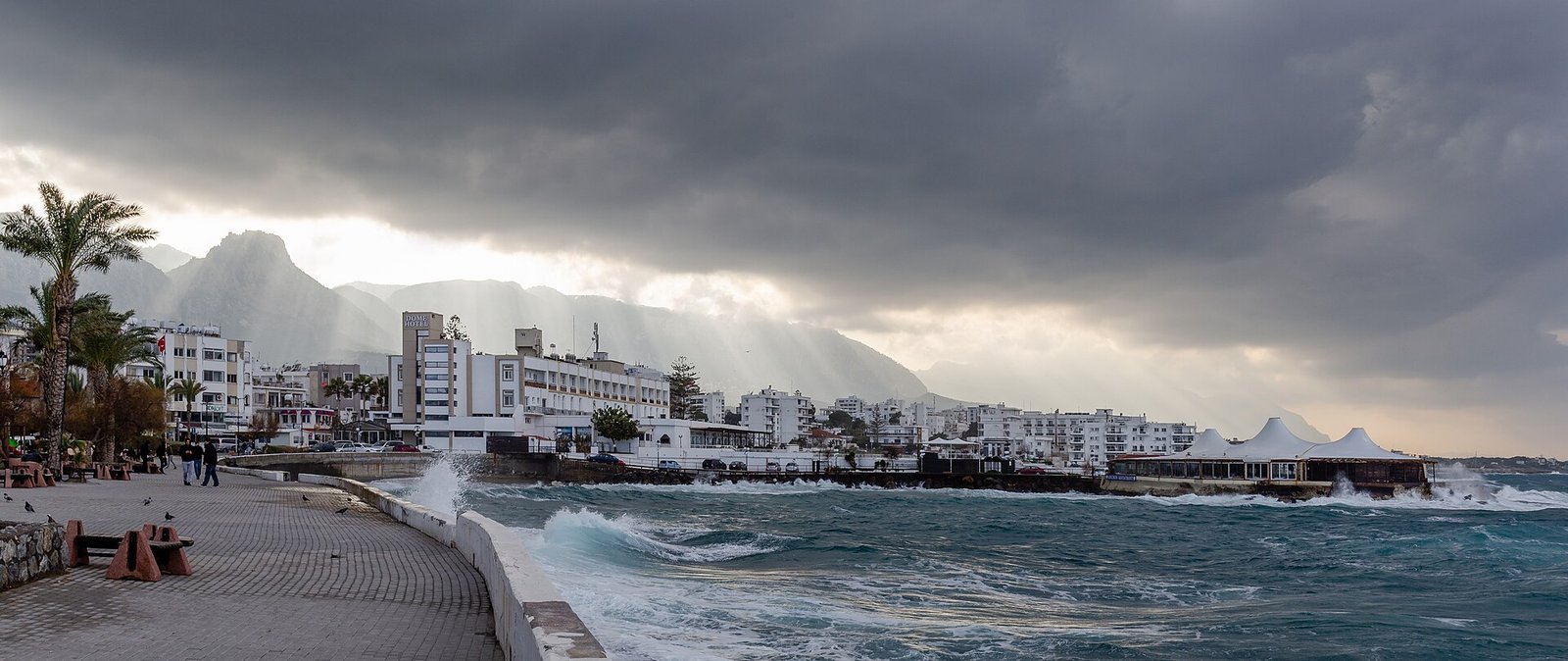
Image: Coast with Dome Hotel, Kyrenia, Northern Cyprus 03.jpg — Michal Klajban, CC BY-SA 4.0