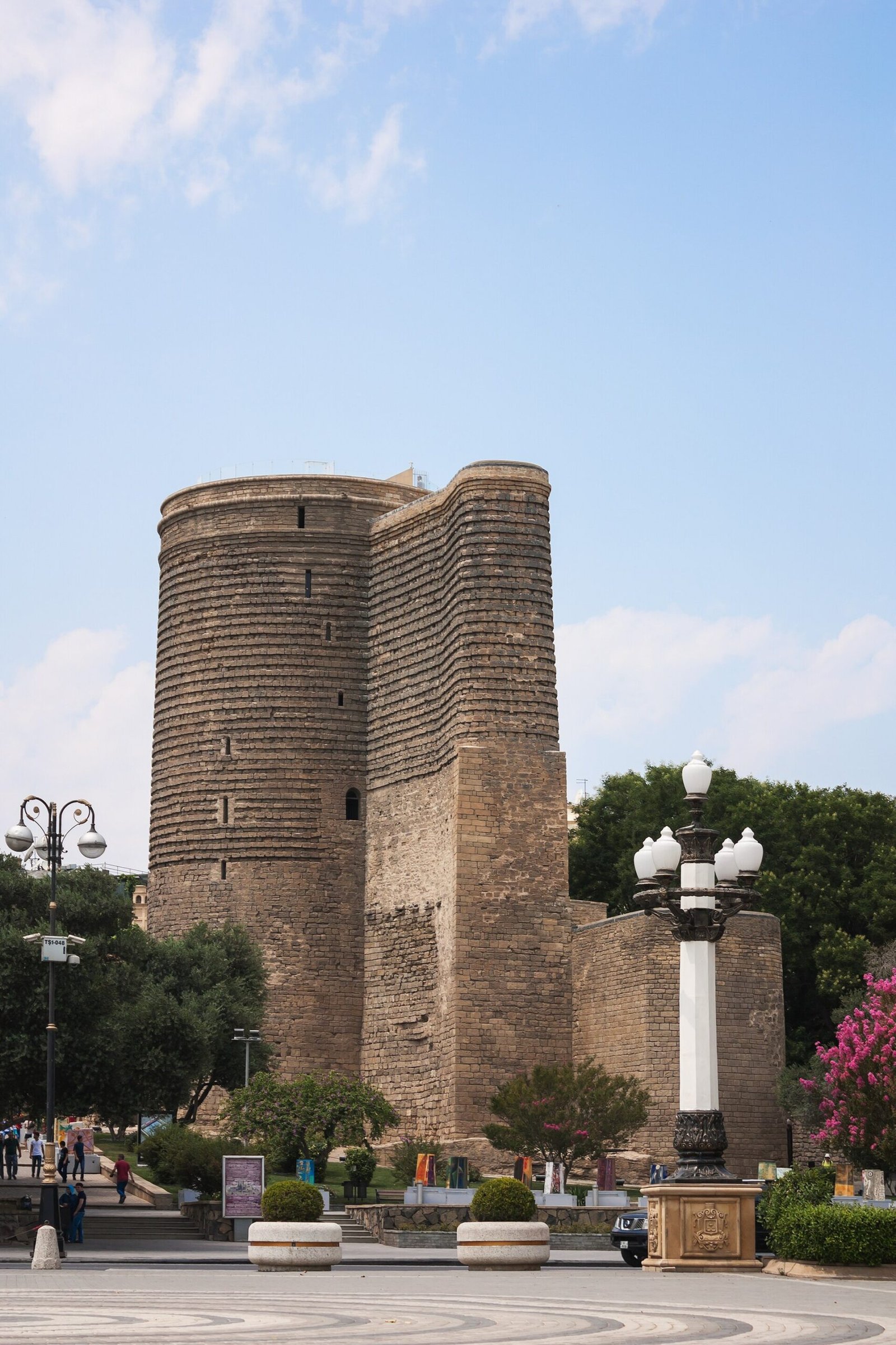
Why was Baku’s Maiden Tower built?
Baku’s Maiden Tower has a documented history of defensive use. Its original purpose has several competing explanations: a fortress, a Zoroastrian fire temple and an observatory. The official museum account states that the tower served defensive purposes for a long period. That gives the fortress interpretation a place in its history, even while the temple and observatory theories offer different readings of the building.
UNESCO describes the standing monument as a 12th-century structure built over earlier remains from the 7th–6th centuries BC. Those dates refer to different layers of the site. If you want to understand the tower’s history, keep the earlier structures separate from the monument that UNESCO dates to the 12th century.
Where is the Maiden Tower in Baku, Azerbaijan?
The tower’s Azerbaijani name is Qız qalası. It stands in Baku, Azerbaijan’s capital, in the southeastern section of the walls of Icherisheher. The coastal boulevard is nearby. Its position places the monument within the historic walled city and close to the waterfront.
From the roof, you can see Icherisheher’s streets and minarets, Baku Boulevard and Baku Bay. These views connect the tower with the surrounding city. Below the roof, its interior is divided into eight floors with vaulted ceilings made from dressed stone.
The official monument description gives its diameter as 16.5 metres. Its height measures 28 metres on one side and 31 metres on the other, reflecting the ground around it. Both height figures therefore belong to the same building.
Maiden Tower history: what do its dates and inscription show?
UNESCO’s 12th-century dating is also consistent with the lettering of the tower’s Kufic inscription. The inscription sits approximately 14 metres above the ground and carries the name Masud ibn Davud. Its script is dated to the 12th century.
That name needs careful handling. The Presidential Library’s discussion challenges the identification of Masud ibn Davud as the architect because the inscription gives him no title meaning architect or master builder. The presence of a name and the identification of a profession are separate matters.
Historian Sara Ashurbeyli proposed another chronology. She placed the tower’s construction in the 4th–6th centuries AD. Her interpretation differs from UNESCO’s dating of the standing monument. It should be presented as an alternative theory, with its attribution attached.
Excavations in 1962–1963 supplied evidence about the foundations. They revealed that the tower rests on a large rock sloping toward the sea. They also showed that the adjoining projection supports the structure. This finding gives that projection a physical role in the building.
Was the Maiden Tower a fortress, temple or observatory?
The defensive theory connects the tower with the Shirvanshahs’ fortification system. In this interpretation, warning signals passed from the tower to other castles in Absheron during danger. The proposed role was therefore connected with a wider network of defenses.
Supporters of this explanation point to the thick walls and a water well concealed within the wall. They interpret both as features of a fortress capable of enduring a siege. The well matters here because the argument concerns the building’s internal provisions as well as its exterior strength.
Davud Akhundov offered a religious interpretation. He described the Maiden Tower as a Zoroastrian fire temple with seven fire outlets at the top. This is a specific reconstruction of its purpose. The seven outlets belong to Akhundov’s theory and should be understood within that interpretation.
An observatory theory attributed to Ahmedov focuses on stone projections. He connected 30 projections in the lower part and 31 in the upper part with the number of days in months. His explanation reads the arrangement as evidence of a calendar-related function.
These arguments use different features: walls and water for defense, fire outlets for worship, and numbered projections for observation. The official museum account adds a firmer statement about use over time: the tower served defensive purposes for a long period before becoming a museum in 1964.
What is the Maiden Tower story?
One legend centres on a ruler’s daughter and an unwanted marriage. When her father wishes to marry her to someone she does not want, she asks him to build a tower for her first. After its construction, she jumps from the tower and dies.
In that telling, the tower becomes part of a story about the daughter’s refusal. The requested building and her final leap link the monument to the maiden of the legend. The story is a legendary explanation, separate from the inscription and archaeological evidence.
Another legend gives the maiden a different role. A fire-haired young woman emerges from sacred fire while the city is under siege. She defeats the enemy commander in a duel and saves the city. Here, the maiden is a defender rather than a ruler’s daughter facing marriage.
There is also an interpretation of the name that does not depend on either story. It treats “maiden” as a symbol of a tower that an enemy could not capture. This explanation stands alongside interpretations that connect the name with legends.
Timeline
- 7th–6th centuries BC: UNESCO dates the earlier structures beneath the tower to this period.
- 4th–6th centuries AD: Sara Ashurbeyli’s alternative theory places the tower’s construction in these centuries.
- 12th century: UNESCO dates the standing monument to this century. The inscription’s lettering is also assigned to this period.
- 1962–1963: Excavations reveal the large rock beneath the tower and the supporting role of its adjoining projection.
- 1964: The tower begins operating as a museum.
- 2000: The Walled City of Baku, including the tower and the Shirvanshahs’ Palace, enters the UNESCO World Heritage List.
- 2003–2009: The World Heritage property appears on UNESCO’s List of World Heritage in Danger.
- April 2011: Restoration of the tower begins.
- January 2013: The tower closes to visitors during restoration.
- 2 January 2014: It reopens.
Details you won’t find in guidebooks
The original arrangement had no stone staircase between the ground floor and the floor above. Passage was through an opening in the ceiling, using a ladder or rope. If you compare that with taking the stairs at home, the difference is clear: movement between these floors depended on a separate climbing aid.
The concealed well measures approximately 70 centimetres across and 21 metres deep. Those dimensions give substance to the defensive interpretation. Its position inside the wall is also part of the argument made by supporters of the fortress theory.
Circular openings in the vaulted floor ceilings line up on the same vertical axis. This is another feature to keep in mind when picturing the eight-floor interior. The openings form an aligned arrangement through the building.
Restoration also involved the tower’s swifts. Workers installed 500 special bird nests on a neighbouring building and preserved approximately 150 nesting places inside the tower. The work addressed the monument’s fabric alongside its use by birds.
For cracks and voids, restorers injected a lime suspension and silicic acid ester. These materials belong to the recent conservation history of the tower. They offer a more technical detail than the familiar stories of the maiden or the competing theories about its first purpose.
Maiden Tower Baku entrance fee and how to get there
The official visitor address is 99 Neftchilar Avenue. The tower stands in southeastern Icherisheher near the coastal boulevard. You can use the address and its position within the walled city to identify the correct monument when planning your visit.
The official museum page accessed on 31 October 2026 lists daily opening hours of 10:00–19:00. The tariff on that date gives admission as 19 Azerbaijani manat for foreign adults and 9 manat for foreign visitors aged 5–17.
The tower has operated as a museum since 1964. Its restoration began in April 2011, followed by closure in January 2013 and reopening on 2 January 2014. The roof view takes in the streets below, the boulevard and Baku Bay.
FAQ
Why was Baku’s Maiden Tower built?
A defensive interpretation connects it with the Shirvanshahs’ fortifications. Other theories describe a Zoroastrian fire temple or an observatory. The official museum account states that the tower served defensive purposes for a long period.
How old is Baku’s Maiden Tower?
UNESCO describes it as a 12th-century monument built over earlier structures dating to the 7th–6th centuries BC. Historian Sara Ashurbeyli proposed an alternative construction date in the 4th–6th centuries AD.
What is the Maiden Tower story?
One legend tells of a ruler’s daughter who asks for a tower before an unwanted marriage, then jumps from it and dies. Another tells of a fire-haired maiden who defeats an enemy commander and saves the besieged city.
What is the entrance fee for Baku’s Maiden Tower?
The official tariff accessed on 31 October 2026 lists admission at 19 Azerbaijani manat for foreign adults and 9 manat for foreign visitors aged 5–17.
Sources
- UNESCO World Heritage Centre — Walled City of Baku whc.unesco.org
- Presidential Library of Azerbaijan — The Maiden Tower unesco.preslib.az
- Icherisheher State Historical and Architectural Reserve Administration — The Maiden Tower icherisheher.gov.az
- Icherisheher State Historical and Architectural Reserve Administration — Museums icherisheher.gov.az
- Icherisheher Administration — Maiden Tower Restoration icherisheher.gov.az
Image: Maiden Tower in Baku 2015.jpg — AlixSaz, CC BY-SA 4.0