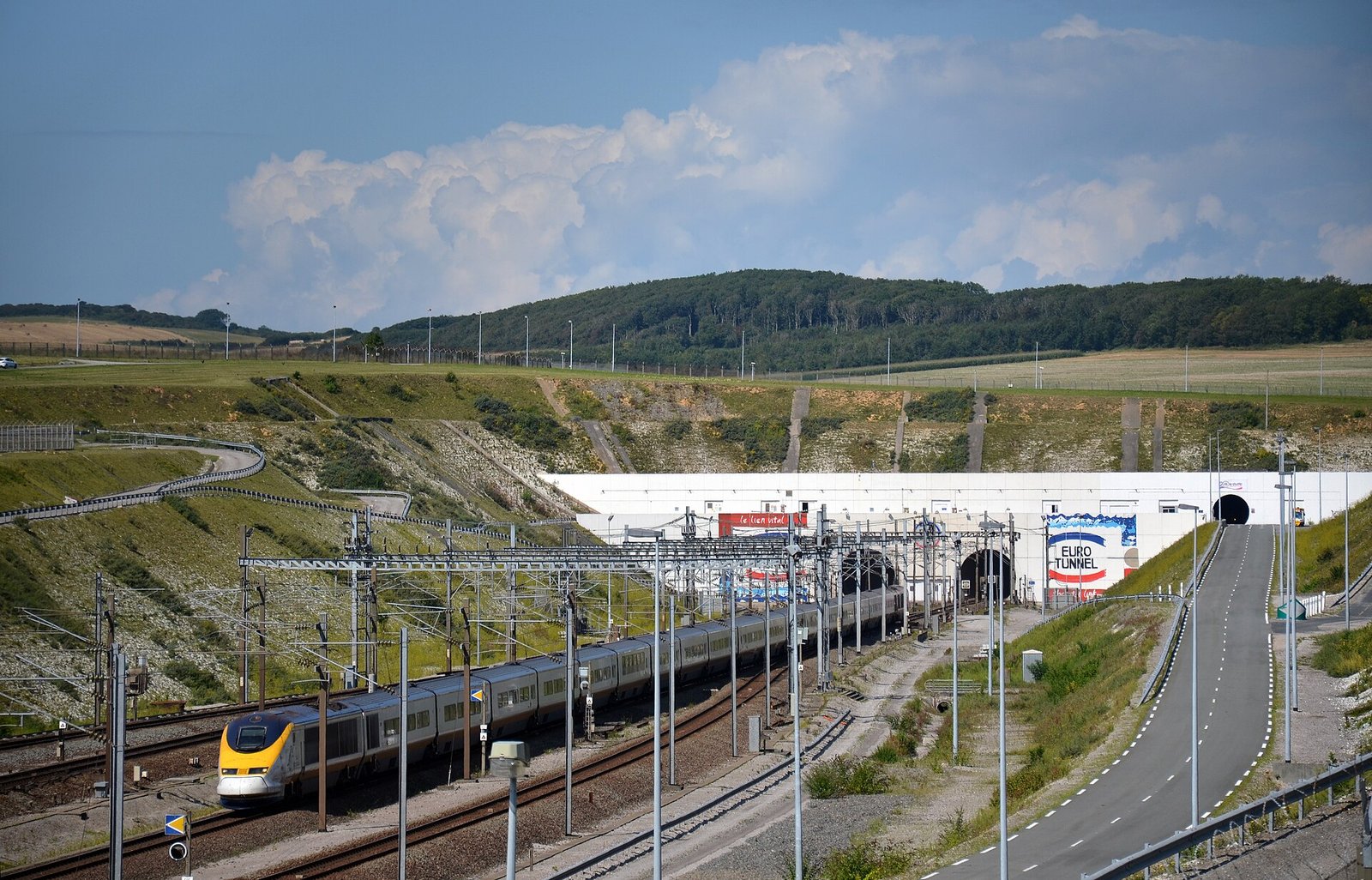
The Channel Tunnel connected Britain and France by excavating two railway tunnels and a central service tunnel beneath the Strait of Dover. The 50.46-kilometre link runs from Folkestone in Kent to Coquelles near Calais, with 37.9 kilometres beneath the sea. Teams using 11 tunnelling machines built the connection, which officially opened on 6 May 1994.
How did workers approaching from opposite shores meet beneath the water? The answer involves carefully chosen chalk marl, a service tunnel excavated ahead of the railway tunnels, and wetter ground on the French side. If you follow those details, the project becomes easier to understand: its history runs from a horse-drawn carriage proposal in 1802 to commercial Eurostar services in 1994.
What exactly was built beneath the sea?
The Channel Tunnel consists of three parallel passages. Two carry railway traffic, while the service tunnel runs between them. Each railway tunnel measures 7.6 metres in diameter. The central passage is smaller, at 4.8 metres. These dimensions describe separate tunnels with different jobs, rather than a single underground space shared by all traffic.
Its total length and underwater length are different measurements. The full connection stretches for 50.46 kilometres. The Institution of Civil Engineers gives the undersea section as 37.9 kilometres. When you picture the route from Folkestone to Coquelles, remember that the entire railway connection is longer than the part beneath the water.
Depth also needs a clear reference point. Getlink puts the tunnels an average of 40 metres beneath the seabed. The Geological Society of London places the route’s lowest point 115 metres below sea level. At that location, the rock above the tunnel reaches 75 metres in thickness. Sea level and the seabed therefore describe different aspects of its position.
Why did earlier Channel Tunnel attempts stop?
Albert Mathieu-Favier proposed a tunnel in 1802. His design provided an upper route for horse-drawn vehicles and a lower gallery for leaking water. Oil lamps would illuminate the carriage passage. The proposal imagined a road beneath the sea, whereas the completed connection would carry trains.
An early excavation attempt began in 1880. Workers on both sides of the Channel used Beaumont & English tunnelling machines. By the time the work stopped in 1882, the English excavation had advanced approximately 2,000 metres. The French excavation had reached 1,800 metres. British opposition brought that attempt to a halt.
Another attempt began in 1973 and ended in 1975. It was abandoned during the period when the oil crisis affected Britain’s economy. The two abandoned efforts had different immediate contexts: British opposition stopped the earlier excavation, while the later project ended amid economic difficulties.
The legal framework for the completed connection came with the Treaty of Canterbury, signed on 12 February 1986. It provided for private companies to build and operate the fixed Channel link. That agreement established a framework for construction and operation between the two countries.
How did engineers excavate the Channel Tunnel?
The construction consortium was TransManche Link. It brought together five British companies and five French companies. Beneath the Channel, its tunnelling operation used six machines from the English side and five from the French side. The combined total was 11 machines working on the tunnel system.
Engineers sought to keep the excavation within the West Melbury chalk marl wherever possible. This material had low water permeability. It also contained fewer fractures than the chalk layers above it. Those properties made the chosen geological layer advantageous for the underwater route.
The service tunnel went first. By advancing this smaller passage ahead of the railway tunnels, engineers could see the actual ground conditions before excavating the larger passages. The central tunnel therefore had a construction role as well as its later maintenance and emergency functions.
Conditions differed between the two sides. Wetter ground on the French side slowed the machines working from France. Machines advancing from England consequently excavated a larger share of the overall route. The work did not divide into equal lengths simply because teams started in both countries.
Tunnel linings included cast-iron pieces bolted together and prefabricated concrete rings. These were components of the completed passages around the excavated route. The construction story therefore involved both removing chalky material and installing the linings that formed the tunnel interiors.
The British and French teams met in the service tunnel on 1 December 1990. Their meeting point lay 22.3 kilometres from England and 15.6 kilometres from France. Those unequal distances reflect the greater length excavated from the English side, where machines had progressed further.
Timeline
- 1802: Albert Mathieu-Favier proposed a two-level tunnel for horse-drawn vehicles, with a lower gallery for leaking water.
- 1880: Early tunnel excavation began on both sides of the Channel using Beaumont & English machines.
- 1882: British opposition stopped the attempt after approximately 2,000 metres of excavation in England and 1,800 metres in France.
- 1973: Work began on another tunnel project.
- 1975: That project was abandoned during the economic difficulties associated with the oil crisis.
- 12 February 1986: The Treaty of Canterbury established the legal framework for private construction and operation.
- 1 December 1990: British and French teams met inside the service tunnel.
- 6 May 1994: Queen Elizabeth II and French President François Mitterrand officially opened the Channel Tunnel.
- 14 November 1994: Commercial Eurostar passenger services through the tunnel began.
Details you won’t find in guidebooks
Mathieu-Favier’s 1802 proposal separated traffic and drainage vertically. Horse-drawn carriages would use the lamp-lit upper level. Water entering the structure would pass into a gallery below. This arrangement gives the early proposal a concrete shape: a carriage route overhead and a water passage underneath.
Excavated material followed different paths on the two shores. In France, chalky material was crushed and mixed with water. It was then pumped behind a specially built embankment on land. That embankment stood 37 metres high, giving the French operation a substantial destination for its excavation material.
On the English side, excavated material helped form a platform reclaimed from the sea. The platform lay at the foot of Shakespeare Cliff near Dover. Rock removed to create the underground route thus became material for a surface construction beside the coast.
The service tunnel also has its own traffic convention. Maintenance and rescue vehicles drive on the left inside it. This detail belongs to the working infrastructure between the countries, alongside the passage’s maintenance access and emergency role.
How does the tunnel work for passengers and vehicles?
Eurostar passenger trains, freight trains and LeShuttle trains use the Channel Tunnel. LeShuttle carries road vehicles through the railway connection. For an everyday comparison, think of taking your car on a train for part of a journey: the vehicle is transported through the tunnel aboard the train.
The maximum operating speed for trains inside the tunnel is 160 kilometres per hour. The railway passages also connect to the central service tunnel through cross-passages every 375 metres. These connections provide access for maintenance and emergency evacuation throughout the route.
The service tunnel is kept at a higher air pressure than the railway tunnels. This arrangement helps prevent smoke entering it if a fire occurs in a railway passage. Its smaller diameter, frequent cross-passages and pressure difference all belong to the same central service passage.
The opening and the start of commercial Eurostar services were separate events. Queen Elizabeth II and François Mitterrand performed the official opening on 6 May 1994. Eurostar began commercial passenger services on 14 November that year. If you are tracing the tunnel’s history, both dates matter: one marks the ceremony, the other the passenger service.
FAQ
Where does the Channel Tunnel connect Britain and France?
It connects Folkestone in Kent, England, with Coquelles near Calais, France, beneath the Strait of Dover.
How long and how deep is the Channel Tunnel?
Its total length is 50.46 kilometres, including 37.9 kilometres beneath the sea. The tunnels average 40 metres below the seabed, while the lowest point lies 115 metres below sea level.
Can you drive through the Channel Tunnel?
Road vehicles travel through the tunnel aboard LeShuttle trains. The railway tunnels also carry Eurostar passenger trains and freight trains.
When did the Channel Tunnel open?
Queen Elizabeth II and French President François Mitterrand officially opened it on 6 May 1994. Commercial Eurostar passenger services began on 14 November 1994.
Sources
- Getlink — The Channel Tunnel getlinkgroup.com
- Getlink — Our history getlinkgroup.com
- Institution of Civil Engineers — The Channel Tunnel ice.org.uk
- Geological Society of London — Channel Tunnel geolsoc.org.uk
- University of Reading — British Tourism and Transborder Cooperation: The case of The Channel Tunnel reading.ac.uk
- Türkçe Vikipedi — Manş Tüneli tr.wikipedia.org
- English Wikipedia — Channel Tunnel en.wikipedia.org
Image: TGV TMST 3011-2 – Sortie Tunnel sous la Manche à Coquelles.jpg — Billy69150 (voir les conditions d'utilisation / see licensin, CC BY-SA 4.0