The short answer: how many Mongol invasions of Japan were there?
There were two. Kublai Khan’s campaigns of 1274 and 1281 both ended in a Japanese victory. In Japanese the two are remembered together as Genkō. The first is known as Bun’ei, the second as Kōan.
The armies were not purely Mongol. Soldiers and sailors came from Yuan-ruled China and from the Goryeo Kingdom in Korea as well. So when you read “the Mongol fleet,” picture a mixed force with several home regions.
The second campaign is the famous one. A typhoon hit the invasion fleet in August 1281. The Japanese called the storm kamikaze, “divine wind.”
Why did Kublai Khan send ships to Japan?
It began with a letter. In 1268, Kublai’s letter was delivered to the Japanese imperial court. Japan’s government sent no reply.
That silence did not end the matter. Kublai sent new embassies in 1275 and 1279. Their members were executed in Japan. Two rounds of envoys put to death left little room for talk.
The 1274 campaign: from Tsushima to Hakata Bay
If you want a mental map, start in Korea and move southeast. The 1274 fleet sailed from Korea and followed a clear route. It went first to Tsushima, then to Iki, and then to Hakata Bay on Kyūshū.
The Royal Armouries gives dates for the landings. On the morning of 5 November 1274, the invaders came ashore at Sasuura on Tsushima and defeated the local defenders. That is the answer to the Tsushima question: the island was the first place hit.
The main force landed at Hakata Bay on 19 November 1274. The Yuan troops advanced in tight ranks and were directed by drum signals.
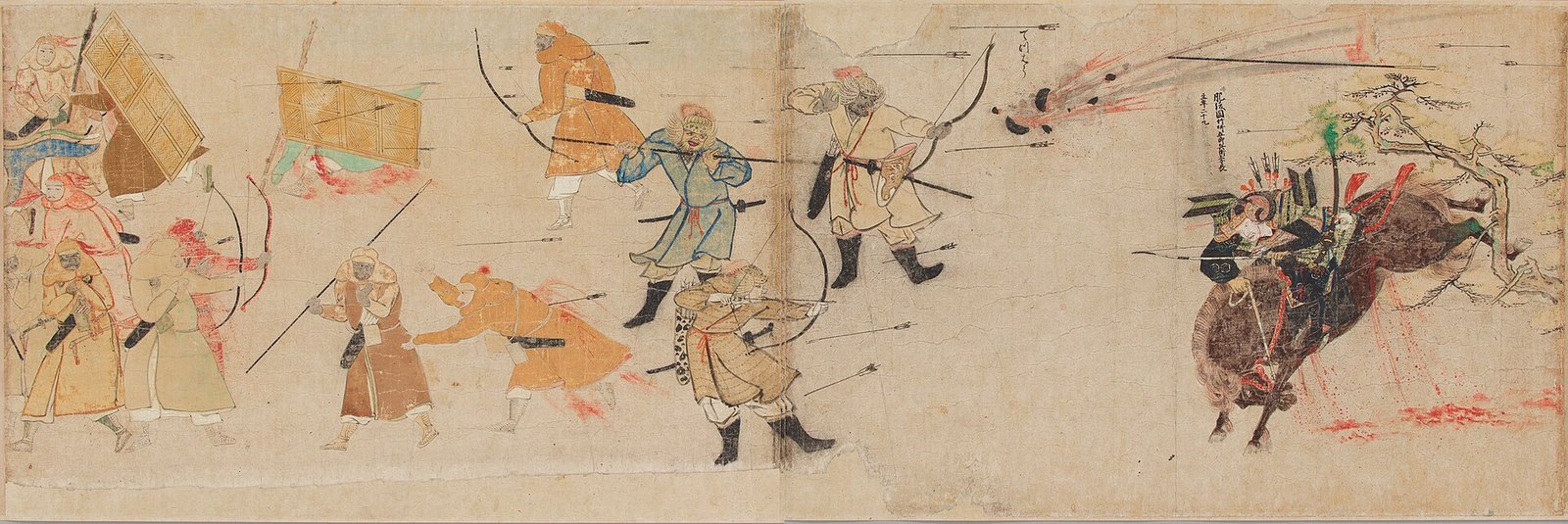
On the Japanese side, we have an unusually vivid record. Takezaki Suenaga, a warrior from Higo, attacked Yuan soldiers in 1274 with only five companions. He fought again in 1281. His battles are shown in the scrolls called Mōko Shūrai Ekotoba. One scene depicts a gunpowder weapon called tetsuhau exploding during the 1274 fighting.
Was there a typhoon in 1274?
This is where popular history and the sources part ways. The Yuan history describes a storm that cost the 1274 fleet losses. But it is unclear whether the storm caught the ships at Hakata or on the way back to Korea.
The traditional claim says a typhoon explains the 1274 defeat. The University of Vienna’s review pushes back. It points out that the Mōkō shūrai ekotoba and the Hachiman gudōkun do not mention such a wind for that year.
So the safe reading is this. A storm in 1274 appears in Yuan history, but its place and its weight in the outcome are disputed. The 1281 typhoon is the one that is strongly documented.
Japan prepares: the Hakata wall
After 1274, the Japanese prepared for a second attack. Around Hakata they built a stone defensive line. The Japanese National Archives give its length as about 20 kilometres. A stone wall about two metres high was built in 1276.
Think of a flood barrier along a river town. It does not stop the water. It slows it and buys time. The wall worked in a similar way. It gave Japanese archers a place to shoot from and made it harder for the invaders to hold the beach.
The 1281 campaign: two fleets, one problem
In 1279, the Yuan defeated the Southern Song. That allowed Kublai to send a fleet from southern China as well as from Korea in 1281.
How big were these forces? Nobody agrees. The common traditional estimate is two forces totalling 140,000 men: 40,000 from Korea and 100,000 from southern China. Thomas Conlan discusses a scale of about 14,000. Morris Rossabi objects to that low figure and proposes roughly 70,000 soldiers and sailors. For a reader, the honest answer is a wide range, not one number.
The plan needed timing. The Korean fleet had orders to wait at Iki for the southern Chinese fleet. It did not wait. In June it attacked Kyūshū.
The Japanese were ready. Archers behind the Hakata wall made it hard for the invaders to gain a foothold on the shore. Japanese warriors in small boats raided the enemy ships.
The typhoon of 15 August 1281
On 15 August 1281, a large typhoon struck the invasion fleet while it lay at anchor. It wrecked ships and left many men stranded at sea or on the shore.
The Royal Armouries describes what happened to the ships. Some sank. Some were driven onto rocks. Some captains cut their anchor ropes to try to save their vessels.
If you have ever seen a boat tied up in a harbour during a gale, you know the problem. Lines that hold in calm weather can drag a vessel into trouble. A fleet crowded at anchor off an unfamiliar coast faced the same danger on a far larger scale.
The Japanese saw the storm as a sign of divine protection. They named it kamikaze, “divine wind.”
Timeline
- 1268: Kublai’s letter reaches the Japanese imperial court. No reply is sent.
- 5 November 1274: Invaders land at Sasuura on Tsushima.
- 19 November 1274: The main force lands at Hakata Bay.
- 1274: The first campaign ends in a Japanese victory. The place and the effect of the storm are debated.
- 1275: Members of a new Yuan embassy are executed in Japan.
- 1276: A stone defensive wall is built at Hakata.
- 1279: The Yuan defeat the Southern Song. New envoys sent to Japan are executed.
- June 1281: The Korean fleet attacks Kyūshū without waiting for the southern Chinese fleet.
- 15 August 1281: A large typhoon wrecks the invasion fleet.
- 1974: A bronze seal is found off Takashima.
- 1994: Wooden anchors with stone weights are found at Takashima.
- 2011: A preserved Yuan ship base is identified at Takashima Kōzaki.
- 27 March 2012: Takashima Kōzaki is registered as a national historic site.
- 2014: A sediment study on the kamikaze typhoons is published in Geology.
Does the ground back up the story?
Researchers have tested the typhoon story with geology. A study published in Geology in 2014 used a coastal lake’s sediment record, about 2,000 years long, to check the kamikaze account.
The result is careful. The team found two sea-flood layers from the late 13th century, which supports a two-typhoon idea. But the researchers said the layers cannot be matched with certainty to the events of 1274 and 1281.
Details you won’t find in guidebooks
- A seal with Phags-pa script. In 1974, a bronze seal engraved in Phags-pa script was found off Takashima.
- Anchors still in place. In the 1994 Takashima excavation, three wooden anchors made of red oak were recorded on the seabed in their original positions, together with their stone weights.
- A bowl with a name. Among about 4,000 finds at Takashima Kōzaki was a celadon bowl inscribed “Wang Baihu.”
- A ship’s keel. In 2011, researchers from the University of the Ryūkyūs found the base of a Yuan ship at Takashima Kōzaki. Its keel and outer planking were preserved, and the recorded length was 12 metres.
- A first for Japan. On 27 March 2012, Takashima Kōzaki became the first underwater archaeological site in Japan registered as a national historic site.
- Five companions. Suenaga’s 1274 attack with only five companions is recorded in his illustrated scrolls.
Is there a map, a film or a book?
For a map, trace the route in your head: Korea, Tsushima, Iki, then Hakata Bay on Kyūshū. The Takashima wreck site lies off the coast in the same region.
For reading, start with Thomas Conlan’s In Little Need of Divine Intervention. It brings together Suenaga’s illustrated scrolls and the translation of about 70 administrative documents. The Japan National Archives page below is a short, free introduction.
FAQ
How many Mongol invasions of Japan were there?
Two. Kublai Khan sent the first fleet in 1274 (the Bun’ei campaign) and the second in 1281 (the Kōan campaign). Both ended in Japanese victory, and Japanese tradition calls the pair Genkō.
Did a typhoon really destroy the Mongol fleet?
For 1281, yes. A large typhoon struck the fleet at anchor on 15 August 1281 and wrecked many ships. For 1274, a storm is mentioned in Yuan history, but where it hit is uncertain, and a University of Vienna review notes that two Japanese sources do not mention such a wind for that year.
Where did the Mongol invasions of Japan take place?
On Tsushima, on Iki and on the coast of Kyūshū around Hakata Bay. The 1281 wrecks were found off Takashima, an island in Nagasaki Prefecture.
What does kamikaze mean?
It means ‘divine wind’ in Japanese. The name was given to the storm that the Japanese saw as a sign of divine protection.
Which book is best for reading more?
Thomas Conlan’s In Little Need of Divine Intervention. It combines Takezaki Suenaga’s illustrated scrolls with the translation of about 70 administrative documents.
Sources
- Türkçe Vikipedi — Moğolların Japonya seferleri tr.wikipedia.org
- Archaeology — Khubilai Khan Fleet archaeology.org
- Japan National Archives — Japan and Mongolia archives.go.jp
- Royal Armouries — Kamikaze: The Mongol Invasions of Japan royalarmouries.org
- Wikipedia — Mongol invasions of Japan en.wikipedia.org
- University of Vienna — Religion-in-Japan: Götterwinde religion-in-japan.univie.ac.at
- GeoScienceWorld — Depositional evidence for the Kamikaze typhoons pubs.geoscienceworld.org
- Worcester State University — Sediment Links Kamikaze Winds to Mongol Invasion news.worcester.edu
- Asian Research Institute of Underwater Archaeology — Project Takashima ariua.org
- Nagasaki Prefecture Cultural Properties Database — Takashima Kōzaki pref.nagasaki.jp
- Princeton University Department of History — In Little Need of Divine Intervention history.princeton.edu
Image: Mōko Shūrai Ekotoba.jpg — Author unknown. Illustration rolls were ordered by Takezaki , Public domain