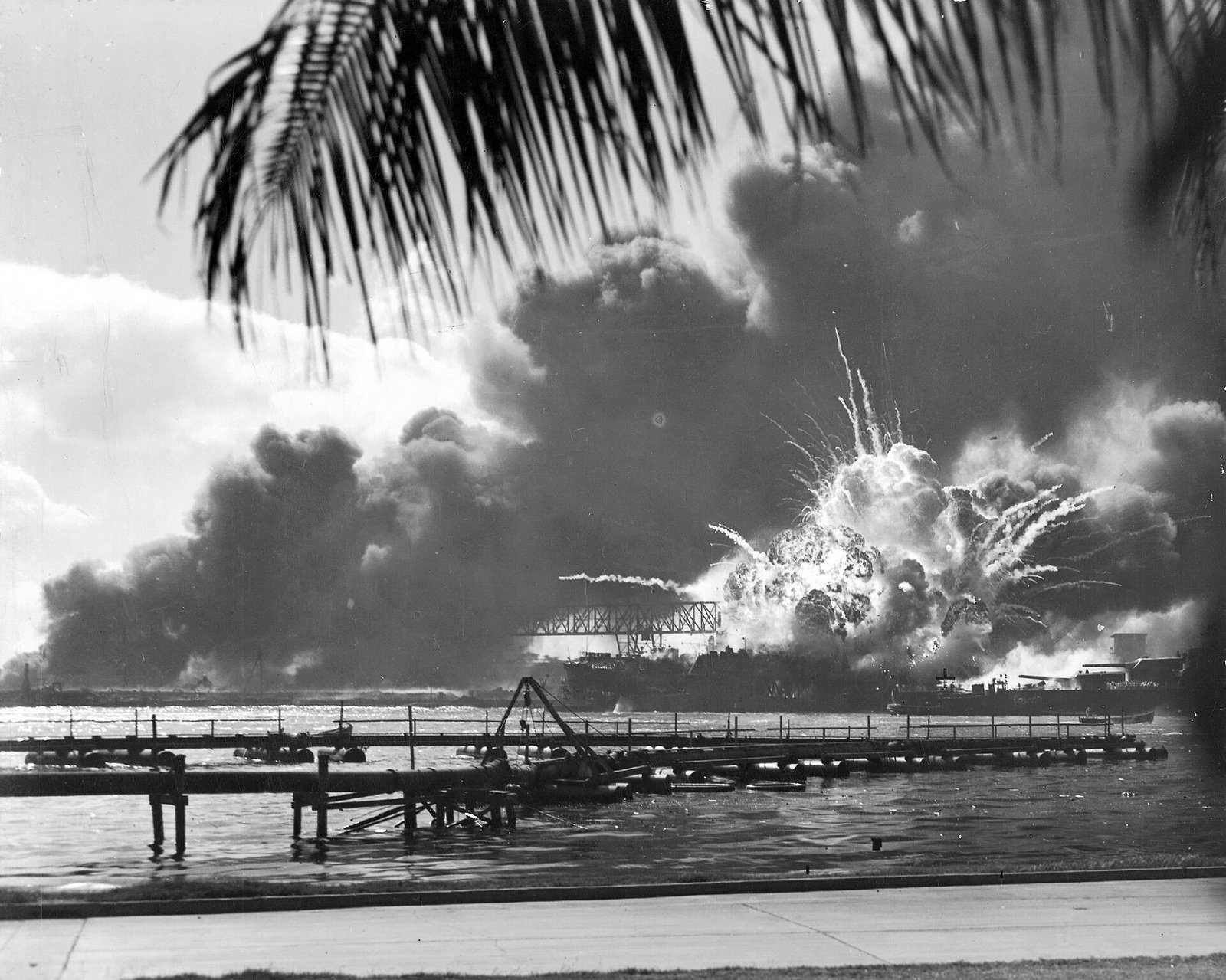
On Sunday morning, 7 December 1941, carrier aircraft appeared over a quiet naval base in Hawaii. In a single morning they had changed the course of World War II. Yet the attack that looked like a triumph for Japan became the start of its defeat. This article gives you the date, the place, the minute-by-minute sequence, the reasons behind the raid and the road to Japan’s surrender.
Attack on Pearl Harbor: Date and Basic Facts
The Attack on Pearl Harbor was a surprise raid by the Imperial Japanese Navy on the US Pacific Fleet. It took place on Sunday, 7 December 1941. Admiral Isoroku Yamamoto, commander of the Combined Fleet, designed the plan. His aim was to stop the Pacific Fleet from interfering with Japan’s operations in Southeast Asia.
The force sailed toward Hawaii on 26 November 1941. Vice Admiral Chūichi Nagumo commanded it. In two waves, 353 aircraft flew from six aircraft carriers.
Where Did the Attack Happen? Location and Map
Pearl Harbor is a lagoon harbor on Oahu, one of the Hawaiian Islands. It lies west of Honolulu. If you look at a map of Oahu, find Honolulu and move west. The harbor is there.
The raid was not limited to the ships in the lagoon. Japanese aircraft also attacked the military airfields on Oahu. The goal was to keep American planes on the ground.
Why Did Japan Attack America?
The road to Pearl Harbor ran through Asia. In 1941 Japan advanced into French Indochina. The United States answered by freezing Japanese assets and expanding its export embargo.
Think of a household whose electricity, fuel and basic supplies are cut off at once. Japan faced something similar, with the loss of resources such as oil and scrap iron. Japanese planners decided to seize Malaya and the Dutch East Indies. They also wanted to delay American intervention.
Talks between Washington and Tokyo in 1941 did not solve the crisis. One core dispute was the demand that Japan withdraw from China. Japan’s military leaders would not accept it.
Attack on Pearl Harbor Minute by Minute
All times below are Hawaii local time on 7 December 1941. They follow the National Park Service and US Navy accounts.
- 06.10: The first Zero fighter lifted off from the carrier Akagi. More than 180 aircraft from the six carriers followed it.
- About 06.47: The destroyer USS Ward sank a Japanese midget submarine at the harbor entrance. That was about an hour before the air raid.
- 07.02: Radar operators Joseph Lockard and George Elliott at Opana detected the incoming aircraft. Lieutenant Kermit Tyler assumed they were 12 American B-17s that were expected that day.
- About 07.55: The first wave reached Pearl Harbor.
- About 08.45: The second wave began. It lasted about an hour.
Notice how little time passed between the first warning and the first bombs. The radar saw the planes. The conclusion drawn from the screen was wrong.
Attack on Pearl Harbor Timeline
This timeline covers the whole story, from the embargo to the surrender.
- 1941: After Japan advanced into Indochina, the US widened its economic sanctions.
- 26 November 1941: The Japanese strike fleet sailed for Hawaii.
- 7 December 1941, 06.10: Aircraft began taking off from the Japanese carriers.
- 7 December 1941, about 06.47: USS Ward sank a midget submarine at the harbor entrance.
- 7 December 1941, 07.02: Opana radar detected the approaching aircraft.
- 7 December 1941, about 07.55: The first wave struck Pearl Harbor.
- 7 December 1941, about 08.45: The second wave began.
- 8 December 1941: The US declared war on Japan.
- 11 December 1941: Germany and Italy declared war on the US, and the US declared war on both the same day.
- 3–7 June 1942: At Midway, Japan lost four aircraft carriers.
- 6 August 1945: The US dropped an atomic bomb on Hiroshima.
- 9 August 1945: The US dropped an atomic bomb on Nagasaki.
- 15 August 1945: Emperor Hirohito announced Japan’s surrender.
- 2 September 1945: Japan signed the formal surrender aboard USS Missouri.
The Cost of the Raid
The numbers are heavy. According to the National Park Service, 2,403 Americans, soldiers and civilians, were killed and 1,178 were wounded. The battleship USS Arizona lost 1,177 men. The Americans lost 188 aircraft, destroyed. All eight American battleships at Pearl Harbor were damaged, and four of them sank.
On paper, this was a major victory. The problem for Japan was what the raid failed to destroy.
Why the Raid Failed Strategically
Three American aircraft carriers based at Pearl Harbor were at sea that morning. They escaped the attack. Carriers would later become the center of the Pacific war.
The Japanese also left the base itself intact. They did not destroy the fuel storage, the shipyard repair facilities or the submarine base. These installations supported later American operations. A fleet can lose battleships and keep fighting if its fuel and repair yards survive.
The political result was just as important. The United States declared war on Japan on 8 December 1941. On 11 December Germany and Italy declared war on the US, and the US responded the same day with declarations against both. A regional conflict had become a global one.
How Japan Lost the War
No single event ended Japan’s war. Several pressures worked together.
Midway. From 3 to 7 June 1942, Japan lost four aircraft carriers and 248 aircraft at the Battle of Midway. American codebreakers had partly broken the Japanese communications code. They identified the target of the Midway attack in advance.
Guadalcanal. By the end of the campaign, Japan had suffered about 14,800 combat deaths. About 9,000 more men died of disease.
Submarines. The US Pacific Fleet Submarine Force reports that its submarines sank 54 percent of all Japanese shipping tonnage lost in the war. That is about 5 million tons.
Production. American factories delivered more than 96,000 bombers and 2.4 million trucks by 1945. Numbers like these show the industrial gap between the two sides.
The final blows. The US dropped atomic bombs on Hiroshima on 6 August 1945 and Nagasaki on 9 August. Emperor Hirohito announced the surrender on 15 August. On 2 September 1945, Mamoru Shigemitsu and Yoshijirō Umezu signed the formal surrender document aboard USS Missouri in Tokyo Bay.
Historians still debate what weighed most in the surrender decision. Richard B. Frank treats Soviet intervention as important but not decisive. Tsuyoshi Hasegawa gives the Soviet invasion the decisive weight.
Details You Won’t Find in Guidebooks
- A submarine sunk before the bombs fell. USS Ward sank a midget submarine at the harbor entrance at about 06.47. The air raid began about an hour later.
- A radar warning that was misread. Lockard and Elliott saw the aircraft at 07.02. Lieutenant Tyler took the blips for 12 friendly B-17s.
- Brothers on one ship. The crew of USS Arizona included 38 sets of brothers. Of the 79 brothers in those sets, 63 died in the attack.
- More than an air raid. Japan also sent five midget submarines to Pearl Harbor. Each carried two crew members and two torpedoes.
- A captured submarine on tour. Kazuo Sakamaki’s midget submarine, HA-19, was captured on 8 December. It later toured the United States to help sell war bonds.
Visiting and Learning More
If you travel to Hawaii, the National Park Service runs the Pearl Harbor sites. Its “Minute by Minute” timeline is a good place to start before you go. Many films and documentaries have covered the attack, but the primary accounts listed below are better for checking facts.
FAQ
What was the date of the attack on Pearl Harbor?
The attack happened on Sunday, 7 December 1941. The first wave reached Pearl Harbor at about 07.55 Hawaii local time. The United States declared war on Japan the next day, 8 December 1941.
Where did the attack on Pearl Harbor happen?
Pearl Harbor is a lagoon harbor on the island of Oahu in the Hawaiian Islands, west of Honolulu. Japanese aircraft also hit military airfields elsewhere on Oahu.
How many people died at Pearl Harbor?
The National Park Service counts 2,403 Americans, soldiers and civilians, killed and 1,178 wounded. The battleship USS Arizona alone lost 1,177 men.
Why did Japan attack the United States?
The US had frozen Japanese assets and widened its export embargo after Japan moved into French Indochina. Japanese planners wanted to seize Malaya and the Dutch East Indies and to delay American intervention. The attack on the Pacific Fleet was designed to do that.
How did Japan lose the war after Pearl Harbor?
Japan lost four carriers and 248 aircraft at Midway in June 1942. It then suffered heavy losses at Guadalcanal and under American submarine attack, and it faced far greater American production. After the atomic bombs of August 1945 and Soviet intervention, Hirohito announced surrender on 15 August 1945.
Sources
- Türkçe Vikipedi — Pearl Harbor Saldırısı tr.wikipedia.org
- Wikipedia — Pearl Harbor en.wikipedia.org
- Wikipedia — Attack on Pearl Harbor en.wikipedia.org
- US Department of State, Office of the Historian — Japan, China, the United States and the Road to Pearl Harbor history.state.gov
- Smithsonian National Air and Space Museum — The Complicated Lead Up to Pearl Harbor airandspace.si.edu
- National Park Service — Remembering Pearl Harbor: Minute by Minute nps.gov
- US Navy Region Hawaii — History cnrh.cnic.navy.mil
- National Park Service — National Pearl Harbor Remembrance Day nps.gov
- National Park Service — People nps.gov
- NOAA — Japanese Mini Submarines at Pearl Harbor sanctuaries.noaa.gov
- Naval History and Heritage Command — Pearl Harbor Attack history.navy.mil
- The National WWII Museum — Battle of Midway nationalww2museum.org
- The National WWII Museum — Guadalcanal: The Joint Fight nationalww2museum.org
- Commander, Submarine Force, US Pacific Fleet — SUBPAC History csp.navy.mil
- The National WWII Museum — Becoming the Arsenal of Democracy nationalww2museum.org
- National Park Service — August 1945 home.nps.gov
- National Security Archive, George Washington University — Editorial note on the Groves Memorandum nsarchive.gwu.edu
- US National Archives — Surrender of Japan (1945) archives.gov
Image: USS SHAW exploding Pearl Harbor Nara 80-G-16871 2.jpg — Unknown navy photographer, Public domain