Who was King Canute, or Cnut the Great?
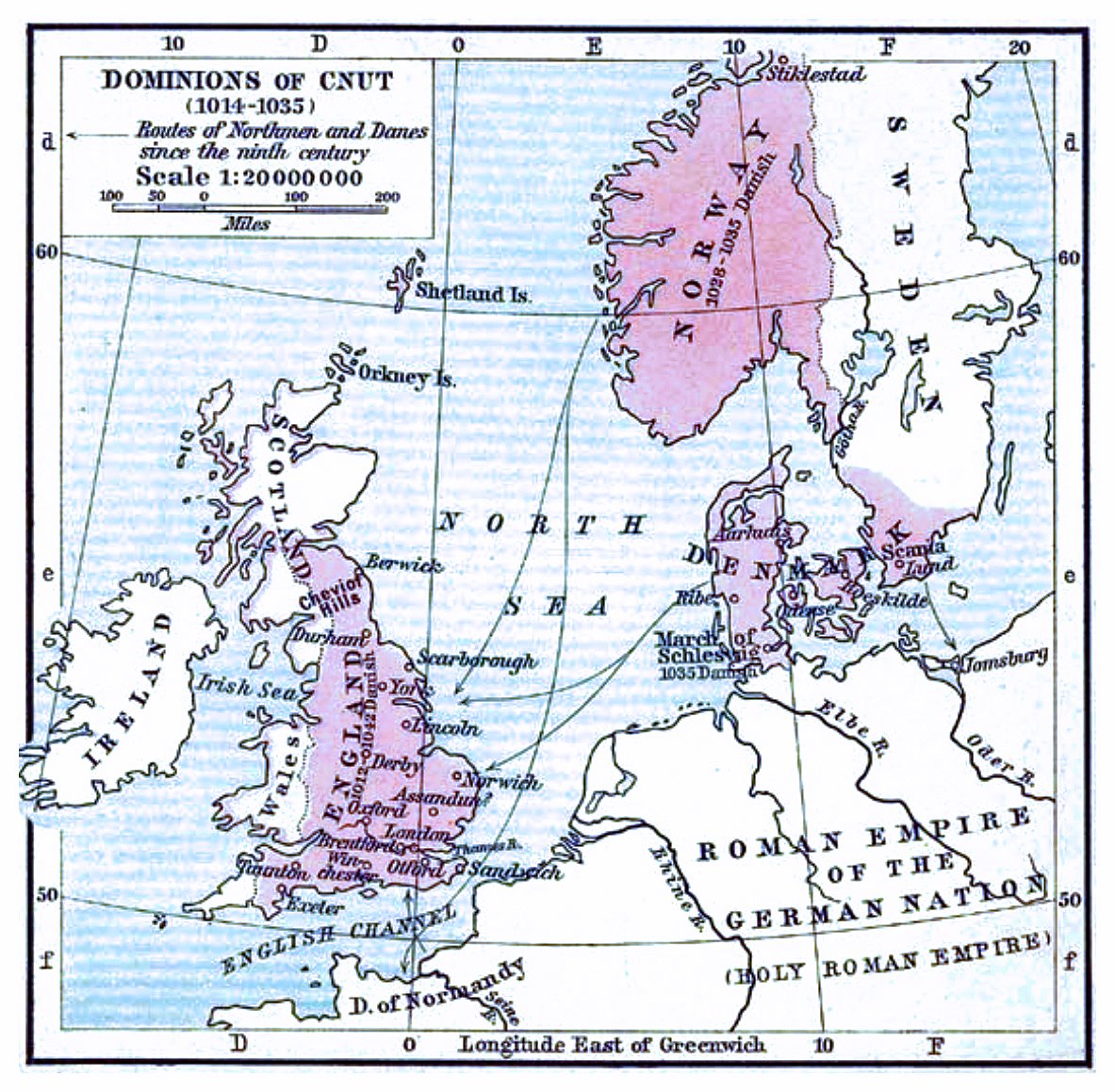
King Canute was a Scandinavian ruler who governed England from 1016 to 1035 and Denmark from 1018 to 1035. He also took the Norwegian crown in 1028. Historians call his combined rule over these kingdoms the North Sea Empire. His career connects military conquest with the practical work of governing several countries.
Canute’s story takes you from an invasion of England to a coronation in Trondheim. England came first in 1016. Denmark followed in 1018. Norway joined his kingdoms a decade later. These separate stages matter when you picture the extent of his authority.
Canute was also a Christian king. He belonged to the second generation of his family to adopt Christianity. His reign included a major collection of earlier English law, cooperation with powerful earls, and a journey to Rome. Battles explain how he gained England, but they account for only part of his kingship.
Cnut pronunciation: how do you say his name?
Cnut and Canute are English spellings of the same ruler’s name. The Old Norse form is Knútr. The English pronunciation is /kəˈnjuːt/, approximately “kuh-NYOOT,” with the stress on the final syllable. When you encounter Cnut on a museum label and Canute in another account, both names can refer to this king.
The name Cnut the Great identifies the ruler whose English reign lasted from 1016 until 1035. Keeping those dates in view helps anchor his story. His Danish kingship began later, in 1018, and his acquisition of Norway followed in 1028.
Cnut and the Vikings: how did his rise begin?
Canute’s father was the Danish king Sweyn Forkbeard. His brother was Harald II, also a king of Denmark. Canute therefore entered English affairs as a member of a ruling Danish family. In 1013, he accompanied his father’s campaign in England.
Sweyn died on 3 February 1014. The Danish army then chose Canute as king. English leading men made a different choice: they recalled Æthelred from Normandy. The army’s decision did not give Canute uncontested authority over England. His father’s death left competing claims to rule.
Canute returned to England in 1015, following the campaign of 1013–1014. That return was a decisive step toward the kingship he secured the following year. His English reign grew out of successive campaigns, rather than an immediate transfer of power after Sweyn’s death.
How did Cnut become king of England?
On 18 October 1016, Canute’s army defeated the army of King Edmund Ironside at Assandun. The battle’s location remains disputed. Ashingdon and Ashdon, both in Essex, are competing identifications. You can attach a precise date to the victory without treating either proposed location as settled.
Canute and Edmund divided England between them in 1016. Edmund died later that year, leaving Canute ruler of the whole country. The sequence is important: military victory was followed by a division of the kingdom, then sole rule after Edmund’s death.
Canute’s coronation as king of England took place in London in 1017. His reign is nevertheless dated from 1016. The difference reflects two separate events: gaining rule over England and undergoing the coronation ceremony.
In July 1017, Canute married Emma of Normandy. She was the widow of the previous English king, Æthelred. The marriage connected Canute to the family of the ruler whom English leading men had recalled only a few years earlier.
How did Cnut the Great govern his kingdoms?
Canute took the Danish throne after his brother Harald II died in 1018. He now ruled both England and Denmark. In 1028, he received the Norwegian crown at Trondheim, adding a third kingdom to his authority.
His responsibilities required help across the sea. While Canute was in Scandinavia, powerful English and Danish earls assisted with England’s government. If you have ever left everyday responsibilities with someone else while travelling, there is a familiar practical connection here: Canute’s absence required other people to carry out the work of government.
A major compilation of earlier English law was prepared during his reign. This gives his kingship a concrete administrative dimension. Alongside the campaigns and crowns, his rule included the collection of laws already associated with England.
In 1018, Canute received a total Danegeld payment of 82,500 pounds. The payment belongs to the same year in which he acquired Denmark’s throne. It is a substantial recorded financial detail within a reign often remembered through battles and the later story of the waves.
Canute travelled to Rome in 1027 to attend the imperial coronation of Conrad II. This journey came before he acquired Norway in 1028. His movements therefore extended beyond the kingdoms he personally ruled, placing him at another ruler’s coronation while already king of England and Denmark.
Who were Canute’s family and successors?
Canute had four children with Ælfgifu and Emma. His children with Ælfgifu were Svein and Harold. His children with Emma were Harthacnut and Gunhild. These family connections become especially relevant when following the English succession after his death.
Harold Harefoot ruled England from 1035 to 1040. Harthacnut followed from 1040 to 1042. Both were Canute’s sons. Their successive reigns carried his family’s English kingship beyond 1035, although neither reign matched the length of their father’s rule in England.
Timeline
- Around 995: An approximate date used for Canute’s birth.
- 1013: Accompanied Sweyn Forkbeard’s campaign in England.
- 1014: After Sweyn’s death, the Danish army chose Canute; English leading men recalled Æthelred.
- 1015: Returned to England.
- 18 October 1016: Defeated Edmund Ironside’s army at Assandun.
- 1016: Became ruler of all England after Edmund’s death.
- 1017: Was crowned in London and married Emma of Normandy.
- 1018: Acquired Denmark’s throne after Harald II’s death.
- 1027: Attended Conrad II’s imperial coronation in Rome.
- 1028: Received Norway’s crown at Trondheim.
- Around 1031: Appeared in the New Minster Liber Vitae.
- 12 November 1035: Died at Shaftesbury in Dorset.
- 1642: Soldiers damaged the Winchester mortuary chests containing remains attributed to him.
Did King Canute really try to stop the waves?
The account of Canute commanding the waves first appears in the twelfth century in Henry of Huntingdon’s writing. That places its first recorded appearance after Canute’s lifetime. It belongs to the king’s later reputation and should be read as a story with competing interpretations.
One interpretation presents the episode as a demonstration of Christian humility. The king’s inability to command the sea illustrates the limits of royal power. Later hostile chronicles interpreted the same action as madness. The familiar image of an arrogant king is therefore only one way the story has been understood.
Canute’s Christianity provides relevant context for the humility interpretation. He was a second-generation Christian within his family. That fact does not turn the waves story into a documented event from his reign, but it explains why the religious reading forms part of his later reputation.
Details you won’t find in guidebooks
A contemporary depiction of Canute survives in the New Minster Liber Vitae, a monastic remembrance book dated to around 1031. The image was made during his lifetime. Unlike the later waves narrative, it offers a representation of the king from the period when he ruled.
A silver coin in the British Museum provides another physical connection. Its collection number is E.6477. Aethestan struck it at Bath. It measures 19 millimetres across and weighs 1.470 grams. These details attach Canute’s reign to a named moneyer, a minting place and a surviving object.
Canute’s Quatrefoil coins, dated to approximately 1018–1024, document the first appearance of a crown with lily motifs on English coinage. If you look closely at his coins, the crown is therefore more than a general sign of kingship. Its design marks a specific development in English coin imagery.
Winchester’s mortuary chests add a more troubled detail. Soldiers damaged the chests in 1642 and scattered the remains inside them across the floor. Canute’s name appears on these chests. Their history matters when considering the remains now attributed to him at Winchester Cathedral.
Where did King Canute die, and where is he buried?
Canute died on 12 November 1035 at Shaftesbury in Dorset, England. His burial place is Winchester. Winchester Cathedral holds remains attributed to him, linking the city to the end of a reign that had encompassed England, Denmark and Norway.
Shaftesbury and Winchester belong to different parts of that final chapter. One was his place of death; the other was his burial location. For a visit connected with Canute’s burial, Winchester Cathedral is the relevant destination, with the later damage to its mortuary chests forming part of the story.
FAQ
Who was Cnut the Great?
Cnut was a Scandinavian ruler who governed England from 1016 to 1035 and Denmark from 1018 to 1035. He added Norway to his kingdoms in 1028.
How do you pronounce Cnut?
The English pronunciation is /kəˈnjuːt/, approximately kuh-NYOOT. His name also appears as Canute and, in Old Norse, Knútr.
Did King Canute really command the waves?
The story first appears in Henry of Huntingdon’s writing in the twelfth century. It has been interpreted as a lesson in Christian humility, while later hostile accounts presented the action as madness.
Where is King Canute buried?
His burial place is Winchester, England. Winchester Cathedral holds remains attributed to him, although soldiers damaged the mortuary chests and scattered their contents in 1642.
Sources
- Viking Ship Museum — Cnut the Great vikingeskibsmuseet.dk
- Wikipedia — Cnut en.wikipedia.org
- Vikipedi — Knut (İngiltere kralı)) tr.wikipedia.org
- British Museum — Coin E.6477 britishmuseum.org
- The Royal Family — Canute ‘The Great’ royal.uk
- Wikipedia — Winchester Cathedral en.wikipedia.org
- Winchester Cathedral — Mortuary Chests: History winchester-cathedral.org.uk
Image: C. 1014-1035 Dominions of Cnut.jpg — William Robert Shepherd, Public domain