The Lighthouse of Alexandria stood at the eastern end of ancient Pharos Island in Alexandria, Egypt, where Qaitbay Citadel now marks its former site beside the Great Harbour entrance. Earthquakes progressively wrecked it, and surviving stones were reused in the citadel around 1480. Underwater remains include large blocks associated with the lighthouse, alongside stones from other structures.
The puzzle begins with those mixed remains: which stones belonged to the tower, and what can they tell you about its design? Coins show a tower crowned by a statue, while underwater surveys record scattered architectural pieces. Following those clues connects the lighthouse’s construction, its gradual destruction and the reconstructions now being tested through 3D modelling.
Where was the Lighthouse of Alexandria?
The lighthouse marked the entrance to Alexandria’s Great Harbour from the eastern tip of Pharos Island. Pharos was connected to Alexandria by the Heptastadion, a causeway more than 1,200 metres long. Its island setting was therefore linked physically to the city.
Qaitbay Citadel occupies the lighthouse’s former location. If you use the citadel to place the ancient tower, you have the essential geographical reference. The underwater archaeological site lies around this area, where CEAlex connects the submergence of remains with subsidence affecting Alexandria’s coast since antiquity.
When was the Lighthouse of Alexandria built, and under whose rule?
CEAlex dates the start of construction to 297 BCE, under Ptolemy I. Completion followed between 283 and 281 BCE, under Ptolemy II. This dating draws on the later Suda dictionary and the chronology of Eusebius, so its precision rests on those textual traditions.
The lighthouse became one of the Seven Wonders of the Ancient World. Its total height is estimated at no less than 100 metres. That figure describes an estimated overall height; the surviving underwater blocks do not constitute an intact tower from which every dimension can simply be read.
The construction dates also separate two royal roles. Ptolemy I began the project, while Ptolemy II ruled when it was completed. Describing the lighthouse as the work of either ruler alone loses that sequence.
What do ancient depictions suggest about its architecture and operation?
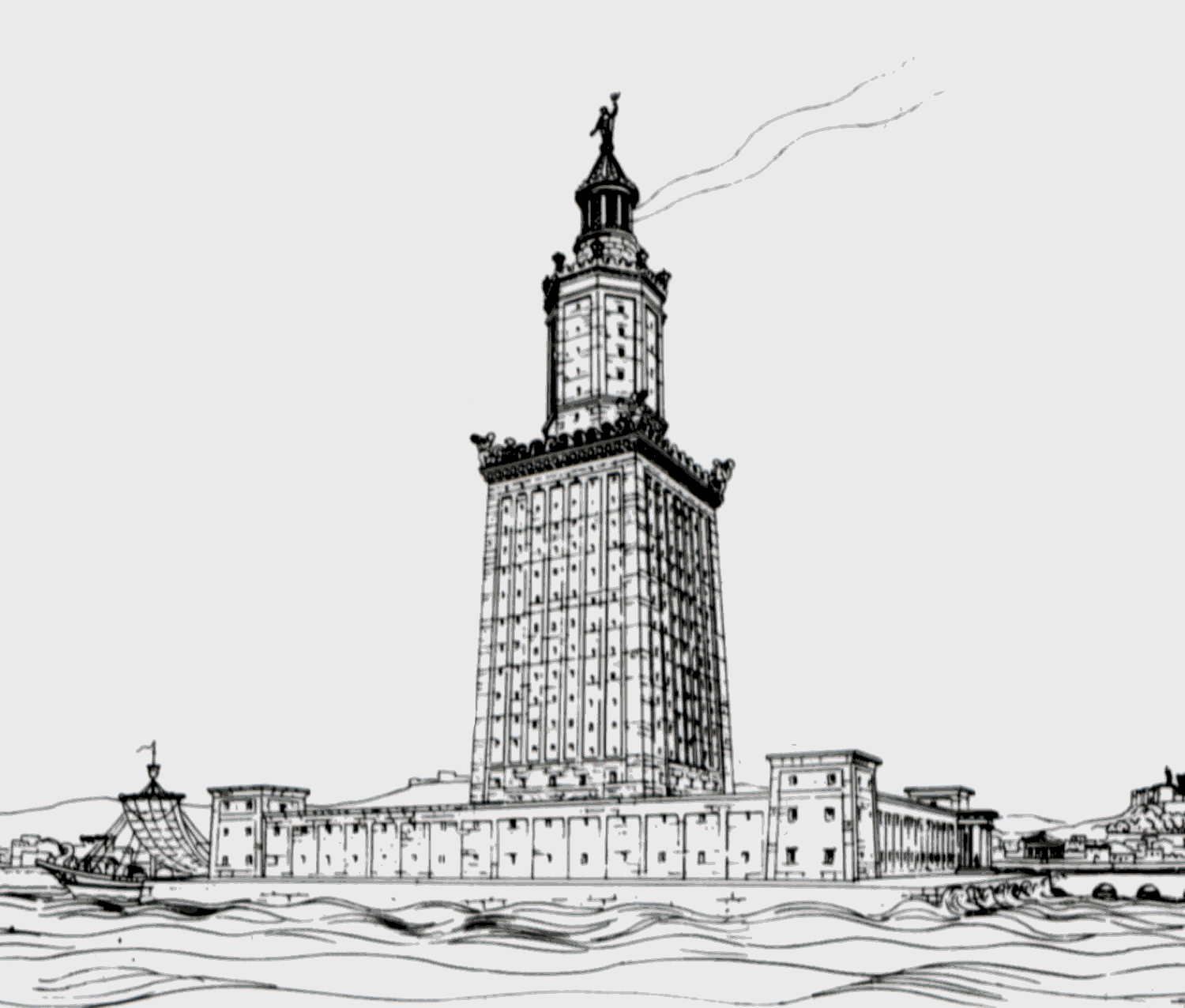
The familiar reconstruction has three stages that narrow upward: a square lower section, an octagonal middle section and a circular upper section. Coins issued during the imperial reigns from Domitian to Commodus show a three-part tower with a statue at its summit. These images supply evidence for the building’s broad arrangement.
CEAlex’s architectural reading of the coins also identifies Triton figures at the four corners of the first terrace. The summit statue and the terrace figures belong to different positions in that interpretation. Keeping them separate helps you read the reconstruction more carefully.
The placement of the light is less secure. A traditional account puts a fire at the top of the tower. CEAlex questions that arrangement because depictions place a large statue at the same point. It treats the fire’s exact location, and its relationship to the mirror account, as disputed.
Ancient depictions therefore support a discussion of the tower’s stages and sculpture without settling every operational detail. A reconstruction can show the square, octagonal and circular sections while still leaving the precise arrangement of the light unresolved.
How did earthquakes and later construction affect the lighthouse?
The lighthouse’s destruction unfolded over time. According to the records compiled by English Wikipedia, an earthquake in 956 caused the upper approximately 20 metres to collapse. This was a major structural loss, but it was not the final disappearance of the building.
CEAlex’s Pharos project links the end of the lighthouse’s operation to damage from the earthquake and associated tsunami of 8 August 1303. Its account states that the building was not repaired after this disaster. The end of its operation and the disappearance of its remaining structure were therefore separate stages.
Ibn Battuta’s visits reveal the continuing deterioration. In 1326, he could enter the damaged lighthouse. By his return in 1349, it was so ruined that its entrance could no longer be reached. His accounts place a worsening ruin between the 1303 disaster and the later reuse of its stone.
Around 1480, stones from portions still partly standing were used to build Qaitbay Citadel on the same site, according to Turkish Wikipedia. Earthquake damage explains the tower’s progressive ruin; later construction explains the reuse of surviving material. Coastal subsidence also helps explain why archaeological remains now lie underwater.
Timeline
- 297 BCE: Construction began under Ptolemy I, according to CEAlex’s dating based on the later Suda dictionary and the chronology of Eusebius.
- 283–281 BCE: The lighthouse was completed under Ptolemy II, according to the same CEAlex dating.
- 956: An earthquake caused collapse in the upper section.
- 8 August 1303: An earthquake and associated tsunami severely damaged the lighthouse and, according to CEAlex, ended its operation.
- 1326 and 1349: Ibn Battuta could enter the damaged building in 1326, then found it too ruined to access in 1349.
- Around 1480: Surviving lighthouse stones were reused in Qaitbay Citadel.
- 1993–1994: Concrete protection blocks threatened the underwater remains; CEAlex’s first excavation campaign followed in 1994.
- 1995–1996: Thirty-six objects were recovered for later display on land.
- 2009 and 2013: Photogrammetric documentation began, then expanded into work on a digital twin of the underwater site.
- 2023: The Pharos project began under Isabelle Hairy.
- 2025: The recovery of 22 large blocks associated with the lighthouse was announced.
Which stones found off Qaitbay Citadel are associated with it?
The Centre d’Études Alexandrines team, founded by Jean-Yves Empereur, carried out its first excavation series around Qaitbay in 1994. The French Ministry of Culture reports approximately 3,500 architectural elements identified during dives. They included capitals, bases, sphinxes, obelisks and colossal statues. Only some were considered likely to belong to the lighthouse.
CEAlex distinguishes several groups within the underwater site. It associates remains in the northwest with the lighthouse, those in the northeast with a Roman-period building, and those in the south with a coastal protection wall. Location within the site is therefore part of the interpretation.
The figures used to describe the site also need their dates and definitions. On 1 January 2020, the CEAlex database contained 3,040 recorded blocks. Its digital surface model covered approximately 65 percent of an archaeological area measuring 15,910 square metres. Those figures describe a dated documentation record, rather than a count of confirmed lighthouse stones.
Work announced in July 2025 brought 22 large blocks associated with the lighthouse up from the seabed for examination and digital scanning. They included stones linked to its monumental entrance. Other pieces belonged to an Egyptian-style pylon gateway that might have formed part of a separate monument. Recovery did not make every attribution certain.
Details you won’t find in guidebooks
Pliny the Elder reported a construction cost of 800 talents. Using its calculation for the Ptolemaic talent, CEAlex translates that amount into approximately 17 tonnes of silver. The conversion gives a material scale to the recorded expense.
The underwater remains faced a modern threat in 1993. Hundreds of concrete blocks were placed in the sea to protect Qaitbay Citadel. They obstructed access to archaeological remains and threatened the site.
The southern coastal protection wall contains another episode of reuse. CEAlex describes it as built from granite columns taken from Alexandria’s ancient buildings and recut. A stone’s presence near the lighthouse therefore does not establish that it originally belonged to the tower.
Some recovered objects can be seen on land. Thirty-six pieces raised in 1995–1996 were placed in display areas in Alexandria, including the Roman Theatre open-air museum and the space in front of the Bibliotheca Alexandrina. These displays offer another way to encounter material recovered from the underwater site.
What uncertainties can underwater excavation and 3D modelling resolve?
A 2025 academic abstract by Hairy, Abdelaziz and Elsayed dates the start of a photogrammetry programme to 2009. Its purpose was to examine pieces and investigate possible joins. The abstract states that this work expanded in 2013 toward a digital twin of the approximately 1.6-hectare underwater site.
Think of trying to fit broken pieces together at home: a possible match needs checking against shape. The lighthouse programme applies that practical question to recorded stone fragments. Its search for possible joins can help test whether separate pieces once formed part of the same architectural element.
The Pharos project, launched in 2023 under Isabelle Hairy, compares archaeological evidence with ancient texts and visual depictions. Its 3D models test reconstruction theories about geometry, materials, interior arrangement, and the shape and number of openings. They give proposed designs specific features that can be checked against the evidence.
The disputed position of the fire shows why these comparisons matter. Coins depicting a summit statue complicate the traditional placement of a fire there. If you examine a reconstruction, the three-part tower and the precise lighting arrangement deserve different levels of confidence.
FAQ
Where was the Lighthouse of Alexandria?
It stood at the eastern end of ancient Pharos Island in Alexandria, Egypt. It marked the entrance to the Great Harbour, at the site now occupied by Qaitbay Citadel.
Was the lighthouse destroyed in a single earthquake?
Its destruction was gradual. An earthquake damaged its upper section in 956, and CEAlex links the end of its operation to earthquake and tsunami damage on 8 August 1303. Surviving stones were later reused in Qaitbay Citadel.
Does every stone underwater belong to the lighthouse?
No. The underwater site contains remains associated with the lighthouse, a Roman-period structure and a coastal protection wall. Only part of the approximately 3,500 architectural elements reported by the French Ministry of Culture was considered likely to belong to the lighthouse.
What can 3D models reveal about the lighthouse?
They help researchers investigate possible joins between blocks and test reconstructions of the lighthouse’s geometry, materials, interior layout and openings. These models are compared with archaeological evidence, ancient texts and visual depictions.
Sources
- CEAlex — Underwater Excavations at the Lighthouse Site pharos.cealex.org
- CEAlex — The Lighthouse of Alexandria pharos.cealex.org
- CEAlex — The Pharos Project pharos.cealex.org
- French Ministry of Culture — Alexandria (Egypt) archeologie.culture.gouv.fr
- English Wikipedia — Lighthouse of Alexandria en.wikipedia.org
- Turkish Wikipedia — İskenderiye Feneri tr.wikipedia.org
- Live Science — Massive blocks from the Lighthouse of Alexandria livescience.com
- Eurographics — 3D Technologies on the Underwater Archaeological Site of the Ancient Lighthouse of Alexandria (Egypt), publication abstract diglib.eg.org
Image: Lighthouse – Thiersch.png — Prof. Hermann Thiersch (1874–1939), Public domain