Denmark–Norway formed in 1380 when Oluf, already king of Denmark, inherited Norway’s throne and united the kingdoms under one ruler. The union ended in 1814 because Denmark’s alliance with Napoleon led to military defeat and the Treaty of Kiel, which forced Frederik VI to surrender Norway to the Swedish king. Norwegian resistance then secured a constitution that survived within a new union with Sweden.
A royal marriage in 1363 began the dynastic connection, but the settlement of 1814 raised a different question: could a king transfer a country without its people’s consent? If you follow the marriage, Copenhagen’s growing authority and Norway’s constitutional resistance, you can see why the union’s beginning and ending rested on different ideas of political power.
How did the dynastic union of 1380 differ from the arrangements of 1536–1537?
In 1363, Norway’s King Håkon VI married Margrete, daughter of Denmark’s King Valdemar IV. Their marriage established the family connection that brought the crowns together. Oluf was elected king of Denmark in 1376. When he inherited Norway’s throne in 1380, the kingdoms acquired the same ruler.
After Oluf died in 1387, Margrete continued governing Denmark and Norway. In 1397, Erik was crowned ruler of three kingdoms at Kalmar. Denmark and Norway thereby joined Sweden in the Kalmar Union. Their shared monarchy now operated within a wider arrangement.
The Bergen Treaty of 1450 envisaged Denmark and Norway as equal kingdoms sharing only their ruler. When Sweden left the Kalmar Union in 1523, Denmark and Norway continued under a common monarch. Sweden’s departure did not dissolve their partnership.
The settlement of 1536 changed Norway’s position. Christian III and the Danish State Council made Norway dependent on the Danish crown. Norway’s separate State Council disappeared. This was a substantial departure from the equality envisaged at Bergen: Copenhagen’s political institutions now exercised stronger control.
Archbishop Olav Engelbrektsson defended both the Catholic Church and Norway’s political autonomy. He lost that struggle and fled in 1537. The changes of 1536–1537 therefore joined a political reorganization to the implementation of the Reformation.
How was Norway governed from Copenhagen?
Between 1536 and 1660, the king and the Danish State Council governed Norway. Central offices supervised provincial administration. Danske Kancelli handled administrative business, while Rentekammeret managed state revenues. These offices connected government in Norway to decisions made in Copenhagen.
Norway’s administrative districts were called len. The most important went to Danish nobles, while smaller districts went to Norwegian nobles. This distribution gave Danish nobles leading provincial positions under the shared monarchy.
Norway nevertheless retained its own law after 1536. It also kept separate ceremonies recognizing the king. At Akershus, the stattholder served as the monarch’s highest representative in Norway. You can therefore distinguish the loss of Norway’s State Council from the survival of other separate arrangements.
How did the Reformation and absolute monarchy affect the two kingdoms?
The Reformation strengthened royal supervision of religious institutions. During the period from 1536 to 1660, the king and the Danish State Council established the Lutheran Church and placed church government under close control. Engelbrektsson’s defeat in 1537 was part of this transformation.
A further change came in 1660. Frederik III compelled the Danish State Council to accept hereditary monarchy. As the council ceased to function, both kingdoms came under an absolute ruler. The council that had helped govern Norway from Denmark no longer exercised its former role.
The Kongeloven, dated 14 November 1665, set out the legal basis of Denmark–Norway’s absolute monarchy. The union had thus passed through several arrangements since 1380: a shared ruler, stronger dependence on the Danish crown, and government under an absolute monarch.
Why did the Napoleonic Wars and the Treaty of Kiel end the union?
Britain attacked Copenhagen on 2 September 1807 because it feared Napoleon might obtain Denmark–Norway’s fleet. Britain subsequently seized the fleet. On 31 October, Crown Prince Frederik allied with Napoleon and joined the Continental Blockade against Britain.
The war brought direct pressure on Norway’s food supply. During 1807–1814, Britain’s naval blockade disrupted the grain imports on which Norway depended. Opposition to the war and dissatisfaction with the king increased. For an everyday connection, think of the grain needed to prepare food: you can trace the consequences of the alliance from naval warfare to the supply of a basic necessity.
Sweden’s ambitions added another threat. In 1812, Swedish Crown Prince Carl Johan and Russia’s Tsar Alexander reached an agreement. It established the basis for Sweden to obtain Norway in return for contributing to the alliance against Napoleon.
Frederik VI tried to change sides in 1813. Those attempts ran into the allies’ demand that he surrender Norway. He remained with Napoleon. After Napoleon’s defeat at Leipzig in October, the Swedish army invaded southern Denmark.
Military pressure forced Frederik VI to accept the Treaty of Kiel on 14 January 1814. Norway was to pass to the Swedish king. Iceland, Greenland and the Faroe Islands, despite their historical connections with Norway, remained attached to Denmark.
Why did Norway resist immediate transfer to Swedish rule in 1814?
Norwegian lawyers challenged the political principle behind the transfer. They argued that when the king released the people from their oath of allegiance, sovereignty returned to the people. The opposing view underlying the Kiel settlement accepted that a monarch could transfer a country to another monarch.
Resistance also drew strength from hostility towards Sweden after earlier wars. Norwegians regarded their army as undefeated within their own country. A treaty surrendering Norway therefore faced opposition from people who did not consider Norway militarily defeated at home.
At Eidsvoll on 16 February 1814, Christian Frederik was advised against claiming kingship by inheritance. Instead, he should await an assembly chosen by the people. That assembly would prepare a constitution and elect a king. The proposal placed constitutional action before a hereditary claim.
The assembly contained competing views about Norway’s future. Around 80 representatives supported independence. Around 30 considered independence unrealistic without the support of the great powers and preferred a loose union with Sweden. On 17 May, signing of the constitution began, and Christian Frederik was unanimously elected king.
The great powers refused to accept Norwegian independence and supported Sweden. This diplomatic isolation helped push Norway towards union. Sweden attacked in late July. The Convention of Moss, signed on 14 August, provided for Norway’s constitution to survive with adaptations for union and for Christian Frederik to leave power.
On 4 November 1814, the Storting adopted the adapted constitution and elected Sweden’s King Karl XIII as king of Norway. You can see why Kiel alone does not explain the final settlement: Norway entered the Swedish union after constitutional resistance and a negotiated agreement preserving its constitution.
Timeline
- 1363: Håkon VI married Margrete.
- 1376: Oluf was elected king of Denmark.
- 1380: Oluf inherited Norway’s throne, beginning the dynastic union.
- 1397: The three kingdoms joined the Kalmar Union.
- 1450: The Bergen Treaty envisaged Denmark and Norway as equal kingdoms sharing only their ruler.
- 1523: Sweden left; Denmark and Norway retained their shared monarchy.
- 1536–1537: Norway’s separate State Council disappeared, and the Reformation was implemented.
- 1660: The transition to absolute monarchy began.
- 1665: The Kongeloven established its legal framework.
- 1807: Britain attacked Copenhagen; Denmark–Norway allied with Napoleon.
- 1813: Napoleon’s Leipzig defeat was followed by Sweden’s invasion of southern Denmark.
- 14 January 1814: The Treaty of Kiel provided for Norway’s surrender to the Swedish king.
- 16 February 1814: The Eidsvoll meeting supported a constitutional and electoral route.
- 17 May 1814: Constitutional signing began; Christian Frederik was elected king.
- 14 August 1814: The Convention of Moss provided for preserving an adapted constitution.
- 4 November 1814: The constitution was adapted, and a shared monarchy with Sweden was established.
Details you won’t find in guidebooks
Engelbrektsson carried his archive with him when he fled to the Netherlands in 1537. He had also chaired Norway’s State Council. His archive became a principal source for Norwegian politics during the Reformation.
Norway’s Overhofret court was established at Akershus in 1666. Its decisions could be appealed to Højesteret in Copenhagen. Norway’s highest court of appeal was therefore located in Denmark.
No Norwegian participated in the Kiel peace negotiations that determined Norway’s future in January 1814. The settlement guaranteed the preservation of Norwegian laws and institutions, but Christian Frederik prevented Sweden’s concessions from being publicized.
The constitutional assembly at Eidsvoll had 112 members, yet northern Norway was unrepresented. Distance and limited time prevented participation. The assembly that prepared the constitution therefore lacked representatives from that part of the country.
FAQ
When was Denmark–Norway formed?
The dynastic union began in 1380, when Oluf inherited the Norwegian throne after being elected king of Denmark in 1376.
Did Norway lose all its separate institutions after 1536?
No. Norway lost its separate State Council but retained its own law and separate ceremonies recognizing the king.
Why did Denmark surrender Norway in 1814?
After Napoleon’s defeat at Leipzig and Sweden’s invasion of southern Denmark, Frederik VI was forced to surrender Norway under the Treaty of Kiel.
Did Norway become independent permanently in May 1814?
No. Norway adopted a constitution and elected Christian Frederik king, but later entered a union with Sweden while retaining an adapted constitution.
Sources
- Lex — Danmark-Norge lex.dk
- University of Oslo, Norgeshistorie — Kongen og det danske riksrådet 1536–1660 norgeshistorie.no
- Norges Bank — 1537–1625 norges-bank.no
- National Archives of Norway — Erkebiskop Olav Engelbrektssons arkiv 1277–1537 nasjonalarkivet.no
- English Wikipedia — Denmark–Norway en.wikipedia.org
- Norwegian Government — NOU 2001:32, Rett på sak regjeringen.no
- University of Oslo, Norgeshistorie — Danmark-Norges utenrikspolitikk 1797–1807 norgeshistorie.no
- University of Oslo, Norgeshistorie — Utenrikspolitikk 1807–1814 norgeshistorie.no
- University of Oslo, Norgeshistorie — Den uakseptable Kieltraktaten norgeshistorie.no
- Turkish Wikipedia — Danimarka-Norveç tr.wikipedia.org
- Norwegian Parliament — Eidsvoll og Grunnloven 1814 stortinget.no
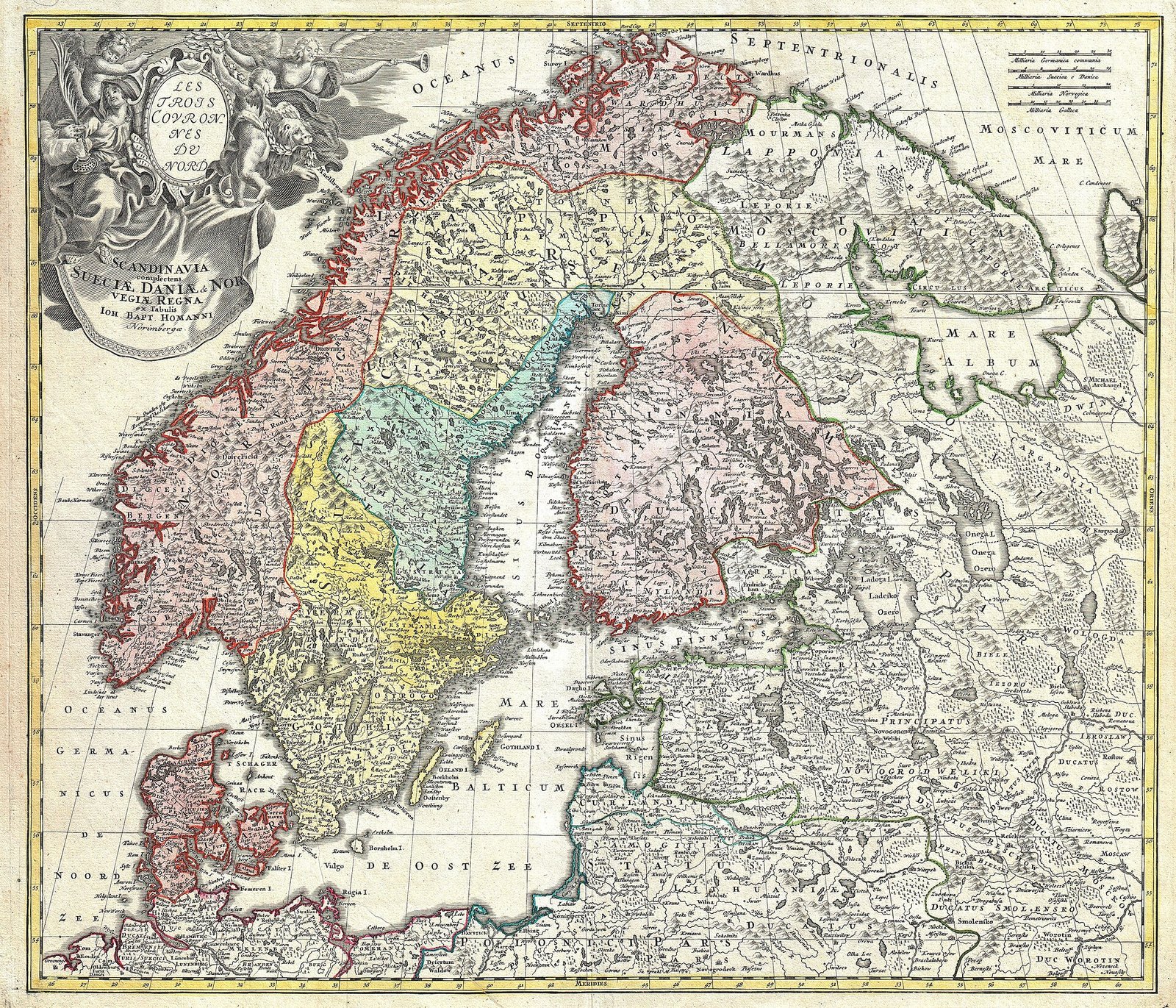
Image: 1730 Homann Map of Scandinavia, Norway, Sweden, Denmark, Finland and the Baltics – Geographicus – Scandinavia-homann-1730.jpg — Johann Homann, Public domain