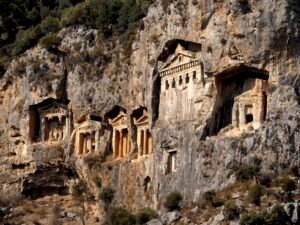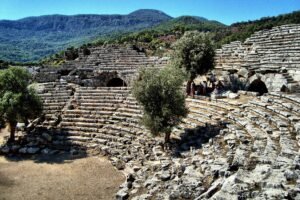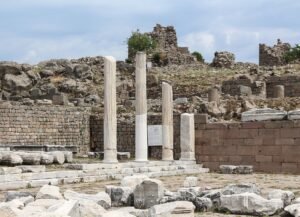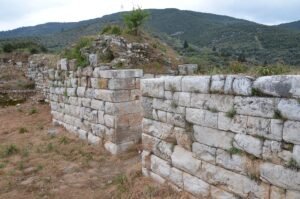
Explore Tlos by starting with the acropolis and the Lycian rock tombs on its slopes, including the monument associated with Bellerophon and Pegasos. Then follow the city’s layout to the stadium at the eastern foot of the acropolis, the theatre farther east, the Great Bath and the Kronos Temple.
Why do some tombs resemble houses, while another looks like a temple? At Tlos, those differences sit beside a hilltop residence, public seating and a bath later adapted for Christian use. You can use these buildings to follow the city’s changing purposes, while keeping the Bellerophon legend separate from its archaeological history.
Where is Tlos in Turkey, and how do you reach it?
Tlos Antik Kenti is in Yakaköy, within Muğla’s Seydikemer district. It stands approximately 15 kilometres southeast of the district centre. The settlement extends from the western slopes of the Akdağlar towards the valley plain formed by the Eşen River.
From Fethiye, the approach follows the direction of Saklıkent. At Güneşli village, an asphalt road branches east towards Tlos. Saklıkent Canyon also has a place in the city’s historical geography: the excavation team identifies it with the southern boundary of Tlos’s ancient territory.
The hillside and valley setting help you understand the ruins together. The acropolis forms the city’s western boundary. The stadium lies immediately below its eastern side, while the theatre occupies the eastern slope. These positions provide a useful framework for exploring the ancient city.
What does Tlos mean?
The name Tlos derives from the Lycian name Tlawa. The excavation team identifies the settlement with Dalawa, a name appearing in Hittite texts from the fifteenth century BC. This identification connects the city’s name with a written tradition much earlier than its Roman buildings.
A foundation legend offers another explanation. It links Tlos with Tloos, the son of Tremiles and Praxidike. The excavation team’s account distinguishes that legendary genealogy from the name’s linguistic origin in Lycian Tlawa. A story about a founder and an explanation of a place-name answer different questions.
How should you explore the acropolis?
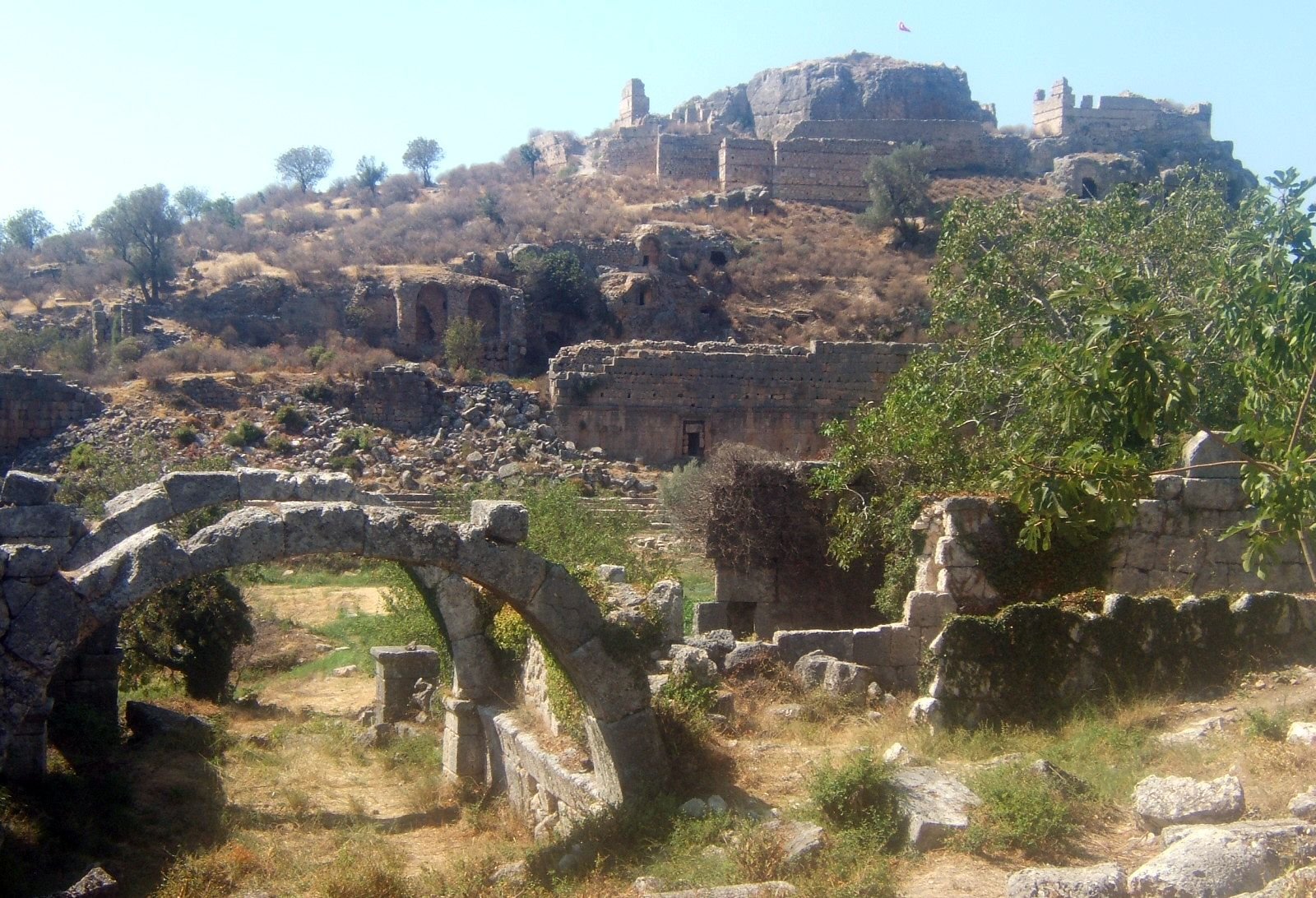
Begin by reading the summit as a place occupied in different periods. Remains of a local ruler’s settlement survive there from the Classical period. In the nineteenth century, the Ottoman local lord Ali Ağa built a residence on the same summit, incorporating ancient remains into its construction.
The summit therefore brings Classical and Ottoman traces into the same setting. Ali Ağa’s residence belongs to a much later chapter than the local ruler’s settlement. Keeping those phases separate helps you avoid treating every structure on the acropolis as part of one ancient building campaign.
Next, turn your attention to the slopes. The necropolis around the acropolis was used from the Classical period onwards. Its rock-cut monuments place the burial landscape directly beside the elevated area associated with local authority.
What should you look for in the Tlos rock tombs?
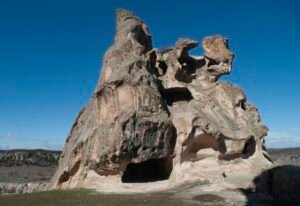
Look first at the façades. Several rock tombs imitate Lycian wooden house architecture. This creates an everyday connection: forms associated with a home were reproduced in stone for the dead. You are looking at an architectural relationship between domestic buildings and burial monuments.
The monument known as the Bellerophon Rock Tomb uses a different model. It stands on Titan Rock, north of the acropolis. Its façade imitates an Ionic temple with four columns. Compare that temple form with the house-like façades elsewhere in the necropolis.
Its plan also deserves attention. The tomb contains an antechamber and two burial chambers placed side by side. Inside are burial couches, or klinai, on which the dead were laid. The temple-like exterior thus belongs to a structure organised for burial, with distinct spaces behind its façade.
What is the Bellerophon legend at Tlos?
The tomb’s familiar name comes from its association with a relief of Bellerophon and the winged horse Pegasos. The image connects the monument with the story of the hero’s struggle against the Khimaira. It gives you a mythological subject to recognise within the city’s funerary architecture.
In the Greek legend, the Lycian king Iobates sends Bellerophon to destroy the Khimaira because he wants the hero killed. Bellerophon succeeds with the help of Pegasos. The dangerous task and the winged horse belong to the legendary narrative attached to the relief.
Early written witnesses to the Bellerophon and Khimaira story include Book VI of Homer’s Iliad and lines 319–325 of Hesiod’s Theogony. These texts place the narrative within an early literary tradition. The tomb’s image should not be treated as proof that Bellerophon existed historically or was buried at Tlos.
What else can you see among the Tlos ruins?
At the eastern foot of the acropolis, the stadium has a single bank of seating cut from the bedrock. It consists of nine rows. This is a useful place to shift your attention from burial monuments to the spaces provided for public gatherings.
The theatre lies on the city’s eastern slope. Its earliest construction phase belongs to the Hellenistic period, and its capacity was approximately 6,000 people. Consider its position alongside the stadium: both buildings help you locate public architecture beyond the acropolis and its tombs.
The Great Bath stands southeast of the city centre. Doorways connect its cold, warm and hot sections. Follow that sequence when thinking about the building’s plan. The linked rooms show how the complex was arranged around spaces with different temperatures.
The Kronos Temple offers another architectural comparison with the rock tombs. It was built in the Corinthian order on a platform measuring 15.67 by 7.78 metres. A staircase of seven steps was placed on its northern façade. Compare its recorded order with the Ionic temple form imitated by the Bellerophon tomb.
What does Tlos history reveal?
Tlos’s settlement history extends beyond the Hittite textual connection. Neolithic settlements are documented in its surroundings, while Chalcolithic and Bronze Age finds come from the city centre. These are different kinds of evidence: nearby settlements, finds within the city and a proposed identification in written records.
Tlos later held substantial standing within the Lycian League. It was one of six major cities entitled to three votes. In 333 BC, it came under Macedonian rule when Alexander the Great gained control of Lycia. In AD 43, Claudius made Lycia a Roman province, bringing Tlos into that provincial framework.
The city’s importance continued into its Christian history. Archaeological evidence identifies Tlos as a Lycian episcopal centre that retained significance until the twelfth century AD. Lycian, Roman, Byzantine and Ottoman traces all survive within its broader historical record.
Timeline
- Neolithic period: Settlements are documented in the surrounding area.
- Chalcolithic period and Bronze Age: Finds attest to early settlement in the city centre.
- Fifteenth century BC: Dalawa, identified with Tlos by the excavation team, appears in Hittite texts.
- Classical period: A local ruler’s settlement occupies the acropolis, and the slope necropolis is in use.
- 333 BC: Tlos comes under Alexander the Great’s rule with Lycia.
- Hellenistic period: The theatre’s first construction phase dates to this period.
- AD 43: Claudius converts Lycia into a Roman province.
- After AD 141: Opramoas donates 60,000 silver denarii to the theatre following an earthquake.
- Eleventh century AD: Parts of the Great Bath become a church and cemetery.
- Nineteenth century: Ali Ağa builds his summit residence using ancient remains.
- 2005: The first scientific excavations begin at Tlos.
- 6 February 2009: The proposal including Tlos is submitted to the UNESCO World Heritage Tentative List.
Details you won’t find in guidebooks
The Road Guide Monument at Patara records connections to Tlos from seven directions within the Lycian road network. That evidence adds a wider geographical context to the city’s three-vote status in the Lycian League. Tlos belonged to a network of routes as well as a political organisation.
The stadium plain contains a pool measuring 72 by 8.30 metres, approximately one metre deep. Keep this feature in mind alongside the nine seating rows. The recorded layout includes both the rock-cut spectator area and a substantial water feature in the middle of the plain.
The theatre has a temple at the midpoint of its upper seating section. An inscription also records that Opramoas of Rhodiapolis donated 60,000 silver denarii to the theatre after the AD 141 earthquake. These details connect the building with religious architecture and documented financial support.
The Great Bath changed function in the eleventh century AD. A church was created in its warm section, while the cold section became a cemetery. Remembering the original temperature sequence makes this later arrangement easier to understand: separate parts of one bathing complex acquired separate Christian uses.
FAQ
Where is Tlos in Turkey?
Tlos is in Yakaköy, in the Seydikemer district of Muğla. It lies approximately 15 kilometres southeast of the district centre.
What does Tlos mean?
The name derives from Lycian Tlawa. A foundation legend connects it with Tloos, the son of Tremiles and Praxidike, but the excavation team explains its origin through the Lycian name.
Is Bellerophon buried at Tlos?
The tomb is associated with Bellerophon through its relief. That mythological image does not establish that the hero existed historically or was buried there.
Is Tlos a UNESCO World Heritage Site?
Tlos is included in the Ancient Cities of Lycian Civilization proposal submitted to the UNESCO World Heritage Tentative List on 6 February 2009. Tentative listing is distinct from World Heritage inscription.
Sources
- Akdeniz University, Tlos Excavations — About the City tlos.akdeniz.edu.tr
- Türkiye Culture Portal — Tlos Ancient City kulturportali.gov.tr
- Turkish Museums — Muğla Tlos Archaeological Site turkishmuseums.kprod.kultur.gov.tr
- UNESCO — Ancient Cities of Lycian Civilization whc.unesco.org
- Akdeniz University, Tlos Excavations — Acropolis tlos.akdeniz.edu.tr
- Akdeniz University, Tlos Excavations — Necropolis tlos.akdeniz.edu.tr
- Akdeniz University, Tlos Excavations — Stadium Area tlos.akdeniz.edu.tr
- Höyük — The Theatre and Council Building Complex at Tlos in Light of Current Evidence hoyuk.gov.tr
- Akdeniz University, Tlos Excavations — Theatre tlos.akdeniz.edu.tr
- Akdeniz University, Tlos Excavations — Great Bath tlos.akdeniz.edu.tr
- Akdeniz University, Tlos Excavations — Kronos Temple tlos.akdeniz.edu.tr
- Wikipedia — Tlos tr.wikipedia.org
Image: Tlos ruins Turkey.jpg — Toksave, CC BY-SA 3.0