Nevşehir at a glance
Nevşehir is a city in central Turkey. It is also the name of the province that holds much of Cappadocia. The city centre is young by Anatolian standards. Its name and its main mosque come from one burst of building in the early 18th century.
The province is far older. Prehistoric tools, Bronze Age mounds, Seljuk-era politics and rock-cut homes all sit within it. If you want the short version, start with the name. Then work backwards.
What does the name Nevşehir mean?
The name means “newly founded city.” It was used for Muşkara, a settlement that grew through building and resettlement work in the early 18th century. In other words, the name records an event. A village became a town, and people called it new.
The name was also used in paperwork. In Ottoman bureaucratic letters, the city is sometimes written as Nevşehr-i Dilârâ. You will meet this form only in archival material, not on road signs.
Before Nevşehir: the village of Muşkara
Muşkara appears in an Ottoman register of 1518. It was a village of the Uçhisar sub-district (nahiye). That sub-district belonged to the Ürgüp district (kaza), which in turn belonged to the sanjak of Niğde. The village sat low in the administrative chain.
The same register gives its tax population. There were 86 households and 19 unmarried men. All of them were non-Muslim. That is the full picture of Muşkara in 1518: a small taxpaying community, listed beside neighbouring villages.
Nothing in this record suggests a future provincial centre. The change came two centuries later.
Who made Muşkara a city?
The person behind the change was Damat İbrahim Paşa. His epithet “Nevşehirli” means “of Nevşehir,” and it ties his name to the town for good. His building and resettlement work in the early 18th century turned Muşkara into Nevşehir.
The work was not only about stone. A study published in the journal Belleten describes the decisions he had issued. One set up a market on Mondays and Thursdays. Another made the judge of Ürgüp live permanently in Nevşehir.
These two decisions explain a lot. A market brings traders and buyers. A resident judge brings lawsuits, deeds and officials. Together they pull a village into the role of a town.
You can see the same logic today. If you buy vegetables at a weekly neighbourhood market, you are using the oldest tool of town-making. People come on a fixed day, and a place grows around that habit.
The Kurşunlu Mosque and the complex around it
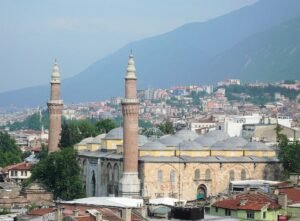
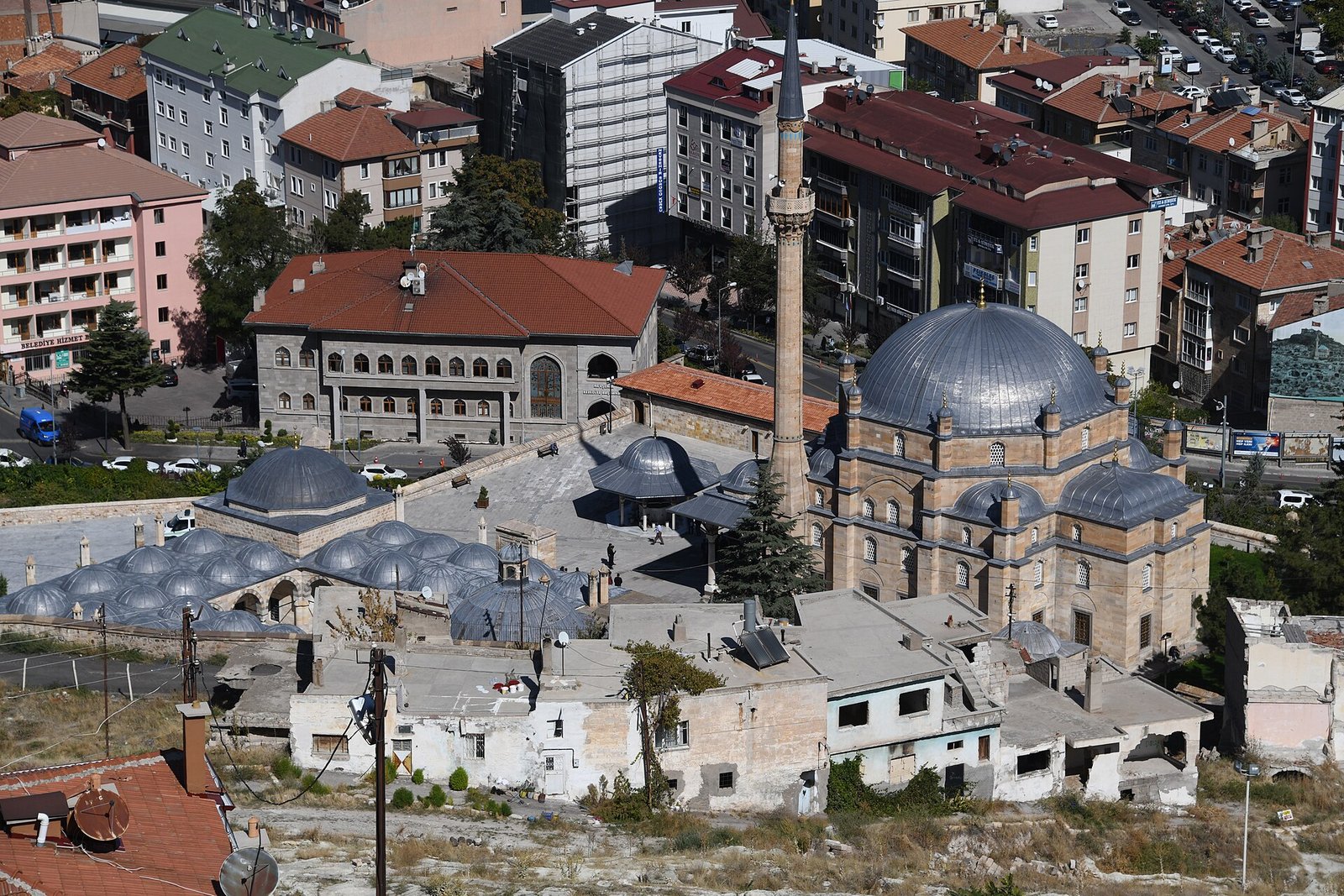
The Kurşunlu Mosque in the city centre was built by Damat İbrahim Paşa in 1726–1727. It is the anchor of his complex. According to the Nevşehir Provincial Mufti’s Office, the Damat İbrahim Paşa Complex consists of:
- a mosque
- a madrasa
- a caravanserai
- a primary school
- a soup kitchen
- a bath
- two fountains
The list reads like a small town on its own. People could pray, study, eat, wash and lodge travellers in one place. Few villages received such a package at once.
Damat İbrahim Paşa also had a library founded in Nevşehir. Its inscription is dated 1727. The verse text on it was written by the poet Nedim. A library with an inscription by a well-known poet shows the ambition behind the project.
Who carried the stones?
Building at this scale needs muscle. The Belleten study records that the job of hauling building stone went to nomadic communities. Named groups include the Boynuinceli, Mamalı, Pehlivanlı and Kocabeyoğlu Turkmens.
This detail rarely appears in tourist summaries. It shows that the new city was not built only by officials and masons. Pastoral groups moving through the region were drawn into the work.
Is Nevşehir the ancient Nyssa?
Some writers say Nevşehir continues the ancient city of Nyssa. The Islamic Encyclopedia of the Turkish Religious Foundation notes that this is not settled. Another place, Nar, has been put forward as the site of Nyssa instead.
So be careful with signs or brochures that state the link as fact. The safe statement is that the identification is debated. The documented history of the town as Nevşehir begins with the Ottoman records above.
Older layers across the province
The province has a deep past that does not depend on the city’s name. Three finds show how far back it goes.
Civelek Cave, Gülşehir. Archaeologists found vessels, spindle whorls, and stone and bone tools here. They date to the Chalcolithic period, roughly 5000–3000 BC.
Zank Höyük, near Sarılar in Avanos. Excavations at this mound uncovered remains from the Early Bronze Age and from the Assyrian Trading Colonies Period.
The Seljuk and Mongol era. After the Battle of Malazgirt, the area passed to Seljuk rule. After the Battle of Kösedağ in 1243, it came under Mongol-Ilkhanid influence.
Together these show people living here long before Damat İbrahim Paşa. His achievement was to give the region a new urban centre, not to found human settlement from nothing.
Bridges, churches and houses
Buildings elsewhere in the province add dated anchors.
The Yavuz Sultan Selim Bridge at Özkonak carries an Ottoman Turkish inscription on its north face. It gives the date 1514. Locals call the bridge Demirli Köprü.
In Mustafapaşa, in the Ürgüp district, the Church of Constantine and Helena is recorded as a building of 1729. That is only a few years after the Kurşunlu Mosque. A Greek inscription at the entrance of the Mustafa Savaş House in the same village gives the date 1910. The ground floor of that house has facing eagle figures.
In Gülşehir, a second mosque is also called Kurşunlu, or Karavezir. Silahtar Seyyid Mehmet Paşa had it built in 1779, using yellow and white cut stone. Do not mix it up with the one in the city centre. Two mosques with one name, 53 years apart, make an easy trap.
The Avanos stone bridge: two dates
The Stone Bridge over the Kızılırmak at Avanos shows how sources can disagree. The Avanos District Governorate says construction began in 1898 with the support of Kurena Arif Bey and finished in 1900. The General Directorate of Highways gives a different range in its 2025 financial report: 1902–1906.
The governorate adds one more fact. The bridge’s deck was originally wooden. Between 1924 and 1926, a concrete deck replaced it under the Hungarian master Wolf.
Both dates are on record, and they do not match. Treat the construction years as unsettled.
Becoming a province in 1954
Law no. 6429 made Nevşehir a province. Article 4 of the law sets the date of effect as 20 July 1954. From that day Nevşehir stood as a province in its own right.
A world heritage landscape
In 1985, Göreme National Park and the Rock Sites of Cappadocia were placed on the UNESCO World Heritage List. UNESCO recognised the cultural and natural values together. It describes the rock-cut dwellings, villages and underground settlements of the area as remains of a traditional way of life reaching back to the 4th century.
Kayaşehir: a district found in the city centre
The most surprising discovery is in the city itself. In 2014, urban renovation work around Nevşehir Castle uncovered Kayaşehir, a rock-cut hillside settlement.
It contains a rock-cut church with frescoes, passage tunnels and nearly a thousand rooms. After cleaning and restoration, part of it opened to visitors on 20 July 2020. That is the same calendar day as the 1954 provincial law.
If you visit, you can stand in the modern city and look into the rock below it. For a place named “new city,” that is an odd twist.
Timeline
- 5000–3000 BC: Chalcolithic finds at Civelek Cave in Gülşehir.
- 1243: After the Battle of Kösedağ, the region falls under Mongol-Ilkhanid influence.
- 1514: Date on the inscription of the Yavuz Sultan Selim Bridge at Özkonak.
- 1518: Muşkara is recorded as a village in the Uçhisar sub-district of the Ürgüp district, in the sanjak of Niğde.
- Early 18th century: Damat İbrahim Paşa’s building and resettlement work turns Muşkara into Nevşehir.
- 1726–1727: The Kurşunlu Mosque is built in the city centre.
- 1729: Date of the Church of Constantine and Helena in Mustafapaşa.
- 1779: The Karavezir (Kurşunlu) Mosque is built in Gülşehir.
- 1910: Date on the Greek inscription of the Mustafa Savaş House.
- 20 July 1954: The law making Nevşehir a province takes effect.
- 1985: Göreme and the rock sites of Cappadocia join the UNESCO list.
- 2014: Kayaşehir is uncovered during urban renewal.
- 20 July 2020: Part of Kayaşehir opens to visitors.
Details you won’t find in guidebooks
- The 1518 count. Muşkara’s tax roll lists 86 households and 19 unmarried men, all non-Muslim.
- An official alias. Ottoman letters sometimes call the city Nevşehr-i Dilârâ.
- A poet on the library. The 1727 inscription of Damat İbrahim Paşa’s library carries verse by Nedim.
- The stone haulers. Nomadic groups, among them the Boynuinceli and Kocabeyoğlu Turkmens, were assigned to carry building stone.
- A shared date. The 1954 provincial law and the 2020 opening of Kayaşehir both fall on 20 July.
- Eagles in Mustafapaşa. The Mustafa Savaş House has facing eagle figures on its lower floor.
FAQ
What does the name Nevşehir mean?
It means “newly founded city.” The name was used for Muşkara, a village that grew through building and resettlement work in the early 18th century.
What was Nevşehir called before?
The settlement was called Muşkara. An Ottoman register of 1518 lists it as a village of the Uçhisar district, in the Ürgüp sub-province of the Niğde province.
Who built the modern town of Nevşehir?
Damat İbrahim Paşa, known as Nevşehirli, drove the work. He had the Kurşunlu Mosque built in 1726–1727 and the complex around it, and he secured a twice-weekly market and a permanent judge for the town.
When did Nevşehir become a province?
Law no. 6429, which created the province, set its date of effect as 20 July 1954.
Is Nevşehir the ancient city of Nyssa?
That identification is proposed, but it is not settled. Another location, Nar, has also been suggested, and the Islamic Encyclopedia of the Turkish Religious Foundation says the question remains open.
Sources
- TDV İslâm Ansiklopedisi — Nevşehir islamansiklopedisi.org.tr
- Türkiye Kültür Portalı — Nevşehir kulturportali.gov.tr
- Nevşehir İl Müftülüğü — Kurşunlu Camii’nin yeniden açılışı nevsehir.diyanet.gov.tr
- Türkiye Kültür Portalı — Gülşehir Kurşunlu Camii kulturportali.gov.tr
- Nevşehir İl Kültür ve Turizm Müdürlüğü — İl Halk Kütüphanesi Müdürlüğü nevsehir.ktb.gov.tr
- Belleten — Nüfus Defterleri’ne Göre Boynuincelü Aşireti (1830–1845) belleten.gov.tr
- Türkiye Kültür Portalı — Yavuz Sultan Selim Köprüsü kulturportali.gov.tr
- Avanos Kaymakamlığı — Avanos’un Tarihi Köprüleri avanos.gov.tr
- Bursa Uludağ Üniversitesi Açık Erişim — Mustafapaşa konut mimarisi çalışması acikerisim.uludag.edu.tr
- Nevşehir Üniversitesi — Savaş Yıldırım, Ürgüp Mustafapaşa’da Duvar Resimli İki Ev dosyalar.nevsehir.edu.tr
- UNESCO World Heritage Centre — Göreme National Park and the Rock Sites of Cappadocia whc.unesco.org
- Anadolu Ajansı — Tarihi Kayaşehir turistlere gece gündüz ev sahipliği yapıyor aa.com.tr
- TBMM — 6429 sayılı Kanun www5.tbmm.gov.tr
Image: Nevşehir Damat Ibrahim Pasha complex in 2023 5091.jpg — Dosseman, CC BY-SA 4.0