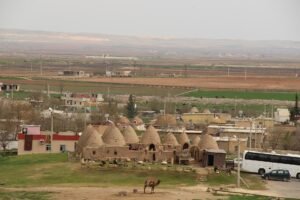
Ayvalık’s Greek stone houses stand within a landscape of churches, olive-oil factories, soap works and warehouses. Its islands helped shelter a natural harbour. Olive production helped turn that harbour into an important trading port after the 1880s. The population exchange later changed the communities living among these buildings.
When you explore Ayvalık, three histories meet: the island harbour, the architecture built by its Greek population, and the settlement of Muslim exchange migrants. Two separate churches named Taksiyarhis make that history especially tangible. One stands in the town centre. The other stands on Cunda.
Where is Ayvalık? Ayvalık nerede
Ayvalık is a district of Balıkesir on Turkey’s northwestern Aegean coast. It lies between the gulfs of Edremit and Dikili, opposite the Greek island of Lesbos, known in Turkish as Midilli. That position places the town and the island across the water from one another.
Turkey’s UNESCO submission describes an archipelago of 22 islands, with Cunda as the largest. The inland sea between Ayvalık and Cunda forms a natural harbour. The islands and the shape of the coastline provide its protection. Here, the islands belong to the history of production and trade as well as the coastal landscape.
Cunda is also known as Alibey Island and by the Greek name Moschonisia. Ancient sources referred to Ayvalık and its surrounding islands as Hekatonnessos. These names belong to different historical descriptions of the area. The identification of Ayvalık with ancient Kisthene remains disputed, so it should not be treated as a settled origin story.
Greek architecture: houses, stone and an industrial waterfront
The old stone homes built by the Greek population in Ayvalık and Cunda are collectively called Greek houses today. They form one part of a wider architectural inheritance. Along the historic production waterfront, olive-oil factories, soap works, workshops and warehouses preserve the connection between buildings and the town’s working economy.
Local Sarımsak Stone appears in architectural elements on historic façades. When you look at these buildings, the material offers a concrete connection between domestic architecture and the locality. The houses also belong beside the industrial buildings in an account of Ayvalık: homes, production premises and storage spaces all formed parts of the historic town.
Ayvalık became an important commercial port after the 1880s as production of olives and their by-products developed. Olive oil and soap provide an everyday-life link to this history. Products you might think of as ordinary purchases were central to the town’s production landscape. Its factories and soap works give that connection a physical form.
What to see in historic Ayvalık: Ayvalık gezilecek yerler
The Taksiyarhis Church in central Ayvalık has an entrance inscription dated 1844. It dates the present basilica building, which belongs to the church’s third construction phase. The date therefore refers to a particular surviving structure within a longer building history.
Following the Ministry’s restoration in 2012, this church opened as the Taksiyarhis Memorial Museum in 2013. Its history also includes a long period of use as a Tekel warehouse, beginning in 1927. Religious use, storage and museum use belong to the same building’s documented past.
Cunda has a separate Taksiyarhis Church. Rebuilt on older foundations in 1873, it is a rectangular neoclassical building with a single dome. After restoration, it opened as the Ayvalık Rahmi M. Koç Museum on 31 May 2014. If you are comparing the churches, keep their locations and dates distinct: central Ayvalık, 1844; Cunda, 1873.
Saatli Mosque provides another example of a building changing function. The Greek community originally built it as a church. Its former bell tower was later converted into a clock tower. In Küçükköy, Hagios Athanasios Church became Küçükköy Central Mosque through the transformations of 1928. These buildings connect architectural survival with changes in use.
The population exchange: departures and new arrivals
The Greek occupation of Ayvalık began on 29 May 1919 and ended on 15 September 1922. The agreement governing the Greek–Turkish population exchange followed during the Lausanne negotiations. Signed on 30 January 1923, it contained 19 articles and provided for a compulsory exchange beginning on 1 May 1923.
The agreement covered Greek Orthodox Turkish nationals in Turkey and Muslim Greek nationals in Greece. Its categories therefore combined religious affiliation with citizenship. Calling it simply an exchange of Greeks and Turks can obscure the terms under which the compulsory movement was organised.
Most of Ayvalık’s Greek population had already departed for Lesbos and Greece before the exchange’s formal starting date. This distinction matters to the town’s chronology. The agreement did not mark the beginning of every departure. For Ayvalık, the movement of people and the formal exchange timetable must be read separately.
Muslims arriving from Crete, Macedonia and Lesbos were settled in Ayvalık under the 1923 exchange. A September 1924 assessment recorded 21,807 migrants in 4,922 households. Those figures give the settlement process a concrete scale. They also place households, alongside churches and factories, at the centre of the town’s history.
Küçükköy adds another layer to this account. Architect Berrin Akın Akbüber’s 2018 research summary describes Bosnian migrants living alongside Greeks there from 1912. After the exchange, Bosnians lived alongside exchange migrants from Serres and the islands. The settlement history of the surrounding area therefore includes movements that preceded the 1923 agreement.
Timeline
- 1803: Ayvalık Academy was founded.
- 1821: Much of Ayvalık was destroyed during the suppression of the uprising, and the Greek population was removed.
- May 1823: Francesco Casciai’s cadastral plan documented the coastal street layout.
- 1844: An entrance inscription dates the present third-phase basilica building of central Ayvalık’s Taksiyarhis Church.
- 9 December 1852: The Yunda islands were transferred from the Sanjak of Lesbos to the Ayvalık district administration.
- 1873: Cunda’s Taksiyarhis Church was rebuilt.
- After the 1880s: Olive-based production accelerated Ayvalık’s development as a commercial port.
- 29 May 1919: Greek occupation began in Ayvalık.
- 15 September 1922: Greek occupation ended.
- 30 January 1923: The population exchange agreement was signed.
- September 1924: An assessment recorded 21,807 migrants in 4,922 households in Ayvalık.
- 1927: Central Ayvalık’s Taksiyarhis Church began serving as a Tekel warehouse.
- 2013: The Taksiyarhis Memorial Museum opened in central Ayvalık.
- 31 May 2014: Cunda’s Taksiyarhis Church opened as the Rahmi M. Koç Museum.
- 15 April 2017: Ayvalık Industrial Landscape entered UNESCO’s World Heritage Tentative List.
Details you won’t find in guidebooks
A cadastral plan dated May 1823 documents a grid of streets along Ayvalık’s coast. Its author was the Florentine engineer Francesco Casciai. The plan supplies a dated record of the waterfront’s street arrangement.
The Yunda islands belonged administratively to the Sanjak of Lesbos until 9 December 1852. On that date, they were attached to the Ayvalık district administration. The transfer is a precise reminder that the historical relationship between these islands and Lesbos involved administrative boundaries as well as their position across the sea.
Inside central Ayvalık’s Taksiyarhis Church, the upper gallery built for women is wooden and U-shaped. It has 16 windows. This interior detail belongs to the mainland church. It helps distinguish that building from Cunda’s single-domed, rectangular Taksiyarhis Church.
Why the UNESCO entry concerns an industrial landscape
Ayvalık Industrial Landscape entered UNESCO’s World Heritage Tentative List on 15 April 2017. The sheltered harbour, olive-oil factories, soap works, workshops and warehouses explain why industry is central to its description.
For your visit, that framework connects the Greek houses with the working waterfront. The churches document religious architecture and later reuse. The factories document olive-based production. The exchange history explains the departure and arrival of populations. Together, these documented histories give substance to the streets and buildings of Ayvalık and Cunda.
FAQ
Where is Ayvalık?
Ayvalık is a district of Balıkesir on Turkey’s northwestern Aegean coast. It lies between the gulfs of Edremit and Dikili, opposite the Greek island of Lesbos.
Are the two Taksiyarhis churches the same building?
No. The church in central Ayvalık became the Taksiyarhis Memorial Museum in 2013. The separate church on Cunda opened as the Ayvalık Rahmi M. Koç Museum on 31 May 2014.
How did the population exchange change Ayvalık?
Most of Ayvalık’s Greek population had left before the exchange officially began. Muslim migrants from Crete, Macedonia and Lesbos were settled in Ayvalık under the 1923 exchange.
Is Ayvalık a UNESCO World Heritage Site?
Ayvalık Industrial Landscape entered the UNESCO World Heritage Tentative List on 15 April 2017.
Sources
- Turkish Wikipedia — Ayvalık tr.wikipedia.org
- English Wikipedia — Ayvalık en.wikipedia.org
- UNESCO World Heritage Centre — Ayvalık Industrial Landscape whc.unesco.org
- Ayvalık Site Management — Ayvalık Chronology ayvalikmiras.com
- Ministry of Culture and Tourism — Taksiyarhis Memorial Museum muze.gov.tr
- Vehbi Koç Foundation Encyclopedia — Ayvalık Rahmi M. Koç Museum encyclopedia.vkv.org.tr
- Balıkesir Provincial Directorate of Culture and Tourism — Historic Buildings balikesir.ktb.gov.tr
- Ayvalık Site Management — Republican Period ayvalikmiras.com
- Ayvalık Municipality — History ayvalik.bel.tr
- UNESAK 2018 — Berrin Akın Akbüber, Research Summary on Küçükköy’s Migration History kongre.akademikiletisim.com
Image: Ayvalık, Turkey.jpg — Esther Lee, CC BY 2.0