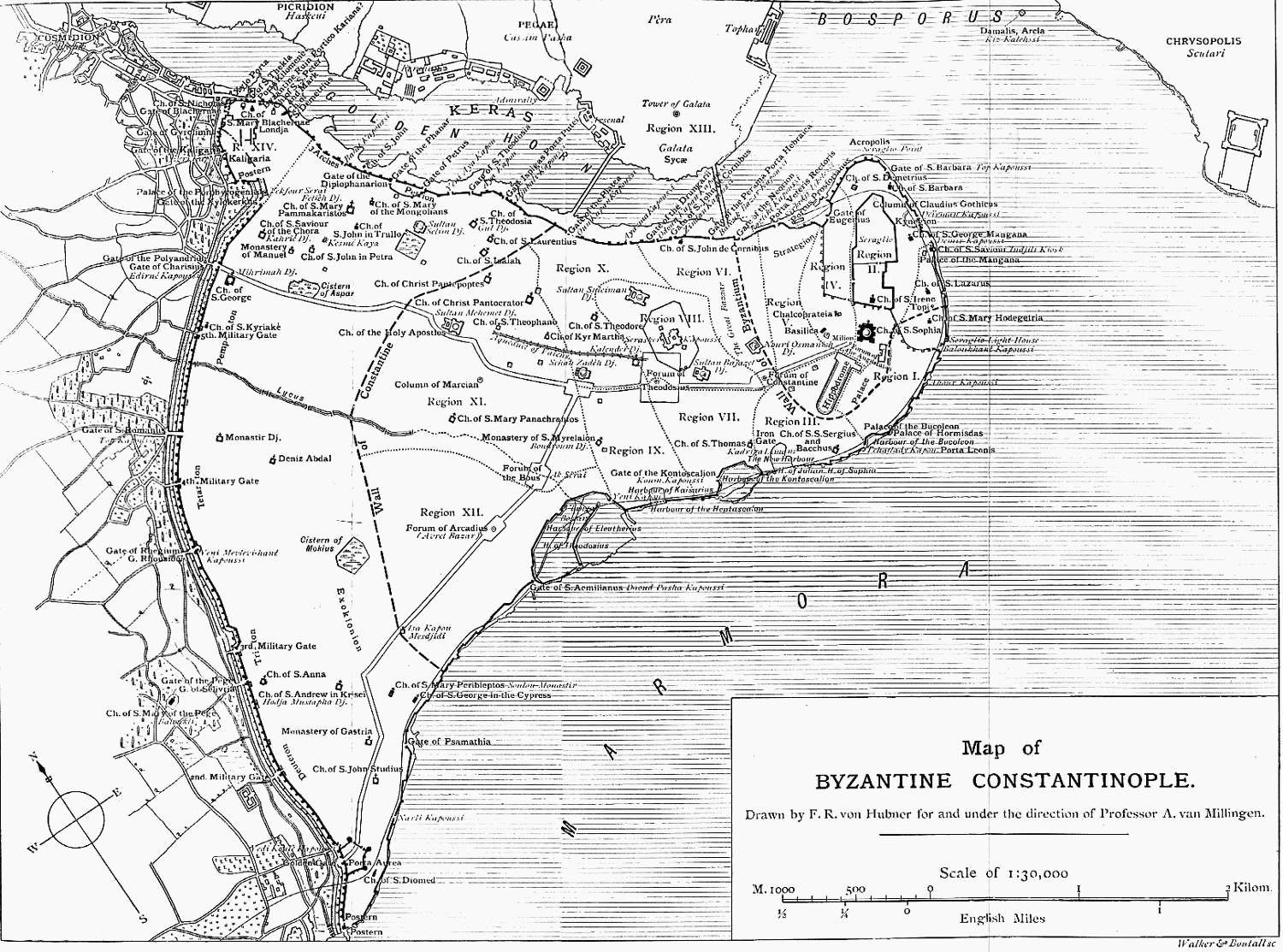
İstanbul History in Summary
İstanbul sits where the Bosphorus joins the Black Sea to the Sea of Marmara. That strait also separates Europe from Asia. Few cities hold such a position, and it shaped almost everything that happened here.
Here is the short version. People lived on the Historic Peninsula by about 6500 BCE. Greek settlers founded Byzantion in the 7th century BCE. Emperor Constantine made the city a Roman capital in 330. Crusaders held it from 1204 to 1261. Sultan Mehmed II conquered it on 29 May 1453. Ankara replaced it as capital in 1923.
The rest of this article fills in each step. You can also jump straight to the timeline.
Where the City Sits
The Historic Peninsula is the old core of the city. Three waters surround it. The Golden Horn lies to the north, the Bosphorus to the east and the Sea of Marmara to the south, according to UNESCO.
When you look at a map, notice how much of the old city is edged by water. That is why the peninsula was so easy to defend and so valuable to hold.
Before Byzantion: Settlement Around 6500 BCE
Most people start the story with the Greeks. The ground says otherwise. Excavations at Yenikapı uncovered the remains of a prehistoric settlement. They show that people lived on the Historic Peninsula as early as about 6500 BCE.
This matters for a simple reason. The city’s story does not begin with an empire or a founding legend. It begins with ordinary people choosing a good spot by the water.
Byzantion: The Greek Colony
In the 7th century BCE, Greek settlers from Megara founded the colony of Byzantion. They built it on the European shore of the Bosphorus.
This is the first of the city’s recorded names. It is the root of the word “Byzantine”, which you will meet again below.
Constantinople: The Roman and Byzantine Capital
In 330, Emperor Constantine I made Byzantion the new capital of the Roman Empire. The city took the name Constantinople. The name means “the city of Constantine”. Because it was the empire’s new capital, people also called it “New Rome”.
Two monuments from this era still define the skyline of the Historic Peninsula.
- The land walls. UNESCO describes the Theodosian land walls as 6,650 metres long. It dates their second line of defence to 447.
- Hagia Sophia. The present building was raised between 532 and 537. Anthemios of Tralles and Isidoros of Miletus designed it.
The record is steady on these two points. One wall line took shape in the 5th century, and one great church rose in the 6th.
Latin rule, 1204 to 1261
Not every chapter was a triumph. In 1204, the armies of the Fourth Crusade captured Constantinople and set up the Latin Empire there. That Latin rule lasted until 1261, when Byzantine rule was restored.
So the city changed hands twice within about six decades. You will rarely see this in a quick tour of the sights, yet it explains why the Byzantine story does not run in a straight line.
The Conquest of 1453
After a siege of about two months, Sultan Mehmed II conquered the city on 29 May 1453. The Byzantine and Christian Museum in Athens presents this event as the fall of Constantinople.
The Ottoman centuries left their own landmarks:
- Topkapı Palace. UNESCO lists it among examples of 15th-century Ottoman palace architecture.
- Süleymaniye Mosque and Complex. Mimar Sinan designed it, and it was built between 1550 and 1557.
The Ottoman capital phase ended on 13 October 1923, when Ankara became the capital. That date closes İstanbul’s long run as a seat of government.
Origin of the Name İstanbul
This is the question behind the “istanbul history name” searches. The honest answer is that scholars still discuss it. Two explanations compete.
Theory 1: a Greek phrase for “the city”
Yavuz Kartallıoğlu reports the widely repeated explanation. It ties the name to the medieval Greek phrase stin Poli(n). Depending on context, the phrase can be read as “in the city” or “to the city”. On this view, the name grew out of how people spoke about the city rather than out of a formal title.
Theory 2: a shortened Constantinople
The opposing view derives İstanbul directly from Constantinople, which was shortened and altered over time. Stachowski and Woodhouse, in a study published by the Turkish Language Association, compare this view with the explanation from the Greek phrase.
I will not pick a winner for you. The evidence in these sources does not settle it. What you can say safely is that both ideas are discussed in the academic literature.
What we know for sure
The name is older than the conquest. Kartallıoğlu cites a 12th-century Armenian source that contains the form Stambol. That is roughly three centuries before 1453. So the idea that Turks invented the name after the conquest does not hold up.
Timeline
- About 6500 BCE: Early phases of prehistoric settlement at Yenikapı.
- 7th century BCE: Settlers from Megara found the colony of Byzantion.
- 330: Constantine I makes the city the new capital of the Roman Empire.
- 447: Second defence line of the Theodosian land walls.
- 532–537: Construction of the present Hagia Sophia.
- 1204: Fourth Crusade armies capture the city; Latin rule begins.
- 1261: Byzantine rule is restored.
- 29 May 1453: Mehmed II conquers İstanbul.
- 1472: Construction of the Çinili Köşk.
- 1550–1557: Construction of the Süleymaniye Mosque and Complex.
- 1869: Founding of the Müze-i Hümayun.
- 13 June 1891: The classical Archaeology Museum building opens to visitors.
- 13 October 1923: Ankara becomes the capital.
- 1985: The Historic Areas of İstanbul join the UNESCO World Heritage List.
- 2004–2013: The Yenikapı Metro-Marmaray excavations uncover 37 shipwrecks.
İstanbul History Museum: The Archaeology Museums
If you want one museum for the city’s deep past, choose the İstanbul Archaeology Museums. Their institutional base is the Müze-i Hümayun, founded in 1869 with works gathered in Hagia Eirene.
The classical museum building was designed by Alexandre Vallaury. It opened to visitors on 13 June 1891.
The complex also holds the Çinili Köşk, dated 1472. It is the oldest structure in the museum complex. So you walk past a 15th-century building on the way to the displays.
İstanbul History Tour: UNESCO Areas
A good tour follows the UNESCO listing. The Historic Areas of İstanbul entered the World Heritage List in 1985. The Ministry of Culture and Tourism says the heritage consists of four zones:
- The Sultanahmet Archaeological Area.
- The Süleymaniye quarter.
- Zeyrek.
- The Land Walls.
This gives you a simple plan. Take one zone per outing. The first leans on Hagia Sophia and the early city. The Süleymaniye zone is where the Ottoman complex stands. The Land Walls zone lets you walk beside the defences described above.
Details You Won’t Find in Guidebooks
1. The “Byzantines” called themselves Romans. The name “Byzantine” is a modern label. The people of the medieval state described themselves as Rhomaioi, meaning Romans, according to the Metropolitan Museum of Art. So when you stand in Constantinople, you stand in a city whose own people thought of it as Roman.
2. The name had 15 spoken forms. Kartallıoğlu’s 2016 study used 38 translated written texts. From them he found that the name İstanbul was pronounced in 15 different forms in the Ottoman period. The spelling you take for granted had a lot of variety behind it.
3. A museum building that began as an art school. The building of the Museum of the Ancient Orient was commissioned by Osman Hamdi Bey in 1883 as the School of Fine Arts. It was assigned to the museums when the school moved in 1917.
4. Shipwrecks under a transit project. The Metro-Marmaray excavations at Yenikapı, between 2004 and 2013, uncovered 37 shipwrecks dating from the 5th to the 10th centuries. Think about that the next time you hear about construction on a city rail line. Here, the digging for a transit project recovered a fleet’s worth of history. A team from İstanbul University led by Prof. Dr. Ufuk Kocabaş documented 27 of these wrecks and removed them from the site.
FAQ
How old is İstanbul?
Finds from the Yenikapı excavations show human settlement on the Historic Peninsula reaching back to about 6500 BCE. The Greek colony of Byzantion was founded in the 7th century BCE.
What was İstanbul called before?
The city was first Byzantion, founded by settlers from Megara. After 330 it was called Constantinople, ‘the city of Constantine’, and also ‘New Rome’.
When did İstanbul stop being the capital?
Its time as capital ended when Ankara became the capital on 13 October 1923.
Is the name İstanbul older than 1453?
Yes. Yavuz Kartallıoğlu cites a 12th-century Armenian source that has the form ‘Stambol’. That shows the name was in use before the conquest.
Which museum should I visit for the city’s early history?
The İstanbul Archaeology Museums. Their institutional roots go back to the Müze-i Hümayun of 1869, and the complex includes the Çinili Köşk of 1472.
Sources
- İstanbul Excavations: Marmaray and Metro Projects (Büyük İstanbul Tarihi) istanbultarihi.ist
- Vikipedi, İstanbul tr.wikipedia.org
- The Metropolitan Museum of Art, Byzantium (ca. 330–1453) metmuseum.org
- UNESCO, Historic Areas of Istanbul whc.unesco.org
- Byzantine and Christian Museum, The Fall of Constantinople byzantinemuseum.gr
- Ministry of Culture and Tourism, İstanbul Archaeology Museums muze.gov.tr
- Yavuz Kartallıoğlu, İstanbul Şehir Adının Telaffuzunun Tarihî Süreç İçinde Gelişmesi dergipark.org.tr
- Turkish Language Association, The Etymology of Istanbul: Making Optimal Use of the Evidence tdkbelleten.gov.tr
- Ministry of Culture and Tourism, İstanbul’un Tarihi Alanları kvmgm.ktb.gov.tr
- İstanbul University AVESİS, Yenikapı 16 Batığı’nın 3 Boyutlu Dijital Modelleme Çalışması avesis.istanbul.edu.tr
Image: Byzantine Constantinople.png — F.R. von Hubner, Public domain