Patara sits on the Mediterranean coast of Türkiye, and its stones hold more than one story. It was the capital of a league of Lycian cities. It had a harbor, an assembly hall and a Roman lighthouse. It also carries a tradition about St. Nicholas, the figure behind the Santa Claus stories. This guide sorts the documented facts from the popular claims.
Where is Patara?
Patara Ancient City lies in Gelemiş neighborhood of Kaş district, in Antalya Province. It stands east of the Eşen River. It marks the southern end of the Xanthos Valley.
The name changes with the language. The Lycians wrote it Pttara. The Greeks wrote it Πάταρα. If you look at a map of the Turkish coast, you are looking at the region the ancient Lycians called home.
Patara, Turkey: a very old settlement
Patara is much older than its Roman monuments. Stone axes, Tepecik pottery and a figurine found there show settlement reaching back to the Late Chalcolithic and Bronze Ages.
Hittite texts add a written trace. They describe the Lukka campaign of King Tudhaliya IV in the 13th century BC. A place name in them, Patar, is linked with Patara.
In 333 BC, Patara surrendered to Alexander the Great, together with the other Lycian cities.
Patara, capital of the Lycian League
Patara was the capital of the Lycian League. It was among the main cities that held three votes each. The others were Xanthos, Pınara, Olympos, Myra and Tlos.
Think of the league as a council of towns. Each town sent delegates, and the bigger towns had more say. Many people know a similar system from their own local government.
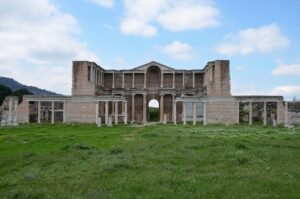
The building where the delegates met still stands. It is the Patara Council Hall (Meclis Binası). It was built by the 1st century BC at the latest. Excavators found decisions of the Lycian League there, which confirms its use as the league’s assembly.
The hall measures 42.80 × 30.60 meters. It has 21 rows of seats and could hold about 1,400 people.
Ptolemy II Philadelphos also touched the city. According to Strabo, he enlarged Patara and named it after his wife and sister, Arsinoe. The old name stayed in use anyway.
The Patara Road Monument
In AD 46, a monument was set up with the approval of Quintus Veranius, the first Roman governor. It lists the cities of Lycia and the distances along the roads that connect them.
It works like a very old road sign for the whole province. Today you would find the same kind of information on a map app.
The monument is 6.04 meters tall including its base. Its inscriptions are carved on ten stacked rows of stone blocks.
Patara antik kenti: the harbor and the lighthouse
The lighthouse is the best-known monument at Patara. An inscription dated AD 64/65 states that Emperor Nero had it built for the safety of sailors.
It was not always visible. Excavations in 2004–2005 uncovered it from beneath a sand dune on the west bank of the ancient harbor mouth.
The harbor itself changed over time. It was about 1.6 kilometers long and a little under 400 meters wide. It slowly silted up and was cut off from the sea by a wide dune.
The tower’s measurements are specific:
- The outer cylinder is 6 meters across.
- A spiral stair connects the inner and outer cylinders.
- The stair is about 80–90 centimeters wide.
According to a DHA report of 16 April 2025, the 26.5-meter tower has been raised again. The restoration scaffolding around it has been removed.
Is it the world’s oldest lighthouse?
The ministry’s Patara promotion uses the label “the world’s oldest lighthouse.” The excavation director disagrees. In 2020, Havva İşkan Işık said Patara was not the first lighthouse. She said its distinction is that it can be rebuilt from its own original material.
A careful way to put it: Patara has one of the best-documented ancient lighthouses, with a dated inscription. “First in the world” is a claim the excavation team itself does not make.
St. Nicholas and Patara
Tradition holds that St. Nicholas, the historical figure behind the Santa Claus stories, was born in Patara. Treat this as a tradition. The Catholic Encyclopedia counts the birth story as legend. It also says certain historical knowledge of his life is very limited.
The documented Christian history of Patara is easier to state. In Acts 21:1–3, Paul changes ships at Patara. He boards one bound for Phoenicia and continues toward Tyre. Later, Bishop Eudemus of Patara attended the Council of Nicaea in AD 325.
Timeline
- Late Chalcolithic–Bronze Ages: stone axes, pottery and a figurine document early settlement.
- 13th century BC: the name Patar appears in the texts about Tudhaliya IV’s Lukka campaign.
- 333 BC: Patara surrenders to Alexander the Great.
- By the 1st century BC: the Council Hall is built.
- AD 46: the Patara Road Monument is erected.
- AD 64/65: the lighthouse is built under Nero.
- AD 325: Bishop Eudemus attends the Council of Nicaea.
- 4th–5th centuries AD: the Council Hall is folded into the city walls as a defensive bastion.
- 1478: Prince Cem arrives at Patara to meet the Rhodians.
- 1911: the wireless telegraph station is damaged in an Italian naval bombardment.
- 1988: systematic excavations begin under Fahri Işık.
- 2004–2005: the lighthouse is dug out from under the dune.
- 6 February 2009: the Ancient Cities of Lycian Civilization nomination, including Patara, is submitted to the UNESCO Tentative List.
- April 2025: the scaffolding around the rebuilt lighthouse tower is removed.
Details you won’t find in guidebooks
- A second lighthouse. The inscription on a statue base found at Patara mentions a lighthouse called the antipharos. Its location has not been pinned down.
- Carvings on the lighthouse blocks. The stones carry four reliefs: one dolphin, one phallus and two crosses.
- A council hall turned into a fort. In the 4th–5th centuries AD, the Council Hall was joined to the city walls and became a defensive bastion.
- A prince on the shore. In 1478, Prince Cem came to Patara to meet the Rhodians. His father, Mehmed the Conqueror, had asked him to.
- A wireless station. The Ottoman wireless telegraph station at Patara was built to communicate with Derna in Libya. It was badly damaged in 1911 when the Italian navy shelled it during the Ottoman-Italian War.
What to look for when you visit
Start with the Council Hall. Count the 21 rows of seats and picture 1,400 delegates and citizens inside.
Then find the Road Monument. Its ten blocks of text are a distance table for Lycia.
Finish at the lighthouse near the old harbor mouth. Look at the 6-meter outer cylinder and the narrow stair inside it. Ask yourself how a keeper climbed it every night.
FAQ
Where is Patara?
Patara is in Gelemiş neighborhood of Kaş district, Antalya. It lies east of the Eşen River at the southern end of the Xanthos Valley.
Is the Patara lighthouse the oldest in the world?
The ministry’s promotion uses that label. The excavation director, Havva İşkan Işık, said in 2020 that Patara was not the first lighthouse. She said its value lies in being rebuilt from its own original material.
Who built the Patara lighthouse?
An inscription dated AD 64/65 says Emperor Nero had it built for the safety of sailors.
Was St. Nicholas born in Patara?
Tradition says so. The Catholic Encyclopedia, however, treats the birth story as legend and says certain historical knowledge of his life is very limited.
When did excavations at Patara begin?
Systematic excavations began in 1988 under Fahri Işık.
Sources
- Antalya İl Kültür ve Turizm Müdürlüğü — Patara antalya.ktb.gov.tr
- Antalya İl Kültür ve Turizm Müdürlüğü — Meclis Binası antalya.ktb.gov.tr
- Antalya İl Kültür ve Turizm Müdürlüğü — Patara Yol Anıtı antalya.ktb.gov.tr
- Antalya İl Kültür ve Turizm Müdürlüğü — Deniz Feneri antalya.ktb.gov.tr
- Antalya İl Kültür ve Turizm Müdürlüğü — Araştırma Tarihi antalya.ktb.gov.tr
- UNESCO World Heritage Centre — Ancient Cities of Lycian Civilization whc.unesco.org
- Wikipedia — Patara (Lycia) en.wikipedia.org
- Vikipedi — Patara tr.wikipedia.org
- Anadolu Ajansı — Patara’daki deniz feneri asırlar sonra yeniden ışık verecek aa.com.tr
- Demirören Haber Ajansı — Patara Deniz Feneri, 544 yıl önceki gibi ayakta dha.com.tr
- Catholic Encyclopedia — St. Nicholas of Myra newadvent.org
- Catholic Encyclopedia — Patara newadvent.org
- ToposText — Patara/Arsinoe topostext.org
Image: Patara Ruins (7023429755).jpg — William Neuheisel from DC, US, CC BY 2.0