Baroque is a style that developed around 1600–1750 across architecture, painting, sculpture, music and other arts, using movement and dramatic effects to engage the emotions. European art and architecture became so theatrical partly because Catholic reform promoted persuasive religious images, while churches, absolute monarchs and aristocrats used spectacle to strengthen their authority.
Why would a marble figure place you in the position of its enemy, or a palace display hundreds of mirrors? Bernini’s David and the Hall of Mirrors at Versailles show how Baroque artists and patrons directed attention. Following those effects from Rome to Istanbul also reveals how the style changed as it traveled.
What does Baroque mean, and which periods and regions does it describe?
The name Baroque is associated with the Portuguese word barroco, meaning an irregularly shaped pearl. The artistic label covers roughly 1600–1750, although regional differences matter. It describes several arts, including music, rather than architecture alone.
The style developed in Rome around 1600. It spread from Italy to France, Spain and Portugal, then to Austria, southern Germany, Poland and Russia. That geography helps explain why Baroque cannot be reduced to one kind of building or one religious setting.
Its dates also need flexibility. Istanbul’s Nuruosmaniye Mosque was built in 1748–1755. Most of the European pavilions at Beijing’s Yuanmingyuan Palace were completed in 1756–1766. These examples show Baroque forms continuing beyond the period’s approximate endpoint.
How did Catholic reform and royal patronage influence Baroque art?
The Council of Trent met between 1545 and 1563. Its decisions concerning religious images supported their role in teaching and strengthening faith during Catholic reform. This supplied an important context for art designed to make religious messages clear and emotionally compelling.
In seventeenth-century Catholic settings, visual storytelling deliberately sought to persuade viewers. Movement, expressions and dramatic encounters could give a religious message immediate force. Caravaggio’s The Supper at Emmaus offers a concrete example: recognition becomes visible through light and bodily reactions.
Yet Catholic reform does not explain the entire period. Werner Weisbach identified Baroque with Counter-Reformation art. Rudolf Wittkower considered it misleading to reduce the whole Baroque era to that explanation. Their disagreement matters because the style also served royal and aristocratic authority.
At Versailles, the Hall of Mirrors celebrated the political, economic and artistic achievements of Louis XIV’s France. Built between 1678 and 1684, the gallery measures 73 metres. Its scale and decorative program made royal achievement something visitors could experience through space.
The officially Protestant Dutch Republic followed another path. Limited church and court commissions encouraged an art market that supported secular subjects, including landscapes and still lifes. Baroque-era painting therefore included works shaped by buyers outside the religious and royal settings often associated with the style.
How were movement, light and space used in painting, sculpture and architecture?
Caravaggio painted The Supper at Emmaus in 1601. Strong contrasts between light and darkness intensify the moment when the apostles recognize Jesus. The drama depends on a particular instant, with illumination helping to concentrate attention on the encounter.
The figures make that instant physical. One apostle rises from his chair. Another spreads his arms. If you look at their gestures, surprise becomes readable through bodies in motion. The religious event gains force through actions that a viewer can recognize immediately.
Bernini’s marble David, made in 1623–1624, similarly captures action before its outcome. The 170-centimetre figure shows the hero just before he throws his stone at Goliath. The sculpture holds that moment of preparation, making the coming movement central to the work.
Its intended viewing position adds another effect. According to the Galleria Borghese, the viewpoint places you where Goliath would stand. Your position therefore becomes part of the action. The space in front of the sculpture helps complete the encounter suggested by the marble figure.
Architecture could make solid walls appear active. At Rome’s San Carlo alle Quattro Fontane, Borromini developed a design between 1634 and 1646 that used concave and convex surfaces. Inward and outward curves gave movement to the walls themselves.
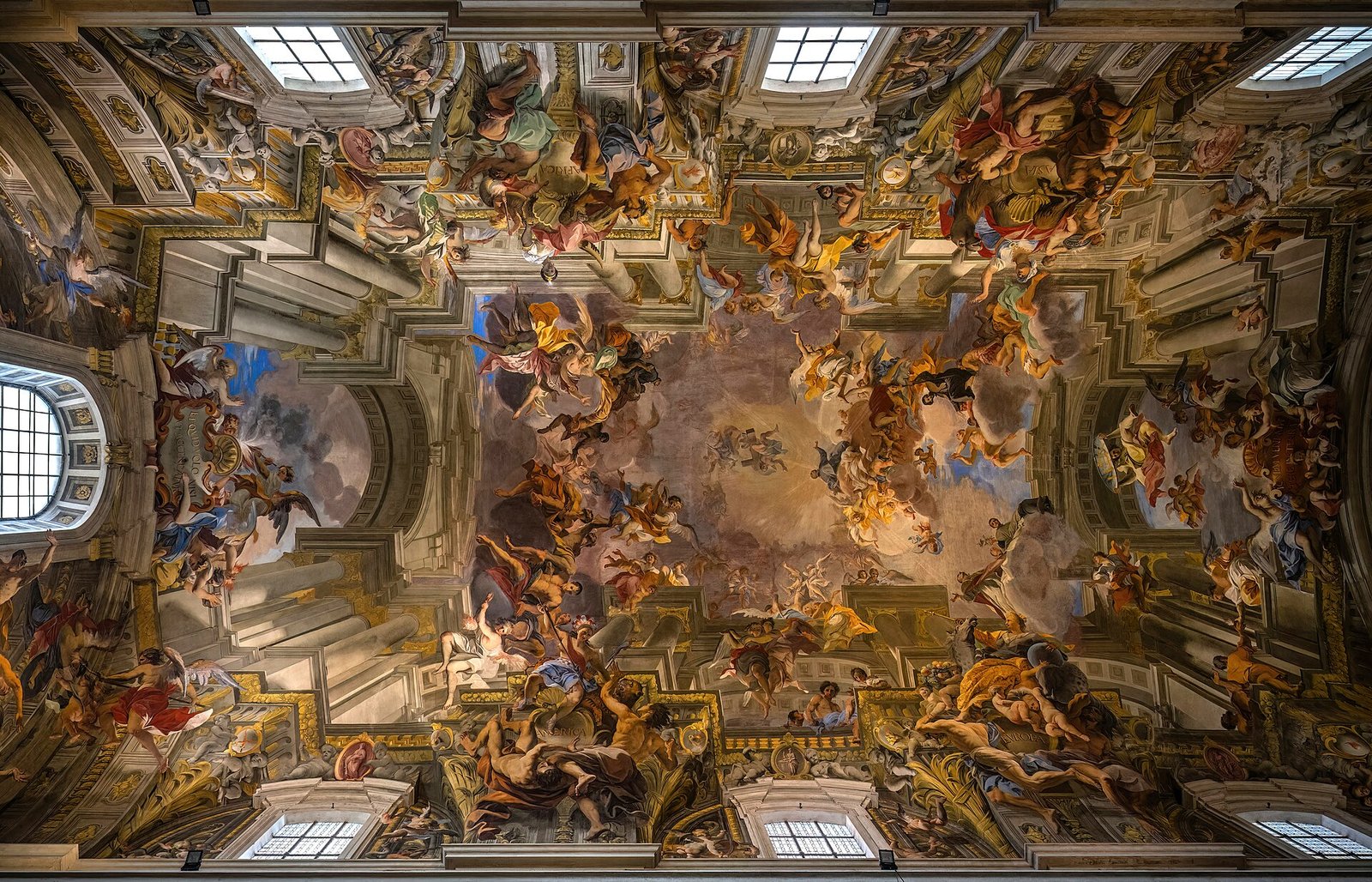
Baroque interiors also manipulated light and apparent space. Painted ceilings created the illusion of an opening into the sky. Hidden windows illuminated domes and altars. Painting, sculpture and architecture could work together as an integrated arrangement, carrying the same message through several forms.
There is an everyday-life connection in Caravaggio’s supper scene: someone starts to rise from a chair when surprise interrupts a meal. That recognizable reaction carries the painting’s religious drama. You can begin with the ordinary gesture before considering the larger event it expresses.
How does Baroque differ from Renaissance and Rococo art?
The Victoria and Albert Museum contrasts Renaissance balance and controlled order with Baroque movement and dramatic effects. This gives you a useful starting point for looking. Bernini’s poised throw and Borromini’s curving walls both make action central to the experience.
Baroque artists nevertheless continued to engage with antiquity. Nude figures could heighten a story’s drama or personify concepts such as Truth and the Three Graces. The classical inheritance remained available even when artists used it to create emotional intensity.
Rococo emerged in France during the 1720s. According to the Rijksmuseum’s periodization, its European influence continued into the 1770s. These dates overlap with the broad Baroque period, so the two labels do not describe a clean change occurring everywhere at once.
The Rijksmuseum identifies light colors, delicate curves, leaf and shell motifs, and asymmetry as characteristic of Rococo. These features provide a more specific comparison than decoration alone. Baroque’s dramatic movement and coordinated spatial effects offer another set of things to examine.
How did the style change beyond Europe?
Colonialism, trade and missionary networks carried Baroque forms to Africa, Asia and the Americas. Local materials, tastes and needs changed those forms. The style’s wider history therefore includes adaptation by the people who designed and made buildings in different settings.
In the Philippines, the churches at Manila, Santa Maria, Paoay and Miag-ao show European Baroque reinterpreted by Chinese and Filipino craftspeople. Their role matters: these buildings represent local participation in reshaping the style, rather than its simple repetition.
At Bom Jesus do Congonhas in Brazil, a church completed in 1772 belongs to a religious complex that also includes soapstone prophets and sculptural groups depicting Christ’s Passion. Architecture and sculpture combine within the same setting, extending the Baroque practice of bringing arts together.
Istanbul’s Nuruosmaniye Mosque provides another example. Built in 1748–1755, it combined Baroque aesthetics with Ottoman traditions. Ünver Rüstem also emphasizes the cross-cultural expertise of local non-Muslim artists in that combination.
Details you won’t find in guidebooks
The unfinished back of Bernini’s David preserves evidence of its original placement against a wall. That detail helps explain why its intended viewpoint matters. The sculpture’s first arrangement directed the encounter between the figure, its surrounding space and the viewer.
Near David’s feet, an eagle’s head appears on the musical instrument. It refers to the emblem of the Borghese family, who commissioned the work. A small carved feature thus connects the biblical subject with its patron.
Versailles turns craftsmanship into a political statement. The Hall of Mirrors contains 357 mirrors arranged within 17 arches. They demonstrated that French manufacturing could challenge Venice’s monopoly in mirror production, giving the gallery’s glittering surfaces an economic message.
In Guercino’s 1619 painting Samson Captured by the Philistines, Samson is the only nude figure among armed men. His exposed muscular body emphasizes the contrast between physical strength and present helplessness. Nudity makes his predicament more pointed.
At Beijing’s Yuanmingyuan Palace, the European pavilions included Baroque-inspired fountains and sculptures designed by Jesuits. Most of the pavilions were completed between 1756 and 1766. Their presence places Baroque design within a setting far from the Rome where the style first developed.
Timeline
- 1545–1563: The Council of Trent addresses religious images during Catholic reform.
- Around 1600: Baroque develops in Rome.
- 1601: Caravaggio paints The Supper at Emmaus.
- 1619: Guercino paints Samson Captured by the Philistines.
- 1623–1624: Bernini makes David.
- 1634–1646: Borromini develops the design of San Carlo alle Quattro Fontane.
- 1678–1684: The Hall of Mirrors at Versailles is built.
- 1720s: Rococo emerges in France.
- 1748–1755: The Nuruosmaniye Mosque is built in Istanbul.
- 1756–1766: Most European pavilions at Yuanmingyuan are completed.
- 1772: The church at Bom Jesus do Congonhas is completed.
FAQ
What is Baroque art?
Baroque describes a style that developed around 1600–1750, with regional differences, across architecture, painting, sculpture, music and other arts. It emphasized movement, dramatic effects and emotional engagement.
Why did Baroque art become so dramatic?
Catholic reform encouraged art that taught religious messages and strengthened faith. Churches, absolute monarchs and aristocrats also used sensory spectacle to reinforce their authority.
How does Baroque differ from Rococo?
Baroque emphasized movement and dramatic effects. Rococo emerged in France in the 1720s and favored light colors, delicate curves, asymmetry, and leaf and shell motifs.
Where can you explore Baroque architecture in Istanbul?
The Nuruosmaniye Mosque, built in 1748–1755, combines Baroque aesthetics with Ottoman traditions and the cross-cultural expertise of local non-Muslim artists.
Sources
- Türkçe Vikipedi — Barok tr.wikipedia.org
- Wikipedia — Baroque en.wikipedia.org
- Museum With No Frontiers — A persuasive language for religious art baroqueart.museumwnf.org
- Patrick Preston — Counter-Reformation and Baroque, University of Malta um.edu.mt
- Victoria and Albert Museum — The Baroque style vam.ac.uk
- National Gallery — The Supper at Emmaus nationalgallery.org.uk
- Galleria Borghese — David galleriaborghese.cultura.gov.it
- Château de Versailles — The Hall of Mirrors en.chateauversailles.fr
- The Metropolitan Museum of Art — The Nude in Baroque and Later Art metmuseum.org
- The Metropolitan Museum of Art — In Praise of Painting metmuseum.org
- Rijksmuseum — Rococo rijksmuseum.nl
- UNESCO World Heritage Centre — Baroque Churches of the Philippines whc.unesco.org
- UNESCO World Heritage Centre — Sanctuary of Bom Jesus do Congonhas whc.unesco.org
- University of Michigan, Khamseen — The Nuruosmaniye Mosque and the Ottoman Baroque sites.lsa.umich.edu
Image: Triumph of St. Ignatius of Loyola, ceiling fresco by Andrea Pozzo.jpg — Wilfredor, CC0