ARPANET began operating in 1969, connecting research computers through a network supported by ARPA. Its first computer-to-computer message travelled from UCLA to the Stanford Research Institute on 29 October. Only two letters arrived before the system crashed: LO.
That interrupted exchange is a useful starting point when you explore the origins of the internet. ARPANET brought together research institutions, packet-switching equipment, and rules for communication between computers. By December 1969, its first four nodes were in place.
ARPANET full form: What does ARPANET stand for?
ARPANET stands for Advanced Research Projects Agency Network. ARPA supported the project within the United States Department of Defense. The name identifies the agency behind the network, whose initial aims included secure communication and information sharing between geographically separated research centres.
In computer history, ARPANET means the research network that began operating in 1969 and became a precursor to today’s internet. Its development involved both physical connections and communication protocols. Computers at different institutions needed equipment to connect them and agreed rules for exchanging information.
ARPANET history: Who developed it?
ARPANET emerged from the work of several people and teams. Larry Roberts contributed network planning. Bob Kahn contributed architectural design. Frank Heart led the BBN team responsible for hardware. Leonard Kleinrock’s UCLA team carried out measurement work.
Roberts presented his ARPANET plan in October 1967 at the first Symposium on Operating Systems Principles. This was a planning milestone before the first working connections. The proposal preceded the installation of UCLA’s first network equipment in September 1969.
The hardware contract followed a separate timetable. A tender for Interface Message Processors opened in August 1968. These devices, usually called IMPs, served as ARPANET’s packet switches. Frank Heart’s BBN team won the contract in December 1968.
Design decisions also changed as the project developed. After the team learned about NPL’s work, the proposed line speed increased from 2.4 kbit/s to 50 kbit/s. ARPANET’s eventual form therefore reflected changes made during its planning and development.
ARPANET in 1969: What happened during the first connection?
UCLA became ARPANET’s first node in September 1969. BBN installed the first IMP there and connected the first host computer. The first computer-to-computer message followed on 29 October, at 22:30 local time.
UCLA programmer Charley Kline sent the message. At the Stanford Research Institute, SRI programmer Bill Duvall worked at the receiving end. Leonard Kleinrock directed the work. The connection joined UCLA’s SDS Sigma 7 computer with SRI’s SDS 940.
The intended command was LOGIN. The letters L and O reached the other computer, but the system crashed before the command was complete. That is why ARPANET’s first message entered the historical record as LO. About an hour later, the teams completed the full login successfully.
By December 1969, the network had four nodes. They were at UCLA, the Stanford Research Institute, the University of California, Santa Barbara, and the University of Utah. The opening exchange between two institutions had become part of a four-node network.
What was ARPANET’s role in computer networks?
ARPANET used packet switching. Data was divided into small packets and reassembled at its destination. This approach reduced dependence on any single node remaining operational. The IMP devices provided the network’s packet-switching hardware.
Communication between host computers also required a protocol. Steve Crocker led the Network Working Group, which completed ARPANET’s first host-to-host protocol, NCP, in December 1970. The network’s development thus continued after its first physical connections were established.
An everyday-life connection appears in email. In 1971, BBN employee Ray Tomlinson developed a program that sent messages across a distributed network. If you use the @ sign in an email address, you encounter a character Tomlinson selected for ARPANET email. It separated the user’s name from the computer’s name.
ARPANET reached a larger public audience in October 1972. Bob Kahn organised its first major public demonstration at the International Computer Communication Conference in Washington. This followed the first connections, the completion of NCP, and Tomlinson’s email program.
Where was ARPANET located?
ARPANET connected institutions rather than occupying one location. Its first node was at UCLA in Los Angeles. The laboratory that sent the first message was room 3420 in Boelter Hall on the UCLA campus.
For you as a reader following the geography of internet history, that room provides a precise starting point. The other end of the first message was the Stanford Research Institute. Santa Barbara and Utah joined them in the initial four-node network by December 1969.
In 1973, ARPANET’s first international connections reached University College London in England and the Royal Radar Establishment in Norway. These links extended a network that had begun with research institutions in the United States.
The route taken on 25 July 1973 shows how those connections worked together. Data sent from UCL to California travelled along the London–Norway cable. It then crossed the Norway–Virginia satellite connection before continuing through the network inside the United States.
Was ARPANET built to survive nuclear war?
The Internet Society’s 1997 joint history distinguishes ARPANET from a separate RAND study concerning secure voice communication. It assigns the nuclear-war scenario to that RAND work. ARPANET’s early objectives included secure communication and information sharing between dispersed research centres.
Security was nevertheless a practical problem on ARPANET. In December 1973, Bob Metcalfe’s RFC 602 reported easily guessed passwords and TIP terminals that allowed access without authentication. Those weaknesses left the network open to unauthorised use.
Timeline
- October 1967: Larry Roberts presented the ARPANET plan at the first Symposium on Operating Systems Principles.
- December 1968: Frank Heart’s BBN team won the IMP development contract.
- September 1969: UCLA received the first IMP and connected its first host computer.
- 29 October 1969: UCLA sent the first message to SRI.
- December 1969: The first four-node network was established.
- December 1970: The Network Working Group completed NCP.
- 1971: Ray Tomlinson developed his network email program.
- October 1972: Bob Kahn organised the major public demonstration in Washington.
- 1973: Connections reached England and Norway.
- December 1973: RFC 602 documented security weaknesses.
- November 1981: RFC 801 published the transition plan from NCP to IP/TCP.
- 1983: The military portion became MILNET.
- 1990: ARPANET was officially retired.
Details you won’t find in guidebooks
The famous LO message was the surviving fragment of a LOGIN command. Its brevity resulted from a crash during the first attempt. The successful login about an hour later matters too: the UCLA and SRI teams completed the operation after the interruption.
Tomlinson chose @ from the non-alphabetic characters on the keyboard. Its purpose was specific. It separated the user from the computer in an ARPANET email address, linking a familiar symbol to the network’s early messaging work.
Metcalfe’s December 1973 security report included a concrete example of unauthorised access. Two high-school students in Los Angeles had obtained a system’s privileged wheel password. The incident accompanied his warnings about weak passwords and unauthenticated terminal access.
The original IMP No. 1 also has a physical location. According to the UCLA Connection Lab’s museum description, it is preserved in room 3420 of Boelter Hall. The room associated with the first message therefore also preserves the network’s first IMP.
Does ARPANET still exist?
ARPANET was officially taken out of service in 1990. Before that, its communication protocols and organisation had changed. Jon Postel’s RFC 801, published in November 1981, set 1 January 1983 as the target for the complete transition from NCP to IP/TCP.
In 1983, the portion associated with military use became a separate network called MILNET. ARPANET’s retirement followed in 1990, after its contribution to the development of the internet. Its history runs from the first IMP installations through international connections and protocol changes.
FAQ
What does ARPANET stand for?
ARPANET stands for Advanced Research Projects Agency Network. It was supported by ARPA, an agency within the United States Department of Defense.
Who developed ARPANET?
ARPANET combined Larry Roberts’s network planning, Bob Kahn’s architectural design, hardware from Frank Heart’s BBN team, and measurement work by Leonard Kleinrock’s UCLA team.
What was ARPANET’s first message?
The first message was LO, sent from UCLA to the Stanford Research Institute on 29 October 1969. The intended LOGIN command was interrupted by a system crash.
Where was ARPANET located?
ARPANET connected multiple institutions. Its first node was at UCLA, and the first message originated in room 3420 of Boelter Hall in Los Angeles.
Does ARPANET still exist?
ARPANET was officially retired in 1990. The UCLA Connection Lab’s museum description identifies room 3420 of Boelter Hall as the home of the original IMP No. 1.
Sources
- Vikipedi — ARPANET tr.wikipedia.org
- DARPA — ARPANET darpa.mil
- Internet Society — A Brief History of the Internet internetsociety.org
- Wikipedia — ARPANET en.wikipedia.org
- UCLA — The Day the Infant Internet Uttered its First Words lk.cs.ucla.edu
- UCLA Connection Lab — 3420 Boelter Hall uclaconnectionlab.org
- Computer History Museum — Internet History of 1970s computerhistory.org
- RFC 2235 — Hobbes’ Internet Timeline datatracker.ietf.org
- Centre for Computing History — UK Connects to ARPANET computinghistory.org.uk
- RFC 602 — The Stockings Were Hung by the Chimney with Care rfc-editor.org
- RFC 801 — NCP/TCP Transition Plan rfc-editor.org
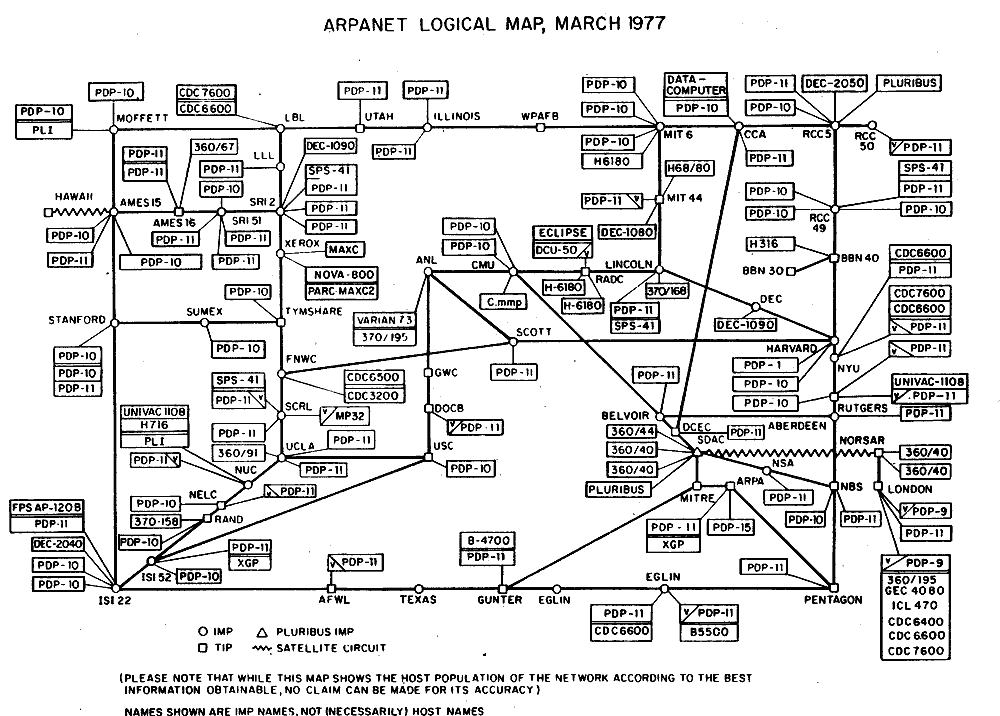
Image: Arpanet logical map, march 1977.png — ARPANET, Public domain