Franklin’s lost expedition ended after HMS Erebus and HMS Terror became trapped in Arctic ice in September 1846. Franklin died in June 1847, and none of the 105 men who abandoned the ships in April 1848 survived. The wrecks, Inuit testimony, and human remains provide evidence of the retreat, disease, and cannibalism involving some bodies.
How much can a frozen body, a marked bone, or a ship’s closed drawer reveal? The evidence extends from three graves on Beechey Island to DNA identifications announced in May 2026. If you follow those discoveries separately, you can see which findings establish events and which require more cautious interpretation.
What happened to Franklin’s lost expedition?
John Franklin led Erebus and Terror out of Greenhithe, England, on 19 May 1845. Their goal was to navigate the Northwest Passage. This meant seeking a sea connection between the Atlantic and Pacific north of North America.
The expedition’s final complement numbered 129 officers and sailors. Both ships carried provisions for a journey lasting up to three years. Like packing food for a long trip, that preparation depended on the length of the journey. Here, the ships became trapped in September 1846 and remained in the ice until their abandonment in April 1848.
Both vessels had equipment intended to help them face the passage. They received iron bow plating, steam engines, and single propellers capable of providing about four knots. These preparations did not prevent their entrapment near King William Island.
The surviving written account records losses before the retreat. By 22 April 1848, 24 men had died, including Franklin. Francis Crozier and James Fitzjames signed the note recording that the remaining 105 intended to leave for the Back River on 26 April.
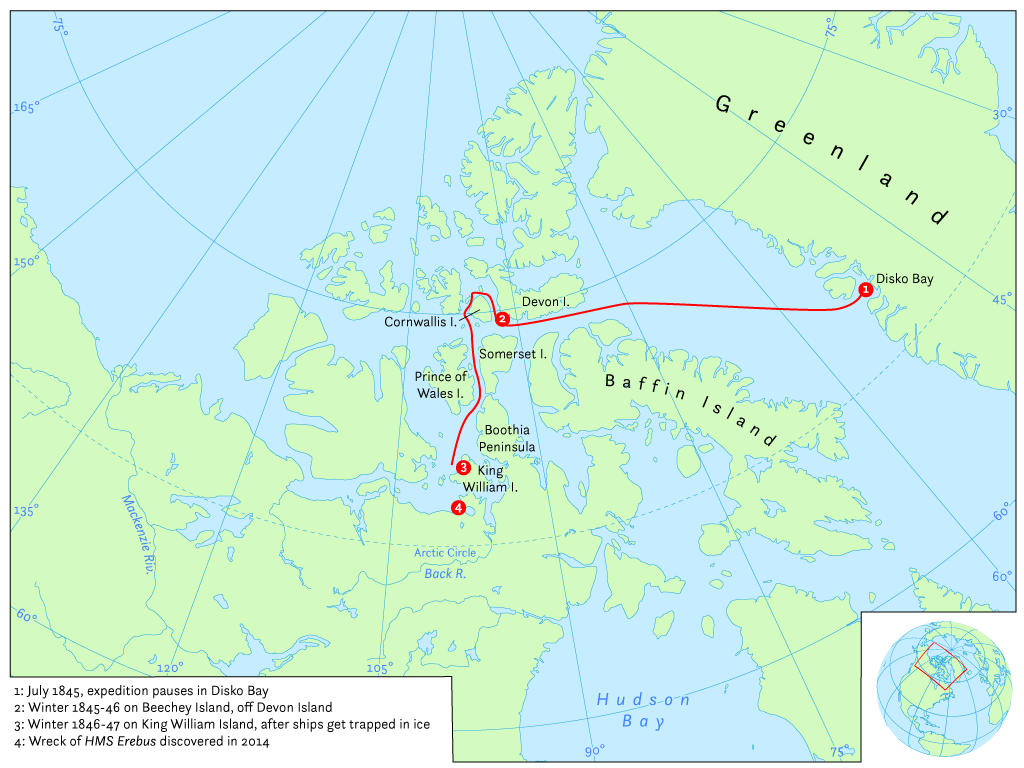
Franklin’s lost expedition map: where did events unfold?
To follow the expedition geographically, you need to distinguish Beechey Island from King William Island. The expedition spent its first winter, 1845–1846, at Beechey Island. John Torrington, John Hartnell, and William Braine died there and were buried.
The next major location is Victoria Strait, near King William Island in what is now Nunavut. Erebus and Terror became trapped there in September 1846. The surviving men later travelled along the island’s western coast, hauling boats on sledges toward their intended route to the Canadian mainland.
The wreck locations add two further points to this map. Erebus was found about 80 kilometres south of King William Island. Terror was found in Terror Bay, southwest of the island. These locations belong alongside the recorded retreat and the human remains when you consider the expedition’s final movements.
Timeline
- 19 May 1845: Erebus and Terror departed Greenhithe under Franklin.
- Winter 1845–1846: The expedition wintered at Beechey Island, where three sailors died.
- September 1846: Both ships became trapped near King William Island.
- 11 June 1847: Franklin died, according to the Victory Point note.
- 22 April 1848: The remaining 105 men abandoned the ships.
- 25 April 1848: Crozier and Fitzjames added the losses and walking plan to the note.
- May 1859: William Hobson found the Victory Point note.
- 1984 and 1986: Autopsies examined the frozen Beechey Island bodies.
- 1997: A study reported cut marks supporting cannibalism.
- September 2014: Erebus was found.
- September 2016: Terror was found.
- 2018: Research did not support lead as a decisive cause of the losses.
- 2019: Remotely operated vehicles recorded Terror’s interior.
- 2024: Genetic research identified James Fitzjames’s remains.
- 6 May 2026: Four further DNA identifications were announced.
Franklin’s lost expedition bodies and mummies
The frozen bodies on Beechey Island belong to Torrington, Hartnell, and Braine. These men died during the first winter. Their remains therefore provide evidence from an earlier stage than the abandonment of the ships and the retreat along King William Island.
Autopsies in 1984 and 1986 revealed lead accumulation and findings associated with tuberculosis. When you encounter these bodies described as the expedition’s “mummies,” keep their dates in view. Their deaths in 1845–1846 preceded Franklin’s death in June 1847 and the retreat in April 1848.
A different collection of remains came from a site discovered on King William Island in 1992. A study published in 1997 described about 400 human bones and fragments. They represented at least 11 people. Approximately a quarter of the remains carried cut marks.
Researchers interpreted those marks as physical evidence supporting Inuit accounts of cannibalism recorded in the nineteenth century. The finding concerns the treatment of some bodies. It does not establish an identical fate for every expedition member.
What do DNA and cut marks reveal?
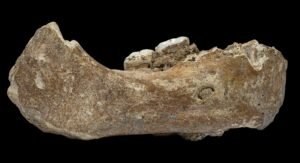
In 2024, researchers identified James Fitzjames through genetic evidence. They compared the Y-chromosome profile from a tooth recovered on King William Island with a sample from a living relative. The identification connected human remains with one of the officers who signed the retreat note.
Metal-tool cuts on the lower jaw identified as Fitzjames’s were interpreted as evidence that his body had been subjected to cannibalism. The identification and the marks answer different questions: DNA establishes whose remains were examined, while the cuts provide evidence about their treatment.
On 6 May 2026, DNA results identified Harry Peglar, William Orren, David Young, and John Bridgens. These findings brought the number of expedition members identified through DNA to six. The University of Waterloo reported no evidence of cannibalism on the remains of those four newly identified sailors.
Did lead poisoning explain the deaths?
Lead was present in expedition remains, but exposure alone does not establish fatal poisoning. Research published in 2018 examined bones and teeth and did not support the conclusion that lead played a decisive role in the losses.
The PLOS ONE study detected lead in some tissues formed close to death. That finding confirmed exposure during the expedition. The researchers did not treat it as sufficient evidence that lead poisoning killed the men.
Hartnell’s fingernail also became part of a proposed explanation involving zinc deficiency and disease. The 2018 assessment noted questions about whether a single nail could adequately demonstrate that deficiency. Both debates show why a detected substance or proposed deficiency needs careful interpretation.
Franklin’s lost expedition ship found: what survived underwater?
A Parks Canada-led team found Erebus in September 2014. Terror followed in September 2016, with Parks Canada confirming its identity. Parks Canada explicitly recognised the fundamental contribution of Inuit knowledge from the Gjoa Haven community to the discoveries.
The wrecks preserve material evidence of life aboard the expedition’s ships. During the 2019 investigation of Terror, seven remotely operated vehicle dives examined 20 cabins or compartments. More than 90 percent of the lower deck was recorded.
Those recordings included the captain’s cabin, where a desk, chart cabinets with closed drawers, a tripod, and two thermometers remained in place. Such objects provide evidence of the ship’s interior alongside the written account of abandonment and the remains found on land.
Details you won’t find in guidebooks
Sammy Kogvik’s recollection helped direct the search for Terror. He described seeing a large piece of wood projecting from the ice about six years earlier. His account prompted the research vessel Martin Bergmann to conduct a sonar search in Terror Bay on 3 September 2016.
At Erebus, the first diving investigations identified at least six anchors within the wreck site. At Terror, the captain’s bedroom was the only lower-deck compartment that could not be accessed during the 2019 survey. It lay behind that deck’s only closed door.
The body identified as Harry Peglar in 2026 had been found in 1859 carrying the documents called the Peglar Papers. These included a seaman’s certificate and poems. The papers connect a later genetic identification with personal material recovered from a body much earlier.
Franklin’s lost expedition book and reading answers
David C. Woodman’s Unravelling the Franklin Mystery: Inuit Testimony was first published in 1991. It reconstructs the expedition’s fate through Inuit oral testimony. That subject connects directly with the knowledge Parks Canada recognised in the discovery of the ships.
For reading answers with explanations, distinguish the evidence by what it establishes. The Victory Point note records deaths and an intended departure. William Hobson found it in a cairn on King William Island’s northwest coast in May 1859. Cut marks address the treatment of remains, while genetic comparisons identify particular individuals.
FAQ
Did anyone survive Franklin’s lost expedition?
No. By the abandonment of the ships on 22 April 1848, 24 expedition members had died. None of the remaining 105 men survived.
Have both ships from Franklin’s expedition been found?
Yes. HMS Erebus was found in September 2014, about 80 kilometres south of King William Island. HMS Terror was found in September 2016 in Terror Bay.
Did lead poisoning cause the disaster?
Lead exposure occurred, but the 2018 research did not support lead as a decisive cause of the expedition’s losses.
Was there evidence of cannibalism?
Yes. Cut marks on human remains support cannibalism, including marks on the jaw identified as James Fitzjames’s. No evidence of cannibalism was reported on the remains of the four sailors identified in 2026.
Sources
- Parks Canada — History of the 1845 Franklin Expedition canada.ca
- Parks Canada — National Historic Site record pc.gc.ca
- Canadian Museum of History — Remembering the Franklin Expedition historymuseum.ca
- English Wikipedia — Franklin’s lost expedition en.wikipedia.org
- Arctic — The Final Days of the Franklin Expedition cjc-rcc.ucalgary.ca
- University of Saskatchewan — New insights into fate of Franklin Expedition news.usask.ca
- PLOS ONE — Franklin expedition lead exposure journals.plos.org
- Parks Canada — Discoveries parks.canada.ca
- Parks Canada — Validation of discovery of HMS Terror canada.ca
- Parks Canada — Finding HMS Terror parcs.canada.ca
- Parks Canada — Finding HMS Erebus parks.canada.ca
- Parks Canada — Remarkable images of HMS Terror canada.ca
- Journal of Archaeological Science: Reports — Identification of a senior officer sciencedirect.com
- University of Waterloo — Daily Bulletin, 2 October 2024 uwaterloo.ca
- University of Waterloo — DNA matches identify four more sailors uwaterloo.ca
- University of Toronto Press Distribution — Unravelling the Franklin Mystery utpdistribution.com
Image: Franklin's-Lost-Expedition.png — Hans van der Maarel, CC BY-SA 4.0