Sivas history: a city on the road
Sivas sits in the east of Central Anatolia, in the upper basin of the Kızılırmak. It is a historic city, and its province lies on the routes of the ancient King’s Road and the Silk Road.
That location explains a lot. Roads bring traders. They also bring armies. Sivas saw both, and you can read the result in its stone buildings.
This guide walks through the city’s history in order. It starts with the name, then moves to the earliest settlements, the Seljuk monuments, the Mongol and Timurid blows, the Ottoman bathhouses, and the congress of 1919.
Where does the name Sivas come from?
The standard explanation points to Rome. In the Roman period the city was called Sebasteia. Over time that name passed through forms such as Sebastos and Sevaste/Sivaste. It then took on a Turkish shape and became Sivas.
There is a local account of how Sebasteia got its name. The Sivas Provincial Directorate of Culture and Tourism passes on a theory that Pythodoris, the wife of Polemon, named the city Sebasteia. She did it to show her loyalty to Augustus.
There is also a rival story. It links the name to “Sipas” and to three water springs in the city. Treat it as a tradition. It is not presented as a verified founding document.
So the safest summary is this. Sivas descends from Sebasteia, and the three-spring tale is a popular alternative.
Sivas, Turkey: how old is the settlement?
The city is old, but its birth date is unknown. Settlements from the Chalcolithic Age have been found in the area. They date to roughly 5000–3000 BC. Even so, the exact founding date of today’s city is not known.
A second site gives firmer numbers. Excavations at Maltepe Höyüğü show continuous settlement there from about 2600 BC until 2000 BC. That is six centuries without a break.
If you are planning a visit, remember that early layers like these sit in mounds and excavation reports, not in the old town square. The square is where you will find the medieval city.
Seljuk Sivas: mosques, a hospital and four famous schools
The oldest major monument in the city center is the Sivas Ulu Camii. Kızılarslan bin İbrahim had it built in 1196–1197, for Kul Ahi. Inside the prayer hall, 50 masonry piers stand in rows across 11 bays. Pointed arches link them together.
The next landmark is a hospital. The Şifaiye Medresesi in the Eskikale district of the Historic City Square began as a Seljuk hospital dated 1217. I. İzzeddin Keykâvus had it built. It measures about 48 × 68 meters and has 30 rooms.
Here is the everyday link. Think of the hospital you would go to when you are ill. Sivas had a large one more than eight centuries ago, and it was built as a major public building.
Then comes the great building year of 1271. Three madrasas date to it:
- Buruciye Medresesi: built by Muzaffer Burucerdi.
- Gök Medrese: built by the Seljuk vizier Sahip Ata Fahreddin Ali; the architect was Kaluyan el-Konevi.
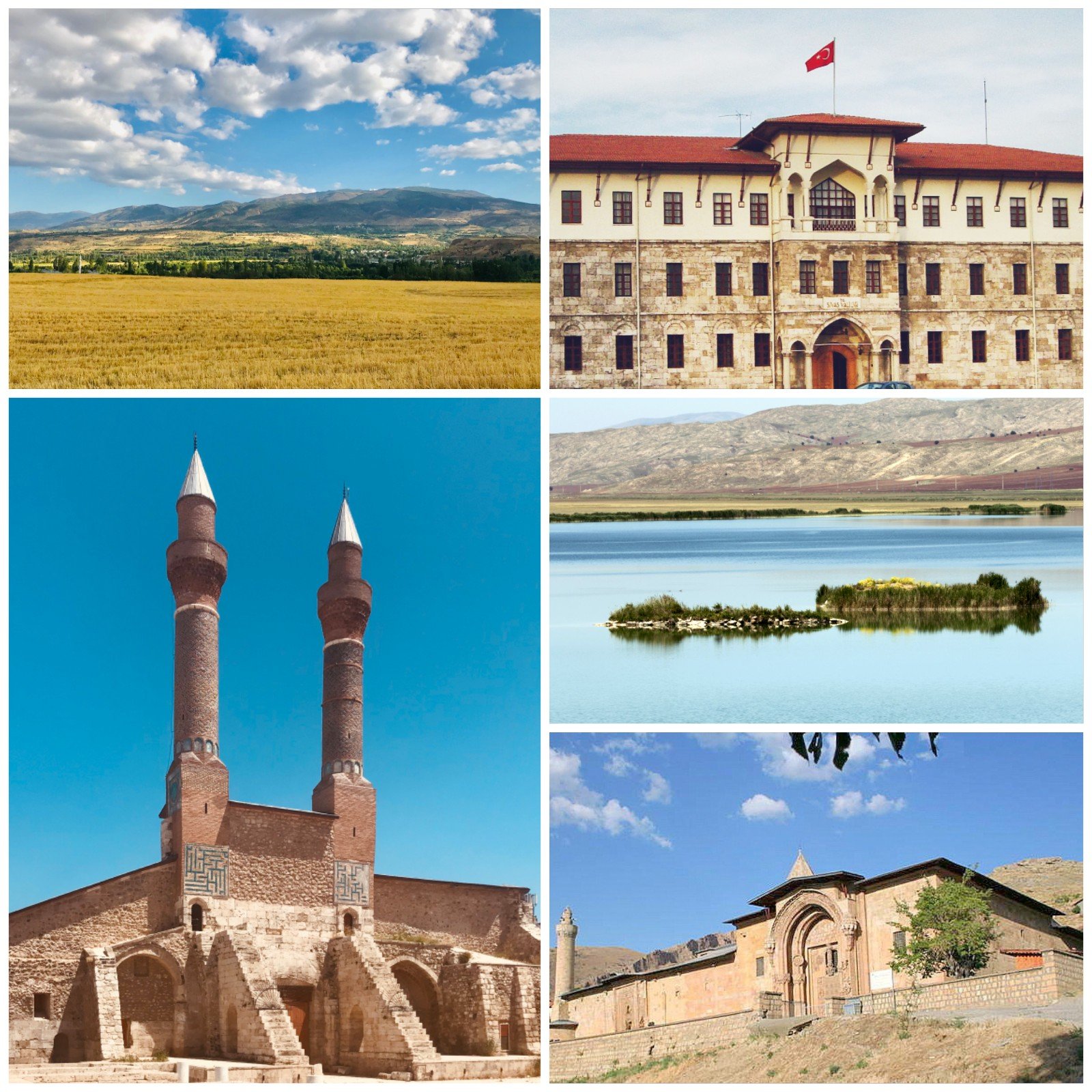
- Çifte Minareli Medrese: according to its inscription, built by the Ilkhanid vizier Şemsettin Muhammed Cüveyni. Only its front facade survives.
Notice the mix of patrons. One is a Seljuk vizier. Another is an Ilkhanid vizier. That fits the period, and the next section explains why.
Mongols, Kadı Burhâneddin and Timur
In 1243 the Seljuks lost the battle of Kösedağ. After that, Baycu Noyan took Sivas. The city was plundered for three days.
The next turning point came in 1398. Kadı Burhâneddin died, and the leading men of Sivas handed the city to the Ottoman ruler Bayezid I.
The peace did not last. Timur captured Sivas in 1400. The walls and important buildings were damaged. The city lost heavily in its economy and its population.
This helps you read the town. When a guide tells you that only a facade survived, or that a wall is gone, remember that Sivas went through the events of 1243 and 1400.
Ottoman bathhouses and a late-Ottoman building
After the shocks of the earlier centuries, the city kept building. Two bathhouses show it.
The Meydan Hamamı stands opposite the Meydan Camisi. It dates to 1564. At the center of its hot room is an octagonal central stone.
The Kurşunlu Hamam was built by Behram Paşa in 1576. It is a double bath with separate sections for women and men.
A hammam is still an everyday habit for many people. If you have ever taken a steam bath on a trip, you already know why a city would put money into these buildings.
The Historic Gendarmerie Building in the City Square is later. It was built in 1908 in the time of Governor Reşit Akif Paşa. It has an L-shaped plan.
Sivas Congress, 1919
This is the event most Turkish students link to Sivas. The Sivas Congress ran from 4 to 11 September 1919. It began its work at 14.00 on Thursday, 4 September, at Sivas Lise.
Its best-known result concerns organization. The national societies were merged under the name Association for the Defence of the Rights of Anatolia and Rumelia. In short, scattered local groups became one body.
This is why Sivas matters for the national struggle. It was not only a stop on the road. It was a place where the movement was organized.
Timeline
- 5000–3000 BC: Chalcolithic settlements in the Sivas region.
- 2600–2000 BC: continuous settlement at Maltepe Höyüğü.
- Roman period: the city is known as Sebasteia, the root of the name Sivas.
- 1196–1197: Sivas Ulu Camii is built.
- 1217: I. İzzeddin Keykâvus has the Şifaiye hospital built.
- 1243: after Kösedağ, Baycu Noyan takes Sivas.
- 1271: Buruciye, Gök Medrese and Çifte Minareli Medrese are built.
- 1398: the city is handed to Bayezid I.
- 1400: Timur takes Sivas and the city is badly damaged.
- 1564: Meydan Hamamı is built.
- 1576: Kurşunlu Hamam is built.
- 1908: the Historic Gendarmerie Building is built.
- 4–11 September 1919: the Sivas Congress meets.
- 1985: the Great Mosque and Hospital of Divriği enter the UNESCO World Heritage List.
- 2014: three Sivas madrasas appear on the UNESCO Tentative List.
Details you won’t find in guidebooks
A tablet that named a lost city. Kayalıpınar, in Yıldızeli, was identified as ancient Samuha thanks to a cuneiform tablet found in 2014.
A hospital that changed jobs. The Şifaiye hospital became a madrasa in 1768. During the First World War it served as a storehouse.
Why the Ulu Camii dates are firm. Its building and repair inscriptions were found during the large repair of 1955. The building inscription is registered in the Sivas Museum under inventory number 1120.
A bridge with a bend. The Eğri Köprü is also called the Bağdat Köprüsü. It is a stone bridge on the Kızılırmak, 179 meters long with 18 arches. After the 12th arch it turns left at an angle of 130 degrees. A repair inscription dated 1802 exists, but the exact date of construction is not known.
Lead in the walls. The Kurşunlu Hamam takes its name from lead poured over iron fastenings in its walls during construction.
Smuggling today. The Sivas Provincial Police Directorate reported an operation in the city center on 30 April 2025. It recovered 25 coins, 7 metal objects and 2 detectors, with the finds judged to be of historic value. History here is still being protected.
UNESCO and Sivas
Two UNESCO links are worth knowing, and they are different.
The first is the Great Mosque and Hospital of Divriği. It is in Divriği district, in Sivas province. The complex dates to 1228–1229 and was added to the World Heritage List in 1985.
The second is the Tentative List. The Buruciye, Gök Medrese and Çifte Minareli Medrese are part of the Anatolian Seljuks Madrasahs file, submitted on 15 April 2014. A tentative listing is a first step. It is not the full inscription.
How to use this history on a visit
Start in the Historic City Square. The Şifaiye, Buruciye, Gök Medrese and Çifte Minareli Medrese are all there, so you can see the 1217 and 1271 buildings on one walk. Add the Ulu Camii for the earlier date of 1196–1197.
Then look for the damage. Count what is missing. The Çifte Minareli Medrese keeps only its front. That is a visible trace of the city’s rough centuries.
Finish with the Ottoman baths and, if you have time, the Eğri Köprü over the Kızılırmak.
FAQ
Where does the name Sivas come from?
The usual explanation is that the Roman-era name Sebasteia passed through forms such as Sebastos and Sevaste/Sivaste and became Sivas in Turkish. A rival story about a name like Sipas and three water springs exists, but it is only a tradition, not a proven founding record.
How old is Sivas?
Settlements from the Chalcolithic Age, roughly 5000–3000 BC, have been found in the region. The exact founding date of today’s city is not known.
What happened at the Sivas Congress?
The congress met from 4 to 11 September 1919 and opened at 14.00 on Thursday, 4 September, at Sivas Lise. It merged the national societies under the name Association for the Defence of the Rights of Anatolia and Rumelia.
Which Sivas buildings are on UNESCO lists?
The Great Mosque and Hospital of Divriği, in Sivas province, has been on the World Heritage List since 1985. The Buruciye, Gök Medrese and Çifte Minareli Medrese are on the Tentative List through the Anatolian Seljuks Madrasahs file submitted on 15 April 2014.
When did Timur take Sivas?
Timur captured Sivas in 1400. Its walls and important buildings were damaged, and the city suffered heavy economic and population losses.
Sources
- TDV İslâm Ansiklopedisi — Sivas islamansiklopedisi.org.tr
- Sivas İl Kültür ve Turizm Müdürlüğü — Tarihçe sivas.ktb.gov.tr
- Vikipedi — Sivas tr.wikipedia.org
- Hitit Üniversitesi — XI. Uluslararası Hititoloji Kongresi bildiri özetleri cdn.hitit.edu.tr
- Wikipedia — Sivas Province en.wikipedia.org
- Türkiye Kültür Portalı — Şifaiye Medresesi kulturportali.gov.tr
- Türkiye Kültür Portalı — Buruciye Medresesi kulturportali.gov.tr
- Türkiye Kültür Portalı — Sivas Genel Bilgiler kulturportali.gov.tr
- Türkiye Kültür Portalı — Çifte Minareli Medrese kulturportali.gov.tr
- UNESCO — Anatolian Seljuks Madrasahs whc.unesco.org
- Türkiye Kültür Portalı — Ulu Camii Kültür Envanteri kulturportali.gov.tr
- Türkiye Kültür Portalı — Sivas Ulu Camii kulturportali.gov.tr
- Türkiye Kültür Portalı — Eğri Köprü kulturportali.gov.tr
- Türkiye Kültür Portalı — Kurşunlu Hamam kulturportali.gov.tr
- Türkiye Kültür Portalı — Meydan Hamamı kulturportali.gov.tr
- Türkiye Kültür Portalı — Jandarma Binası kulturportali.gov.tr
- Atatürk Araştırma Merkezi — Sivas Kongresi’nin 101’inci Yıl Dönümü atam.gov.tr
- Atatürk Araştırma Merkezi — Türkiye Cumhuriyeti Tarihi I atam.gov.tr
- UNESCO — Great Mosque and Hospital of Divriği whc.unesco.org
Image: Collage of Sivas Province.jpg — Maurice Flesier, CC BY-SA 4.0