Trabzon history in short
Trabzon sits on the Black Sea coast. Its history stretches over more than two thousand years. The first firm written trace is from around 400 BC. Later the city served as a Roman harbor, the capital of a medieval state, and an Ottoman town. In 1918 it was liberated from foreign occupation.
This guide follows that story in order. It also shows where you can still see it today.
Where does the name Trabzon come from?
The old name of the city is Trapezus. In Greek, the word means “table”. The most common explanation links the name to the land. The old settlement stood on a high, table-shaped area between the Tabakhane and Zağnos streams.
Next time you sit down at your dinner table, think of it. A flat, raised surface gave a whole city its name.
The name traveled and changed. Western sources record it as Trebizond and Trapezunte. Islamic sources write Atrabazunde and Tarabazunde. Modern Turkish settled on Trabzon.
Note that this is a theory. It is the widely accepted one, but it is still an explanation of the name, not a signed record.
Who founded Trabzon, and when?
You will often read that Trabzon was founded in 756 BC. Turkish Wikipedia states that Milesian merchants who came from Sinop founded it. The TDV Islamic Encyclopedia is more careful. It says this date is passed down, but that the time of founding and the founders are not known for certain.
So treat 756 BC as a traditional date. It is not a proven one.
The region was not empty before the Greeks arrived. According to the Trabzon Provincial Directorate of Culture and Tourism, peoples such as the Colchians, the Drils and the Macrones lived around Trabzon before Greek colonization.
The first written mention: Xenophon’s Anabasis
The oldest written source that names Trabzon directly is Xenophon’s Anabasis. It describes events around 400 BC. This is the point where the city is firmly documented.
Details you won’t find in guidebooks
- A tax-paying town. The Trabzon described in the Anabasis was attached to Sinop and paid it tax. The city was not independent in its earliest documented moment.
- A bridge that could be cut. According to historical accounts, the Komnenos-era Zağnos Bridge had a wooden middle section. In wartime it could be removed. That cut the link between the fortress and the outer neighborhoods.
- Eighteen grave niches. A 2022 academic paper summary reports 18 grave niches on the platform where the Trabzon Hagia Sophia stands. There are 10 in the north and 8 in the south.
- A mansion that became a school. After it was assigned to the Ministry of National Education in 1937, the Kostaki Mansion served for 50 years as a girls’ vocational high school. Today it is the Trabzon Museum.
- A famous overnight stay. Mustafa Kemal Atatürk and Latife Hanım stayed in the same mansion from 15 to 17 September 1924. It was their first visit to Trabzon.
Trabzon under Rome: Hadrian’s harbor
The Roman emperor Hadrian had a harbor built in Trabzon in 130–131. It carried his name. This is a clear sign that Rome saw the city as a useful port on the Black Sea.
The Komnenos capital
In 1204 Alexios Komnenos founded a state, and Trabzon became its capital. This is the period behind the “Trebizond” form of the name that you meet in Western books.
The state ended in 1461. Mehmed the Conqueror took Trabzon that year, and Komnenos rule came to an end.
The Hagia Sophia of Trabzon
The Trabzon Hagia Sophia belongs to the Komnenos age. It was built between 1238 and 1263 as a monastery church, during the reign of Manuel I Komnenos.
Its later life has three steps:
- After a restoration in 1958–1962, it opened as a museum in 1964.
- In 2013 it opened again for prayer as a mosque.
- It sits on a platform with 18 grave niches, as noted above.
If you visit, plan for it as a working mosque.
Ottoman Trabzon: mosques and the market
After 1461 the city took on an Ottoman character. Several buildings still show it.
- Gülbahar Hatun Mosque. Built in 1514 in memory of the mother of Yavuz Sultan Selim. It has a mosque plan with a zaviye, a space for a religious community.
- Erdoğdu Bey Mosque. Built in 1577 by Erdoğdu Bey, the governor of Trabzon, in the neighborhood that bears his name.
- Çarşı Mosque. Built in 1839 by Hazinedarzade Osman Pasha in the Kemeraltı area.
The Trabzon Bedesten stands in the middle of the historic bazaar. It lies west of the Semerciler Mosque, near the Taşhan. It measures about 20.6 × 22.6 meters and was a trading building.
Its origin is argued. Lynch connected the building to the Genoese. Eyice and Karpuz, working from foundation records and architectural features, date it to the Ottoman period.
The Zağnos Bridge links the Ortahisar and Gülbahar Hatun neighborhoods over the İskeleboz Stream. In Akçaabat, most of Ortamahalle, with its Ottoman mansions and old street pattern, was declared an urban protected area in 1988.
War and liberation, 1916–1918
Trabzon passed to the Russian army in April 1916, during the Caucasus Front of the First World War. Turkish troops entered the city on 24 February 1918. The date is remembered as the city’s Liberation Day.
Trabzon museums: where to see the past
Two museums are the easiest places to start.
Trabzon Museum. It is housed in the Kostaki Mansion. The banker Kostaki Teophylaktos had it built as a home between 1898 and 1913. After restoration, it opened as a museum on 22 April 2001.
Ortahisar Municipality Trabzon History Museum. According to the municipality’s activity report, it opened on 28 October 2016.
Historical sites near Trabzon: Sümela Monastery
Sümela Monastery is in the Maçka district of Trabzon. It stands on the Karadağ slope in the Altındere Valley. It is about 1,150 meters above sea level and 300 meters above the valley floor. Türkiye submitted it to the UNESCO World Heritage Tentative List on 25 February 2000.
Timeline
- 756 BC: Traditional date for the founding of Trabzon as a Greek colony. It is disputed.
- Around 400 BC: The Anabasis records the city as Trapezus.
- 130–131: Hadrian has a harbor built.
- 1204: Trabzon becomes the capital of the Komnenos state.
- 1238–1263: The Hagia Sophia is built under Manuel I Komnenos.
- 1461: Mehmed the Conqueror takes Trabzon.
- 1514: Gülbahar Hatun Mosque is built.
- 1577: Erdoğdu Bey Mosque is built.
- 1839: Çarşı Mosque is built.
- April 1916: The Russian army takes the city.
- 24 February 1918: Turkish troops enter Trabzon.
- 15–17 September 1924: Atatürk and Latife Hanım stay in the Kostaki Mansion.
- 1964: The Hagia Sophia opens as a museum.
- 1988: Most of Akçaabat Ortamahalle becomes an urban protected area.
- 25 February 2000: Sümela Monastery is submitted to the UNESCO Tentative List.
- 22 April 2001: The Trabzon Museum opens.
- 2013: The Hagia Sophia reopens as a mosque.
- 28 October 2016: The Trabzon History Museum opens.
FAQ
What does the name Trabzon mean?
The widely repeated theory links the Greek name Trapezus, meaning “table”, to the high, table-shaped settlement area between the Tabakhane and Zağnos streams.
When was Trabzon founded?
Turkish Wikipedia says Milesian merchants from Sinop founded it in 756 BC. The TDV Islamic Encyclopedia stresses that the founding date and the founders are not known for certain.
Is the Hagia Sophia of Trabzon a mosque or a museum?
It is a mosque today. It was built as a monastery church between 1238 and 1263, opened as a museum in 1964 and reopened for worship in 2013.
Which museums tell the story of Trabzon?
The Trabzon Museum in the Kostaki Mansion opened on 22 April 2001. The Ortahisar Municipality Trabzon History Museum opened on 28 October 2016.
When did Ottoman rule begin in Trabzon?
Mehmed the Conqueror took the city in 1461. That ended Komnenos rule.
Sources
- TDV Islamic Encyclopedia — Trabzon islamansiklopedisi.org.tr
- Turkish Wikipedia — Trabzon tr.wikipedia.org
- Trabzon Provincial Directorate of Culture and Tourism — History trabzon.ktb.gov.tr
- Trabzon Provincial Directorate of Culture and Tourism — Mosques trabzon.ktb.gov.tr
- Trabzon Provincial Directorate of Culture and Tourism — Museums and Ancient Sites trabzon.ktb.gov.tr
- Wikipedia — Trabzon Province en.wikipedia.org
- Trabzon Governorship — Message for the 106th Anniversary of Trabzon’s Liberation trabzon.gov.tr
- Eastern Black Sea Cultural Inventory — Hagia Sophia Church / Mosque / Museum karadeniz.gov.tr
- Atatürk University AVESİS — Trabzon Hagia Sophia Grave Niches avesis.atauni.edu.tr
- Trabzon Metropolitan Municipality — Tourism Guide webdata.trabzon.bel.tr
- Turkish Culture Portal — Bedesten kulturportali.gov.tr
- Belleten — Trabzon Bedesten belleten.gov.tr
- Karadeniz Technical University — Trabzon Historic City Architectural Catalogue sanalkent.ktu.edu.tr
- Şengül Erol Yalçınkaya — Historic Bridges in Trabzon Urban Transport ayk.gov.tr
- Ministry of National Education — Ortamahalle Houses okuldisiogrenme.eba.gov.tr
- Ministry of Culture and Tourism — Trabzon Museum (Kostaki Mansion) muze.gov.tr
- Ministry of Culture and Tourism — Sümela Monastery muze.gov.tr
- UNESCO World Heritage Centre — Sümela Monastery whc.unesco.org
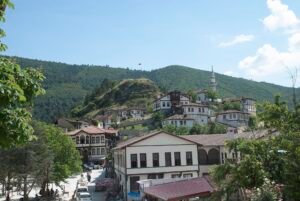
Image: Ancient walls of Trebizond 2.jpg — Kitabi Hamdi, Public domain