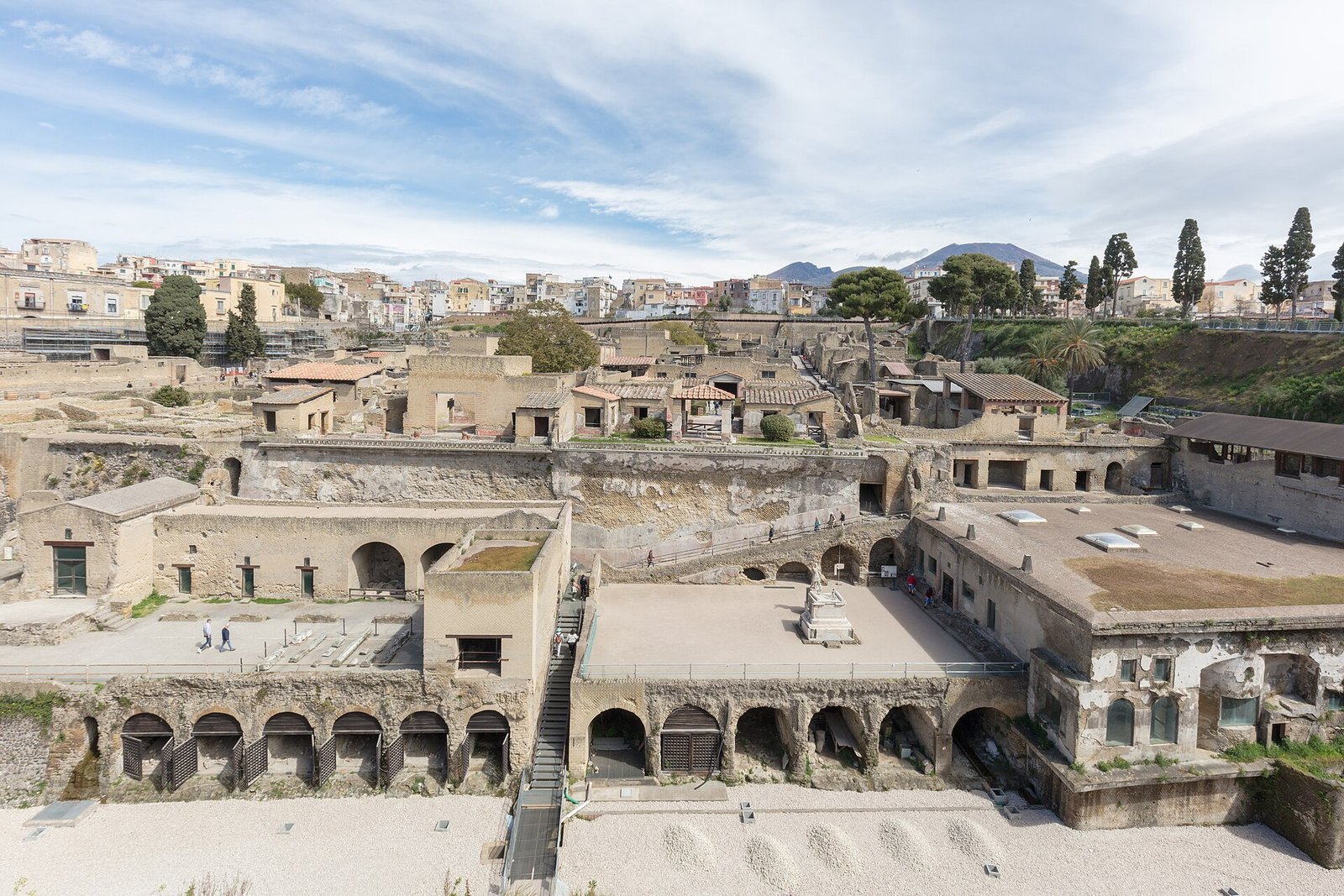
Herculaneum is an ancient Roman town in modern Ercolano, in Italy’s Campania region, about 8 kilometres southeast of Naples. It was preserved differently from Pompeii because hot volcanic currents carbonized wood and papyri, while approximately 20 metres of volcanic material buried the town. Pompeii lay largely beneath ash and lapilli; at Herculaneum, deep burial also created oxygen-free conditions that protected the carbonized papyri from further decay.
A wooden staircase, a house key and a book roll bring different parts of Herculaneum into focus. You can follow these objects from a coastal Roman settlement through the eruption of AD 79 to the excavations beneath modern Ercolano. The ancient shoreline adds another part of the story: approximately 300 people found in vaulted waterfront spaces.
Where is Herculaneum, and what kind of Roman town was it before the eruption?
Herculaneum stood on a plateau facing the sea, at the foot of Vesuvius. Two streams bounded it to the east and west. Its small harbour and coastal setting attracted wealthy landowners who acquired summer residences there.
The archaeological park estimates that the town occupied approximately 20 hectares within its walls. Its population was about 4,000. These figures describe a small settlement whose surviving houses and streets formed part of a larger town still largely buried beneath Ercolano.
The street plan followed the shoreline. Streets called decumani ran parallel to the coast. The cardines crossed them at right angles, creating rectangular blocks. If you use the ancient coast as your reference, this arrangement helps you understand the town’s layout.
Herculaneum became a Roman municipium after its conquest in 89 BC, following its revolt against Rome. An earthquake caused substantial damage in AD 62. The eruption buried the town in AD 79, placing its final destruction after an earlier episode of serious disruption.
How did volcanic currents bury the town in AD 79?
The central difference between Herculaneum and Pompeii concerns the material that overwhelmed them. UNESCO describes Pompeii as buried largely beneath ash and lapilli. Herculaneum was engulfed by pyroclastic surges and flows carrying hot gas and particles.
The archaeological park places the temperature of the first hot clouds to strike Herculaneum at approximately 400°C. It gives the thickness of the volcanic covering as about 20 metres. Heat and deep burial together explain the conditions in which the town’s organic remains survived.
The eruption’s exact date remains disputed. The traditional date is 24 August AD 79. Research announced by INGV in 2022 instead supported 24–25 October, drawing on a charcoal inscription dated 17 October at Pompeii and seasonal finds.
The uncertainty concerns the day and month, rather than the year. Herculaneum was buried in AD 79. Its destruction involved hot volcanic currents, and those currents produced a different preservation environment from the ash and lapilli that largely covered Pompeii.
Under what conditions were wooden structures and papyri preserved?
At Herculaneum, intense heat carbonized wood and other organic materials. Surviving finds include doors, stairs, lintels and partitions. These remains preserve parts of buildings that are rarely available from the ancient world.
The papyri followed a related process. According to the Herculaneum Society, heat carbonized the rolls. The covering above them then created an oxygen-free environment that prevented further decay. Their survival depended on both the initial heating and the conditions after burial.
Karl Weber and his team recovered approximately 1,800 papyrus fragments from the Villa dei Papiri between 1752 and 1754. The Herculaneum Society estimates that these may represent about 800 original book rolls. The fragment count therefore does not equal the number of books.
Weber drew the villa’s first plan in 1754. Much of the building remains beneath the modern town. Its atrium was partly excavated in 1996–1998, while investigation of its seaside pavilion in 2007 recovered remains of valuable wooden furniture.
Burial depth also affected later study. The University of Cambridge explains that Herculaneum lay deeper than Pompeii and that extensive areas were excavated more recently. This allowed preserved organic materials to be examined using more developed methods.
What do human remains on the ancient shoreline reveal about attempted escape?
Twelve vaulted spaces faced Herculaneum’s ancient beach. Approximately 300 skeletons were found in nine of them. The archaeological park suggests that these spaces may have served as storerooms or boat shelters before the eruption.
Women and men, young and old, were found together along the shore. The park interprets their presence as evidence that people gathered there hoping for rescue. The remains place an attempted escape at the waterfront, beneath the town’s sea-facing edge.
Objects found beside the victims included jewellery, bags containing coins, house keys, amulets and a surgeon’s instrument kit. You can connect the keys to the everyday act of taking yours when you leave home; here, house keys were among the possessions carried to the shoreline.
A further skeleton was found on the ancient beach in late 2021. Described as the “last fugitive,” it belonged to an adult man approximately 40–45 years old. The discovery added another individual to the archaeological evidence from the coast.
Details you won’t find in guidebooks
Herculaneum’s organic finds extend beyond structural wood and book rolls. Archaeologists also recovered a press, textiles, ropes, grain and fruit. These materials broaden the surviving record from buildings to objects and substances used in everyday life.
Early attempts to read the papyri could destroy the layers being studied. Rolls were cut vertically. After a layer had been copied, it could be scraped away to expose the material underneath. The history of these books therefore includes losses during their examination.
A boat overturned during the eruption was uncovered in front of the Suburban Baths. Work to expose it began on 3 August 1982. More than 9 metres long, it was arranged for six rowers and a helmsman.
The ancient beach lies approximately 3 metres below present sea level. Its conservation requires drainage systems that collect spring water and rainwater. Following three years of drainage and site works, the beach reopened to visitors on 19 June 2024.
How much of the buried town has excavation and conservation revealed?
Approximately 4.5 hectares of Herculaneum are visible, out of an estimated ancient area of 20 hectares. Much of the town remains beneath the modern settlement. UNESCO notes that some sections have been investigated only through eighteenth-century tunnels.
Systematic underground exploration began in 1738 on the orders of Carlo di Borbone, King of Naples. Investigators reached the buried town through shafts and tunnels penetrating approximately 20 metres of covering. This approach produced access beneath the occupied modern settlement.
Amedeo Maiuri began extensive excavations in 1927. His work exposed, restored and opened much of the area that forms today’s archaeological park. The visible town consequently reflects both ancient survival and the history of excavation and restoration.
The Herculaneum Conservation Project was established in 2001 through the Packard Humanities Institute, with support from David Packard. It brought conservation, research and public education together. Herculaneum had already joined Pompeii and Torre Annunziata on the UNESCO World Heritage List in 1997.
Timeline
- 89 BC: Rome conquers Herculaneum, which becomes a municipium.
- AD 62: An earthquake causes substantial damage.
- AD 79: Pyroclastic currents bury the town; the eruption’s day and month remain disputed.
- 1738: Systematic exploration through shafts and tunnels begins.
- 1752–1754: Karl Weber and his team recover carbonized papyri from the Villa dei Papiri.
- 1754: Weber draws the villa’s first plan.
- 1927: Extensive excavations begin under Amedeo Maiuri.
- 3 August 1982: Work begins to expose the ancient boat outside the Suburban Baths.
- 1996–1998: The Villa dei Papiri’s atrium is partly excavated.
- 1997: Herculaneum enters the UNESCO World Heritage List with Pompeii and Torre Annunziata.
- 2001: The Herculaneum Conservation Project is established.
- 2007: Wooden furniture remains are found in the villa’s seaside pavilion.
- Late 2021: The man described as the “last fugitive” is found on the ancient beach.
- 19 June 2024: The ancient beach reopens after drainage and site works.
FAQ
Where is Herculaneum?
Herculaneum is in modern Ercolano, in Italy’s Campania region, approximately 8 kilometres southeast of Naples.
Why was Herculaneum preserved differently from Pompeii?
Pompeii was buried largely beneath ash and lapilli. Herculaneum experienced hot pyroclastic currents that carbonized organic materials, while deep burial protected materials such as papyri from further decay.
Did people try to escape through Herculaneum’s waterfront?
Approximately 300 skeletons were found in nine vaulted spaces facing the ancient beach. The archaeological park interprets the gathering as people waiting in hope of rescue.
How much of Herculaneum is exposed?
Approximately 4.5 hectares are visible out of an ancient town estimated at about 20 hectares. Much of Herculaneum remains beneath the modern settlement.
Sources
- The Herculaneum Society — The Story of Herculaneum herculaneum.ox.ac.uk
- Parco Archeologico di Ercolano — The Story ercolano.cultura.gov.it
- Parco Archeologico di Ercolano — Area Archeologica ercolano.cultura.gov.it
- UNESCO — Archaeological Areas of Pompei, Herculaneum and Torre Annunziata whc.unesco.org
- Parco Archeologico di Ercolano — The Eruption ercolano.cultura.gov.it
- Vikipedi — Herkulaneum tr.wikipedia.org
- INGV — Ancient mysteries of the AD 79 eruption revealed ingv.it
- Parco Archeologico di Ercolano — Organic finds ercolano.cultura.gov.it
- The Herculaneum Society — Papyri herculaneum.ox.ac.uk
- Parco Archeologico di Ercolano — Villa of the Papyri ercolano.cultura.gov.it
- University of Cambridge — Herculaneum Conservation Project classics.cam.ac.uk
- Parco Archeologico di Ercolano — The Escapees ercolano.cultura.gov.it
- Italian Ministry of Culture — Reopening of the ancient beach cultura.gov.it
- Italian Ministry of Culture — Parco archeologico di Ercolano, Area archeologica cultura.gov.it
- Parco Archeologico di Ercolano — From discovery to archaeological park ercolano.cultura.gov.it
Image: Antigua ciudad de Herculano, Italia, 2023-03-27, DD 141.jpg — Diego Delso, CC BY-SA 4.0