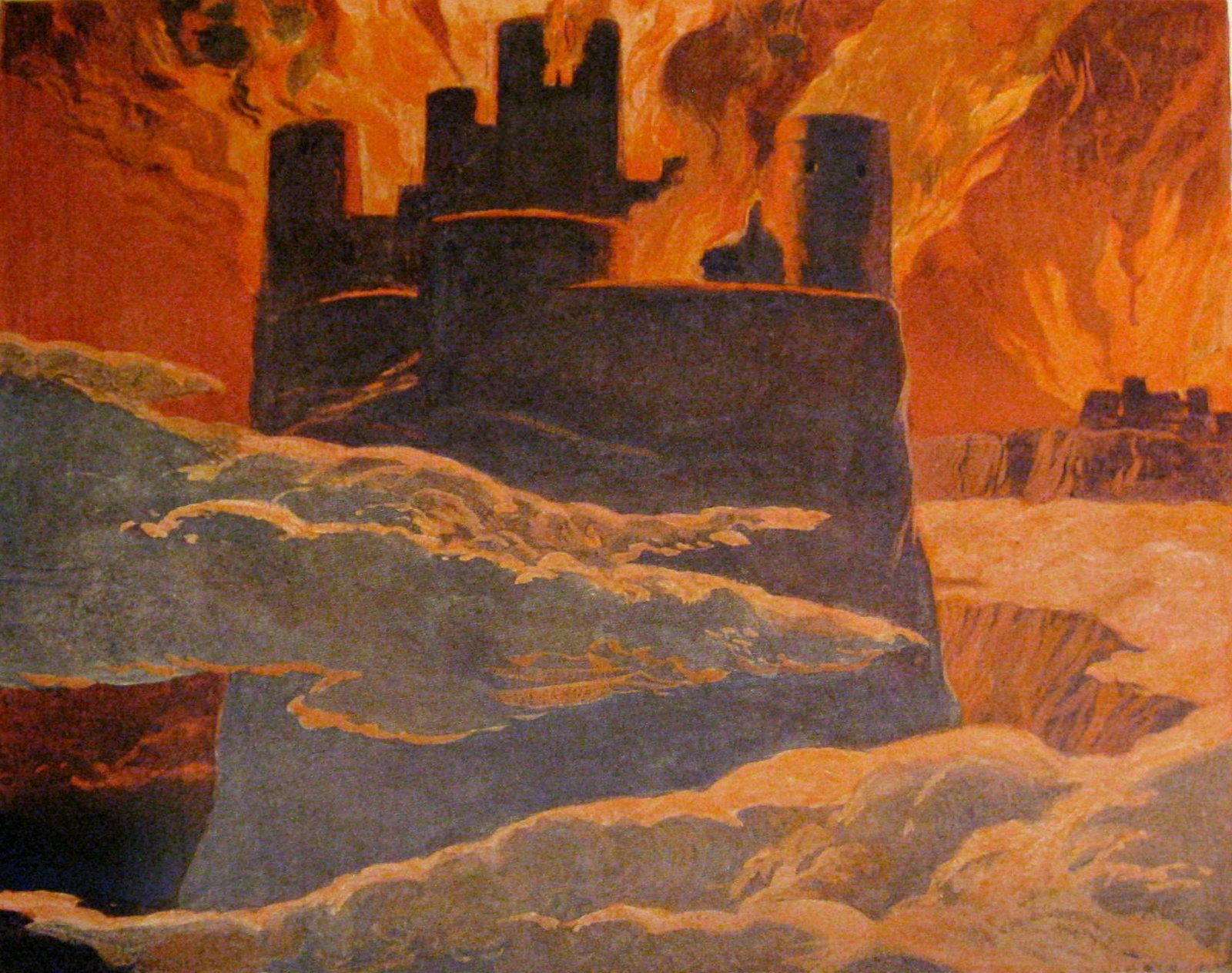
Ragnarök is the sequence of events in Norse mythology that brings the gods’ final battle, the destruction of the world and its rebirth. Odin falls to Fenrir, Thor dies after killing Jörmungandr, and surviving gods and humans inhabit a renewed world.
Why do gods prepare for a battle whose outcome they already know? The Æsir foresee Ragnarök but cannot change the fate governed by the Norns. If you want to understand the myth behind its familiar name, begin with that limit on divine power. Its meaning, medieval sources and individual battles explain how destruction leads to renewal.
Ragnarök meaning: what does the name mean?
The Old Norse name Ragnarǫk joins two elements. Ragna refers to the gods. Rǫk indicates fate or outcome. The name is generally interpreted as the final fate of the gods. That meaning fits an account in which even Odin cannot escape death.
“Twilight of the Gods” comes from the variant Ragnarøkkr. Wagner’s opera Götterdämmerung helped popularize that wording in 1876. The familiar phrase therefore has a different linguistic basis from Ragnarǫk. If you encounter both translations, the distinction lies in the forms of the name.
Ragnarök pronunciation
English Wikipedia gives the Old Norse pronunciation of Ragnarǫk as [ˈrɑɣnɑˌrɒk] in the International Phonetic Alphabet. This transcription belongs to the Old Norse word. It accompanies the form whose elements refer to the gods and their fate or outcome.
Ragnarök in Norse mythology: where does the story come from?
The principal written sources are the Poetic Edda and the Prose Edda. Snorri Sturluson compiled the latter in the 1220s. These medieval accounts preserve the destruction of the gods’ world and the lives that continue afterward.
The tradition has earlier traces. The tenth-century skaldic poems Eiríksmál and Hákonarmál contain references to Ragnarök. Their dates place evidence for the tradition before Snorri’s compilation. The surviving account therefore cannot be treated simply as a story originating with his book.
The main manuscript of the Poetic Edda is Codex Regius. It dates to approximately 1270 and carries the identifier GKS 2365 4to. This manuscript preserves poems central to the written transmission of Norse mythology, including the tradition through which Ragnarök is known.
In Völuspá, a völva, or female seer, recounts the world’s past and future. Ragnarök belongs within that wider vision. Its battles are part of an account that looks backward to earlier events and forward to a world beyond destruction.
What happens before the final battle?
In Snorri’s account, Fimbulvetr consists of three successive winters without a summer between them. The interruption of the seasons precedes the final conflict. Winter does not give way to its usual seasonal relief.
Chapter 51 of Gylfaginning also describes three winters of warfare before Fimbulvetr. Brothers kill one another, and kinship bonds collapse. These are separate details in the account: warfare within human society comes before the prolonged winter without intervening summers.
The gods receive their warning when Heimdallr blows Gjallarhorn. Odin and the Einherjar warriors then go to the plain of Vígríðr. The horn marks the summons to a battle for which Odin’s warriors have already been preparing.
The Swedish History Museum describes valkyries choosing those who will die in battle. Odin receives half of the selected warriors in Valhalla. There, the Einherjar train with weapons every day in preparation for Ragnarök.
You can connect that preparation with an everyday habit: practising regularly before a demanding event. Odin’s warriors follow a daily training routine. Yet the Æsir’s foreknowledge remains central to the myth. Preparation does not give them the power to change the fate governed by the Norns.
Who dies at Ragnarök?
Fenrir swallows Odin. Odin’s son Víðarr then kills the wolf. The sequence places a father’s death and his son’s response within the same final conflict. Odin’s preparations do not prevent his fall.
Thor kills Jörmungandr but cannot survive the serpent’s poison. He takes only nine steps before dying. If you remember one precise detail from his battle, remember those steps: his victory and death belong to the same encounter.
The Prose Edda gives other confrontations equally fatal outcomes. Loki and Heimdallr kill one another. Týr and Garmr also both die in their encounter. These pairings make the final battle a series of losses on both sides.
Freyr faces Surtr without the sword he gave to Skírnir. He is defeated. His missing weapon is an explicit part of the explanation for his defeat, tying a previously surrendered possession to his final confrontation.
Bifröst breaks as the sons of Múspell cross it. Surtr eventually sets the world on fire. The destruction therefore extends beyond the deaths of individual gods: the bridge breaks, and the world itself burns.
How does the world return after Ragnarök?
Víðarr and Váli survive Ragnarök. So do Thor’s sons, Magni and Móði. Baldr returns from Hel. The renewed world thus contains both survivors of the catastrophe and a god who comes back from the realm of the dead.
Human life also continues. Líf and Lífþrasir survive the disaster and become the ancestors of humanity as it multiplies again. The myth’s account of destruction includes a specific human continuation through this pair.
Völuspá describes fields producing crops without being sown. It also places the gods’ old golden gaming pieces in the grass of the renewed world. These details give the return of life concrete forms: growing food and objects recovered from the earlier world.
Timeline
- Tenth century: Eiríksmál and Hákonarmál contain early traces of the Ragnarök tradition.
- 1220s: Snorri Sturluson compiles the Prose Edda, preserving a connected account of Ragnarök.
- Around 1270: Codex Regius, the principal manuscript of the Poetic Edda, is produced.
- 1876: Wagner’s Götterdämmerung helps spread the wording “Twilight of the Gods.”
- 2021: A study by Smith, Ólafsson and Pálsdóttir interprets Viking Age activity at Surtshellir as ritual practice.
Details you won’t find in guidebooks
In the Prose Edda, Naglfar is made from the nails of dead people. The ship sets out for the final battle. Its material is one of the account’s most specific physical details, connecting the dead with the approaching conflict.
Valhalla’s mythical architecture also has precise numbers. It has 540 doors, each allowing 800 Einherjar to pass through at once. These figures accompany the account of warriors trained for Ragnarök.
The golden gaming pieces in Völuspá are old objects found again after the world’s renewal. Together with the unsown fields, they make the aftermath more concrete than a simple statement that life returns. Food grows, and objects from the earlier world reappear.
Surtr also has an association with a physical place: Surtshellir lava cave in Iceland. Archaeologists documented a Viking Age stone structure shaped like a ship about 300 metres inside its entrance. The structure provides material evidence for activity within the cave.
Surtshellir had been regarded as an outlaw refuge since the 1750s. A 2021 study by Smith, Ólafsson and Pálsdóttir instead interpreted its animal-bone deposits as evidence of ritual activity lasting 80–120 years. That interpretation concerns the accumulated archaeological remains.
The proposed purpose of the offerings remains debated. One interpretation connects them with appeasing Surtr. Another connects them with strengthening Freyr, who would fight him. These are alternative explanations of the finds, rather than an established identification of the rituals’ purpose.
Could Christian ideas have influenced Ragnarök?
Snorri wrote in Christian Iceland. One theory holds that Christian ideas influenced his account. Ragnarök also has roots in pre-Christian Germanic tradition. The question concerns the influence on the surviving presentation of a tradition with earlier foundations.
Store norske leksikon explains Ragnarök through an imbalance between cosmic forces that have confronted one another since the world’s beginning. In that reading, the catastrophe is not chiefly punishment for human sins. The gods themselves remain subject to fate.
FAQ
What does Ragnarök mean?
The Old Norse Ragnarǫk combines ragna, referring to the gods, with rǫk, meaning fate or outcome. It is generally understood as the final fate of the gods.
Who kills Odin and Thor at Ragnarök?
Fenrir swallows Odin, and Odin’s son Víðarr then kills the wolf. Thor kills Jörmungandr but dies from the serpent’s poison after taking nine steps.
Who survives Ragnarök?
Víðarr, Váli, Magni and Móði survive, while Baldr returns from Hel. The human survivors Líf and Lífþrasir become the ancestors of renewed humanity.
Is Ragnarök a punishment for human wrongdoing?
Store norske leksikon explains Ragnarök through an imbalance between cosmic forces rather than punishment for human sins. Possible Christian influence on the surviving accounts remains a subject of interpretation.
Sources
- Türkçe Vikipedi — Ragnarök tr.wikipedia.org
- English Wikipedia — Ragnarök en.wikipedia.org
- Árni Magnússon Institute — New electronic edition of Codex Regius of the Poetic Edda arnastofnun.is
- Store norske leksikon — Ragnarok snl.no
- Swedish History Museum — Valkyriorna tog emot i Valhall vikingar.historiska.se
- Journal of Archaeological Science — Surtshellir study, USF academic repository digitalcommons.usf.edu
- Archaeology Magazine — Boat-Shaped Viking Structure Found in Icelandic Cave archaeology.org
Image: Ragnarök by Doepler.jpg — Emil Doepler, Public domain