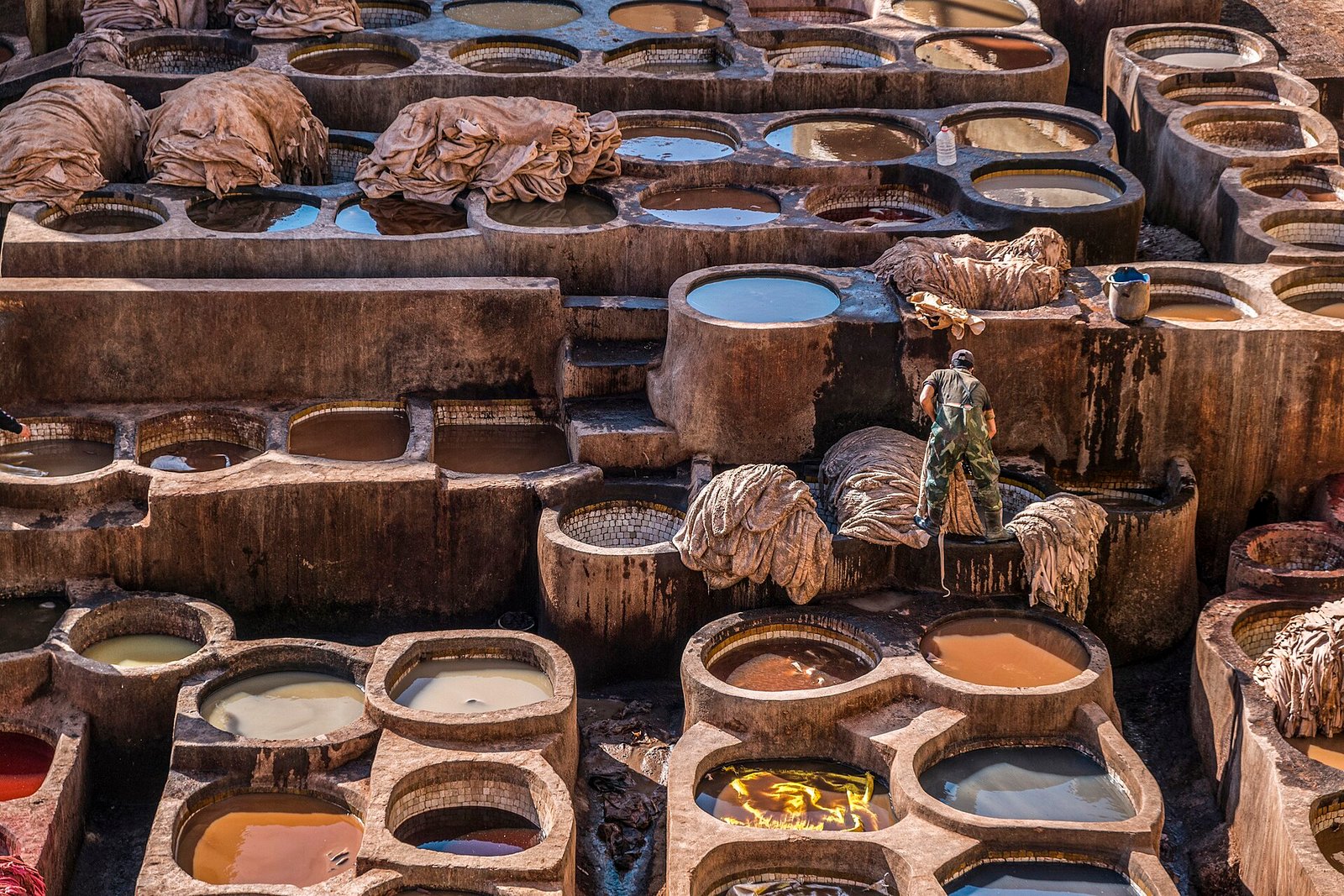
Fez is a historic city in Morocco’s Fes-Meknes region in North Africa, northwest of the Atlas Mountains. Its old settlement grew around the Oued Fes river, and its medina is known for medieval buildings, centres of learning, and traditional crafts. The Chouara tannery stands in Fes el-Bali, beside the river near Saffarin Madrasa.
The coloured tanning pits are part of a larger story. Fez began as separate settlements across a river, became a capital under the Marinids, and developed markets organised around particular trades. If you follow those connections, the medina becomes easier to understand: its walls, religious buildings, workshops, and public baths belong to the same urban history.
Fez, Morocco, on the map
The Oued Fes flows from west to east through the area where the old settlement developed. That river provides a useful starting point for understanding the city. Early Fez consisted of two separately walled settlements, with Andalusian and Kairouanese quarters on opposite sides of the water.
Three names help you read the city’s historical geography: Fes el-Bali, Fes el-Jdid, and Ville Nouvelle. The first two are historic urban districts. Ville Nouvelle was established during French colonial rule. These divisions reflect different stages of growth, rather than a city built in a single period.
Fes el-Jdid lies west of the older city. The Marinids founded it in 1276 with a palace and military centre. Its position matters: the new foundation expanded the city while giving royal and military functions a distinct setting beside the older settlement.
Fez, Morocco: medina history
UNESCO traces the medina’s beginnings to Idrisid foundations between 789 and 808. The familiar image of one enclosed old city therefore hides an earlier arrangement. At first, the river separated two walled communities. Their later union was a major change in the physical organisation of Fez.
The Almoravids brought those settlements within a single wall system in the 11th century. During the Marinid period, especially the 13th and 14th centuries, Fez replaced Marrakech as the capital. Madrasas, mosques, palaces, and fountains formed part of the city’s development under that dynasty.
UNESCO describes the city’s architectural techniques and decoration as a combination of local craftsmanship and Andalusian, Eastern, and African influences. That mixture belongs to the construction and ornament of the medina itself. Fez’s buildings preserve evidence of connections extending beyond the city and its river valley.
The medina entered the UNESCO World Heritage List in 1981. Its inscribed area covers 280 hectares. This designation encompasses an urban setting whose history includes religious buildings, markets, public baths, and craft production, rather than the story of a single monument.
Timeline
- 789–808: Idrisid foundations established the core of Fez.
- 859: Construction began on Qarawiyyin Mosque.
- 11th century: The Almoravids united the two settlements within one wall system.
- 1276: The Marinids founded Fes el-Jdid.
- Late 18th century: Ayn Azliten tannery was established in northern Fez.
- 1912: Morocco’s political capital moved to Rabat.
- 1981: The medina entered the UNESCO World Heritage List.
- 2005–2007: Qarawiyyin Mosque underwent restoration.
Fez, Morocco: the Chouara tannery
Chouara is the largest tannery in Fez. It stands beside the river in Fes el-Bali, near Saffarin Madrasa. Its coloured pits are used to process sheep, cattle, and goat hides into leather suitable for craft production. The setting connects leather production with the geography of the city’s old settlement.
Its foundation date needs careful wording. Local tradition links Chouara to Idris II in the early ninth century. Historians, however, describe its early history as insufficiently documented. The traditional account is part of the tannery’s story, but it does not establish a securely dated beginning.
Traditional leather preparation uses baths containing substances including lime, salt, water, and pigeon droppings. Natural colouring materials include indigo for blue and henna for orange. If you look at the pits, these facts give their colours a practical meaning: they belong to the preparation and dyeing of animal hides.
Chouara is not the only tannery in the city’s history. Ayn Azliten, in northern Fez, was founded in the late 18th century. Its documented period of establishment offers a separate reference point, distinct from the uncertain early foundation traditionally claimed for Chouara.
Fez, Morocco: mosque and learning history
The history of learning in Fez includes Qarawiyyin Mosque, where construction began in 859. The Almoravids enlarged the building in the 12th century. These dates show that its architectural history unfolded across different periods, with later rulers expanding an existing religious institution.
A restoration between 2005 and 2007 was led by architect Mohammed Fikri Benabdallah and carried out with Moroccan specialists. Following that work, Qarawiyyin again admitted women students to its classes. The restoration therefore connects the care of a historic building with the continuation of teaching inside it.
The city’s wider educational setting also includes the madrasas built during its Marinid flourishing in the 13th and 14th centuries. Mosques, madrasas, palaces, and fountains belonged to the same period of capital-city development. Learning formed part of the urban fabric that took shape under Marinid rule.
Fez, Morocco: things to do through its craft history
To understand the medina’s working history, you can follow the trades associated with its markets. The historic souks were organised around craft communities. The Nejjarine quarter is known for woodworking, while Seffarine Square is associated with metalworkers producing trays and teapots from iron, copper, and silver.
A tray or teapot provides an everyday connection to that history. When you carry tea on a tray at home, its familiar function helps explain the practical objects made at Seffarine Square. The square’s craft tradition concerns things used in daily life, as well as the skill required to shape metal.
Public bathing adds another dimension to the medina. The Saffarin, Mokhfiya, and Ben Abbad hammams date approximately to the 14th century. Alongside the mosques and markets, these baths preserve evidence of a city organised around shared daily needs, including washing and the use of public facilities.
Details you won’t find in guidebooks
An account transmitted by the historian al-Jazna’i records 86 tanning workshops in Fez during the Almohad period. The figure places leather production within a much broader workshop landscape. Chouara’s fame today should be read alongside that historical account of numerous tanning establishments across the city.
Attarin Market once specialised in materials used in traditional medicine. Monumental wooden gates stand at its two ends and were closed in the evenings. Those details reveal both a specialised commercial role and a physical means of controlling access to the market at the end of the day.
The early division between Andalusian and Kairouanese quarters also gives the river a social history. It separated two walled settlements before the Almoravids enclosed them together. The later medina thus incorporated communities whose earlier boundaries had been more substantial than a simple division between neighbourhoods.
Fez and Marrakech: a historical connection
Fez and Marrakech are linked through the history of Morocco’s capital. During the Marinid period in the 13th and 14th centuries, Fez replaced Marrakech in that role. The construction of madrasas, mosques, palaces, and fountains belongs to this period of political importance and urban development.
In 1912, Morocco’s political capital moved to Rabat. Fez nevertheless retained its cultural and spiritual importance. Its continuing place in Moroccan life is therefore connected to institutions, buildings, and crafts whose significance extended beyond the presence of political government.
Fez, Morocco: population and the historic city
The 2024 census recorded a population of 1,256,172 for Fez. That figure describes the city, while UNESCO’s 280-hectare inscription concerns the medina’s listed area. Keeping those different scales in mind helps you place the historic districts within the larger city, which also includes Ville Nouvelle.
FAQ
Where is Fez in Morocco?
Fez is in Morocco’s Fes-Meknes region, northwest of the Atlas Mountains. Its old settlement developed around the Oued Fes river.
When was the Fez medina founded?
UNESCO traces its origins to Idrisid foundations between 789 and 808. The Almoravids united its two early settlements within one wall system in the 11th century.
How old is the Chouara tannery?
Local tradition connects Chouara with Idris II in the early ninth century. Historians caution that its early foundation history is not securely documented.
What is the history of Qarawiyyin in Fez?
Construction of Qarawiyyin Mosque began in 859. The Almoravids expanded it in the 12th century, and a restoration took place between 2005 and 2007.
Sources
- UNESCO World Heritage Centre — Medina of Fez whc.unesco.org
- Aga Khan Development Network — Rehabilitation of Al-Qaraouiyine Mosque the.akdn
- Moroccan National Tourism Office — Fès brochure visitmorocco.com
- Wikipedia — Fez, Morocco en.wikipedia.org
- Wikipedia — Chouara Tannery en.wikipedia.org
- Turkish Wikipedia — Fes (şehir)) tr.wikipedia.org
Image: Leather tanning in Fez, Morocco.jpg — Wowan1978, CC BY-SA 4.0