Þingvellir is in southwest Iceland, about 40 kilometres northeast of Reykjavík, within the municipality of Bláskógabyggð. Iceland’s general assembly, the Alþing, was founded here around 930. It met outdoors each summer, bringing lawmaking and court proceedings into a valley that also filled with temporary shelters.
If you want to understand how this assembly worked, start with its summer rhythm. Meetings lasted about two weeks. Local leaders gathered to conduct legislative and judicial business, while farmers, families, craftspeople, storytellers, and travellers also came to the grounds.
Where is Þingvellir National Park in Iceland?
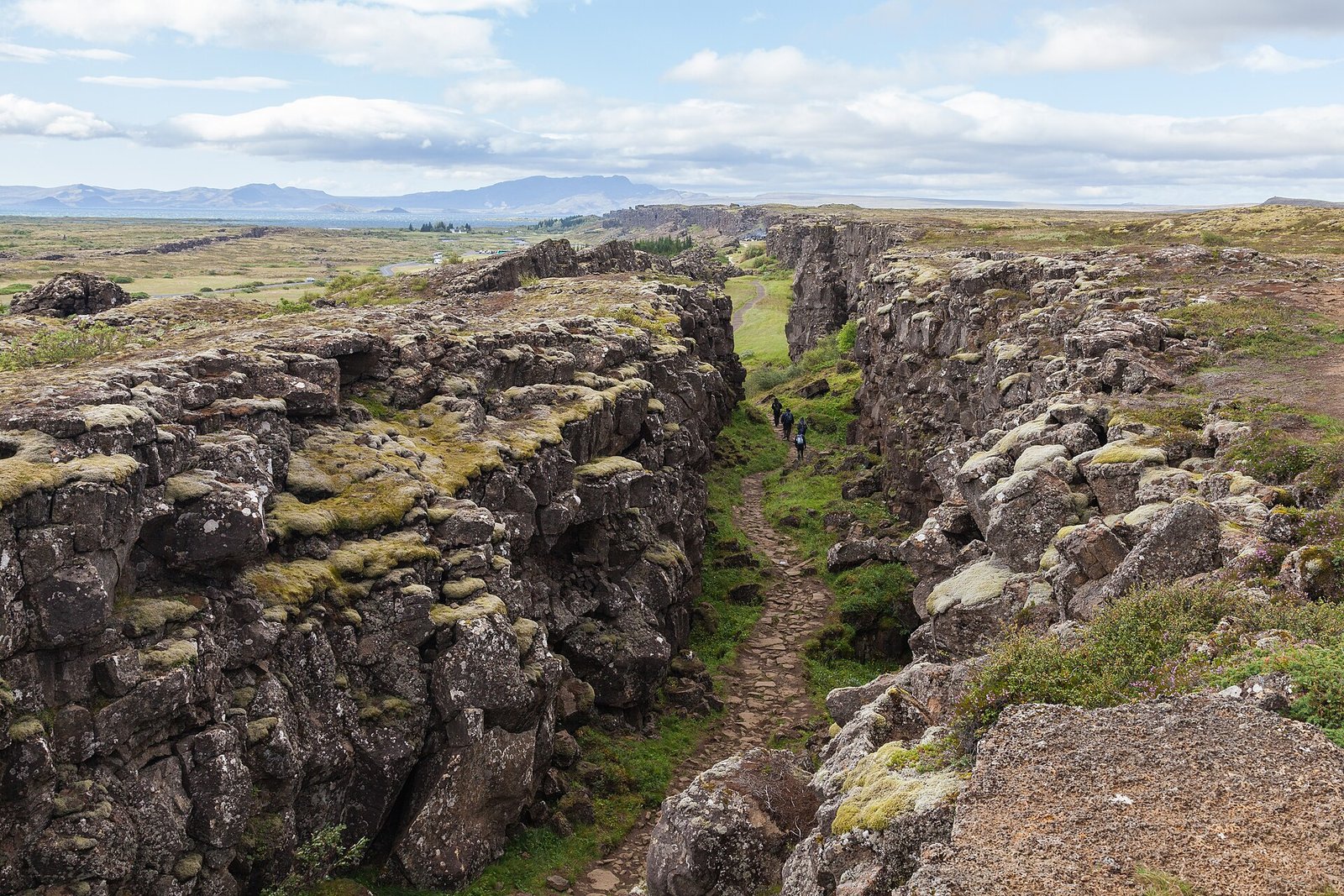
Þingvellir occupies a rift valley on the Mid-Atlantic Ridge. It marks the boundary between the North American and Eurasian plates. The historic assembly grounds therefore sit within a landscape shaped by the movement of two tectonic plates.
Þingvallavatn lies south of the historic meeting area. The Öxará River forms Öxarárfoss waterfall in the Almannagjá fissure. These names help you place the assembly grounds within the surrounding landscape: the lake to the south, and the river and waterfall associated with Almannagjá.
The valley has changed since the first assembly gathered. Its floor has subsided by approximately three to four metres since the Alþing was established. The ground beneath the surviving assembly remains has therefore moved during the site’s long history.
What does Þingvellir mean, and how do you pronounce it?
Þingvellir means “assembly plains.” The name combines the Old Norse þing, meaning assembly, with vǫllr, meaning plain. It names the place through the activity that brought people there.
The Icelandic pronunciation is [ˈθiŋkˌvɛtlɪr̥]. The initial letter Þ sounds like the opening sound of the English word “thirst.”
How did Iceland’s historic assembly meet there?
The Alþing began meeting at Þingvellir around 930 and held its final gathering there in 1798. Its summer sessions took place in the open air. Over roughly two weeks, participants made laws and worked through disputes.
Powerful local leaders called goðar came together for legislative and judicial business. All free men could attend the assembly. Attendance consequently extended beyond those directing its formal work, bringing farmers and other visitors into the same temporary gathering.
Women also attended. Natascha Mehler’s 2015 study distinguishes their presence from their political authority: women were largely excluded from the decision-making bodies. A crowded assembly ground did not give everyone gathered there the same role in its decisions.
For an everyday-life connection, think of the difference between attending a meeting and having a vote. At Þingvellir, that distinction mattered. Families, craftspeople, storytellers, and travellers could be present around an assembly whose formal business rested with particular officeholders and bodies.
What happened at Lögberg, the Law Rock?
Lögberg, or the Law Rock, was the focal point of assembly proceedings during the Icelandic Commonwealth, approximately 930–1262/1264. The assembly opened and closed there. Decisions of the legislative body, the Lögrétta, and announcements concerning the wider community were proclaimed there too.
The lawspeaker, called the lögsögumaður, had a central speaking role. The Lögrétta elected this official for a three-year term. Each summer, the lawspeaker recited one-third of the laws then in force from memory at Lögberg.
That schedule connected the office’s three-year term with the public recital of the law. You can understand why the lawspeaker mattered: legal knowledge had to be voiced before the gathering. The role joined a fixed term of service with a repeated duty to speak the laws aloud.
Lögberg’s exact location remains disputed. One proposed position is a rock ledge above the Hallurinn slope, where the present flagpole stands. Another places it beneath Almannagjá’s high rock wall. Neither proposal establishes its precise location with certainty.
How did the Alþing make laws and hear cases?
The Lögrétta was the Alþing’s legislative body. It adopted new laws, considered legal disputes, and could grant exceptions to existing laws. Lögberg provided a place for public proclamations, while the Lögrétta carried out these legislative functions.
After Iceland was divided into four regions around 965, the Alþing had a court for each region. Each court consisted of 36 judges. These regional courts gave judicial proceedings a structure tied to the country’s four divisions.
A further court appeared in the early eleventh century. Known as the Fifth Court, it had 48 judges. It dealt with cases that the other courts had failed to resolve, adding another body to the assembly’s judicial arrangements.
Where did assembly visitors stay?
People attending the Alþing stayed in temporary shelters called búðir. Their walls were built from stone and turf blocks, with cloth roofs placed above them. These shelters accommodated participants during the summer assembly.
About 50 assembly shelter remains survive at Þingvellir. Most of the visible remains date to the seventeenth and eighteenth centuries. They were probably built over earlier structures, so the surviving walls do not all belong to the assembly’s earliest centuries.
The gathering also raises a historical question about trade. In 1953, historian Björn Þorsteinsson described Þingvellir as Iceland’s largest trading place. Mehler’s 2015 research found the evidence weak and argued that commerce largely served the needs of assembly participants.
Where should you go in Þingvellir to understand its history?
For a historically focused visit, connect the assembly shelter remains with the proposed locations of Lögberg. The shelters show where participants stayed. The Law Rock’s role explains where the assembly opened, closed, and heard public announcements, even though its exact position is debated.
Almannagjá and the Öxará River also belong to the site’s historical story. According to Haukdælaþáttur, an account in the Sturlunga compilation, the river was diverted into Almannagjá to make water easier for assembly visitors to reach. The account connects the gathering’s practical needs with its landscape.
The lake south of the assembly area, Þingvallavatn, provides another geographical reference. Together with Almannagjá, Öxará, and the shelter remains, it helps you relate the historic meeting grounds to named features of the valley.
Details you won’t find in guidebooks
The lawspeaker was the Icelandic Commonwealth’s only salaried official. This paid position carried the responsibility of reciting the laws and occupied a central place in proceedings at Lögberg.
Bad weather could change where the laws were spoken. The legal compilation Grágás allowed their recital inside the church at Þingvellir when conditions were poor. The assembly’s open-air setting therefore had a specific indoor provision for this duty.
Weapons were prohibited in the Lögrétta area in 1154. Bishop Magnús Gizurarson renewed the ban in 1234. The restriction applied to a defined part of the assembly grounds where legislative business took place.
What major decisions and changes happened at Þingvellir?
According to the national park’s historical account, Þorgeir Ljósvetningagoði decided at the Alþing in the summer of 1000 that Icelanders should adopt Christianity. The decision also permitted pagan worship to continue in private.
Lögberg’s earlier public function ended after Iceland accepted the authority of the Norwegian king in 1262–1264. Assemblies nevertheless continued at Þingvellir beyond that change. The final Alþing meeting on the site took place in 1798.
A protection law passed in 1928 stipulated that the protected area should remain the property of the Icelandic nation forever, under Alþing oversight. The national park was established in 1930, marking the thousandth anniversary of the assembly’s foundation.
On 17 June 1944, the Republic of Iceland was established at Þingvellir. Sveinn Björnsson was elected president there. In 2004, Þingvellir National Park entered the UNESCO World Heritage List under cultural criteria three and six.
Timeline
- Around 930: The Alþing was founded at Þingvellir.
- Around 965: Regional courts were established for Iceland’s four divisions.
- Summer of 1000: According to the park’s historical account, Þorgeir Ljósvetningagoði decided at the Alþing that Icelanders should adopt Christianity.
- Early eleventh century: The Fifth Court was created for unresolved cases.
- 1154: Weapons were banned in the Lögrétta area.
- 1262–1264: Acceptance of Norwegian rule ended Lögberg’s earlier public function.
- 1798: The Alþing met at Þingvellir for the last time.
- 1928: A law protected Þingvellir.
- 1930: The national park was established.
- 17 June 1944: The Republic of Iceland was established at Þingvellir.
- 2004: Þingvellir became a UNESCO World Heritage Site.
FAQ
Where is Þingvellir National Park in Iceland?
Þingvellir is in the municipality of Bláskógabyggð in southwest Iceland, about 40 kilometres northeast of Reykjavík. It occupies a rift valley at the boundary between the North American and Eurasian plates.
What does Þingvellir mean, and how is it pronounced?
The name means “assembly plains,” from Old Norse þing, meaning assembly, and vǫllr, meaning plain. Its Icelandic pronunciation is [ˈθiŋkˌvɛtlɪr̥], with Þ sounding like the opening sound of “thirst.”
How did Iceland’s historic assembly meet at Þingvellir?
The Alþing gathered outdoors each summer for about two weeks. Participants stayed in temporary shelters while the assembly made laws, heard disputes, and announced decisions.
Where was the Law Rock at Þingvellir?
Its exact location remains disputed. Proposed sites include a rock ledge above the Hallurinn slope, where the present flagpole stands, and a position beneath Almannagjá’s high rock wall.
Sources
- Wikipedia — Þingvellir tr.wikipedia.org
- Wikipedia — Þingvellir: name and pronunciation en.wikipedia.org
- Þingvellir National Park — History thingvellir.is
- UNESCO — Þingvellir National Park whc.unesco.org
- Icelandic Parliament — Althingi althingi.is
- Natascha Mehler — Þingvellir: A Place of Assembly and a Market? eaglehill.us
- UNESCO — Þingvellir nomination dossier and ICOMOS evaluation whc.unesco.org
- Þingvellir National Park — Þinghelgin thingvellir.is
- Þingvellir National Park — Lögberg thingvellir.is
- Þingvellir National Park — Kristnitaka thingvellir.is
- Þingvellir National Park — Stórhátíðir thingvellir.is
Image: Roca de la Ley, Parque Nacional de Þingvellir, Suðurland, Islandia, 2014-08-16, DD 022.JPG — Diego Delso, CC BY-SA 4.0