Haydarpaşa railway station: a waterfront gateway
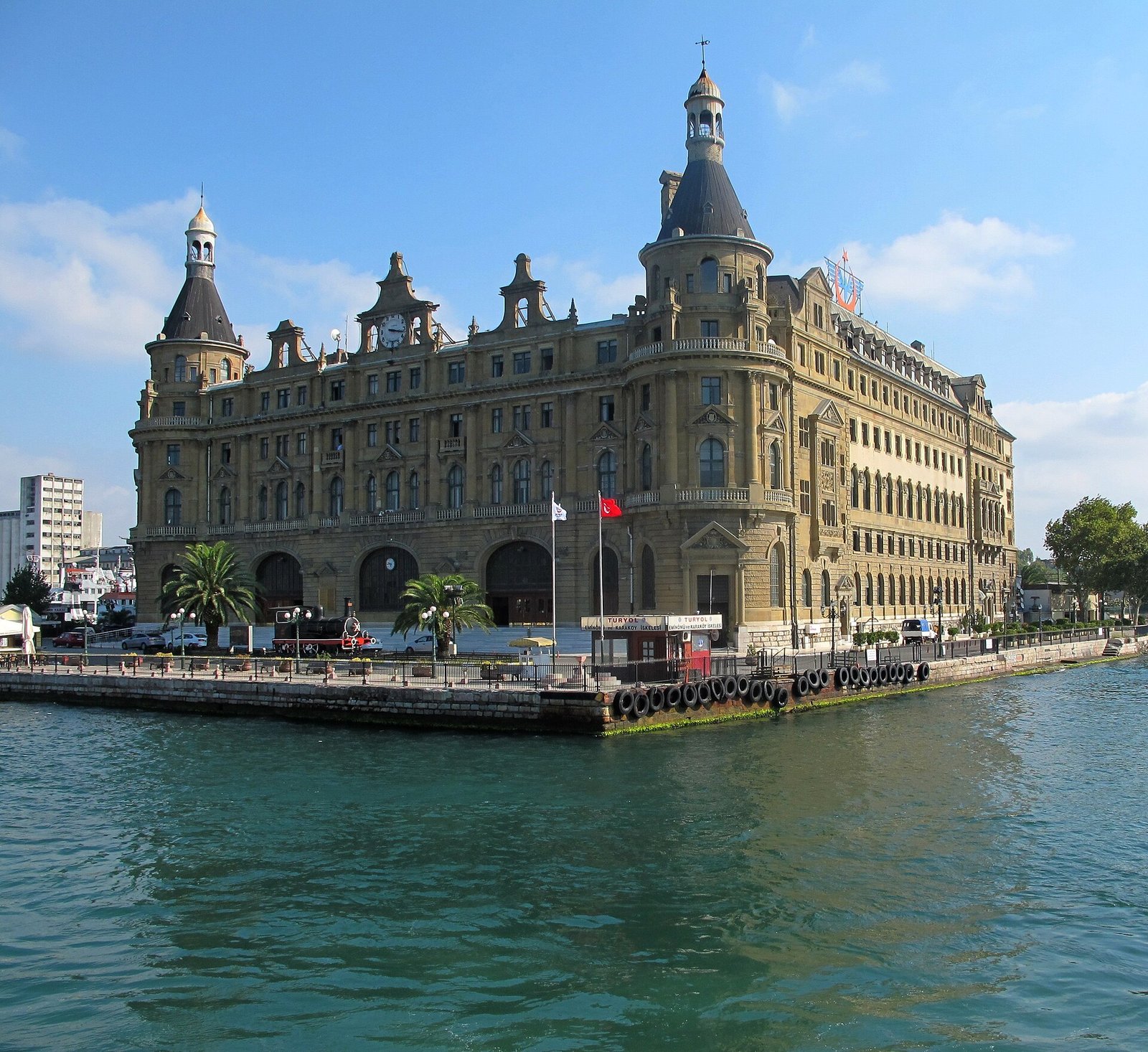
Haydarpaşa railway station stands beside the sea in Rasimpaşa, within Istanbul’s Kadıköy district on the Asian side. Its story begins with a railway opened in 1872. It later became the Baghdad Railway’s northern starting terminal. That change connects a particular stretch of waterfront to a much larger transport project.
The station also offers a way into Istanbul’s collective memory. Its history includes long-distance departures, suburban journeys, and a ferry landing directly outside. You can approach it through monumental architecture. But the electric suburban service introduced in 1969 supplies an everyday-life connection: the station also belonged to the repeated journey between home and another part of the city.
Today, its historical layers extend beneath the tracks. Excavations begun in 2018 uncovered remains around ancient Khalkedon’s western harbour. Railway construction, archaeological discoveries, and restoration now share the same site. Understanding Haydarpaşa means keeping those different histories in view.
How did Haydarpaşa become a Baghdad Railway terminal?
In 1871, Sultan Abdülaziz ordered a railway between Haydarpaşa and İzmit. The first station building and railway line entered service on 22 September 1872. This was the beginning of Haydarpaşa’s railway history. It was not the opening of the building that stands there today.
The Ottoman Anatolian Railway Company took over the station and line in 1888. Another turning point followed in 1904. Haydarpaşa was selected as the Baghdad Railway’s northern starting terminal. Increasing traffic and this expanded role created the need for a larger station.
Construction of the present building began in 1906. The sequence matters. Haydarpaşa first served a railway towards İzmit. It then acquired a place within the Baghdad Railway project. The larger building followed that change in responsibility and demand.
If you associate Haydarpaşa with the Baghdad Railway, 1904 is therefore the key date. The station itself was already operating decades earlier. Its railway history and the history of its present building overlap, but they have different starting points.
When did the present station building open?
The TDV İslâm Ansiklopedisi identifies Otto Ritter and Helmuth Cuno as the architects of the present station. It dates the building’s completion to 1908. Turkish Wikipedia gives 19 August 1908 as the date it entered service.
English Wikipedia places the official opening on 4 November 1909, Sultan Mehmed V’s birthday. These dates describe different milestones: completion, entry into service, and official opening. Keeping those labels attached to their dates makes the chronology easier to follow.
The waterfront setting gained another architectural element in 1917. Vedat Tek designed the ferry landing in front of the station. It was decorated with Kütahya tiles. The landing places ferry architecture directly beside the railway terminal, linking two forms of travel within the same waterfront scene.
Timeline
- 1871: Sultan Abdülaziz orders construction of the Haydarpaşa–İzmit railway.
- 22 September 1872: The first station and railway line enter service.
- 1888: The Ottoman Anatolian Railway Company takes over the station and line.
- 1904: Haydarpaşa becomes the Baghdad Railway’s designated northern starting terminal.
- 1906: Construction begins on the present station building.
- 19 August 1908: The present building enters service, according to Turkish Wikipedia.
- 4 November 1909: English Wikipedia dates the official opening to this day.
- 1917: Vedat Tek designs the ferry landing outside the station.
- 29 May 1969: Electric suburban services begin on the Haydarpaşa–Gebze line.
- 28 November 2010: Fire breaks out on the station roof during repairs.
- February 2012: Long-distance train services stop.
- 19 June 2013: Suburban services stop, ending passenger train service at the station.
- 6 December 2013: Two workers and a company owner receive convictions over the fire.
- 2018: Archaeological excavations begin in the platforms and railway grounds.
- By October 2021: Excavations have yielded approximately 12,000 coins.
- April 2022: A Hellenistic cremation burial is announced.
- 23 September 2026: An announcement links delays to strengthening against liquefaction risk and project changes for new archaeological discoveries.
- 2027: The announced target year for that phase, rather than a confirmed passenger-service reopening.
What happened to Haydarpaşa’s train services?
Electric operation began on the Haydarpaşa–Gebze suburban line on 29 May 1969, following electrification. This gives the station’s history a local scale alongside its Baghdad Railway role. Haydarpaşa served suburban travel as well as longer journeys.
Long-distance trains stopped in February 2012 for the Istanbul–Ankara high-speed railway and Marmaray works. Suburban services continued beyond that point. Their suspension on 19 June 2013 brought passenger train service at Haydarpaşa to an end.
The distinction between these interruptions is useful when you read about the station’s closure. February 2012 marks the suspension of long-distance services. June 2013 marks the later end of suburban services. Passenger operations stopped in stages.
What happened in the 2010 fire?
A fire broke out on Haydarpaşa’s roof during repair work on 28 November 2010. The fire belongs to the station’s recent history alongside the later interruption of train services. The events occurred at different times and should be understood separately.
During the court proceedings, the defence raised the possibility of an electrical fault. On 6 December 2013, the court convicted two workers carrying out insulation work and the company owner of negligently causing the fire. Each received a ten-month prison sentence.
The proposed electrical explanation and the court’s finding are different parts of that record. The defence advanced one possible cause. The judgment established criminal responsibility for negligently causing the fire. Preserving that distinction avoids turning a disputed explanation into a settled fact.
Details you won’t find in guidebooks
Haydarpaşa’s building has a U-shaped plan, but its arms are unequal. The northern arm is shorter than the southern one. This detail gives you a more precise way to think about the architecture than the waterfront frontage alone allows.
The district’s name also carries a historical disagreement. The TDV İslâm Ansiklopedisi challenges the view that connects it to a pasha of Selim III. Instead, it points towards Haydar Pasha, who built a pavilion here in the sixteenth century. It also acknowledges uncertainty over his identity.
Beneath the railway grounds, the discoveries reach much further back. By October 2021, excavations had yielded approximately 12,000 coins. They included an early Khalkedon city coin dated to the fifth century BCE. The quantity and that early example give the excavation a scale beyond an isolated find.
A collective grave was uncovered in the apse of a structure identified as the Church of Saint Bassa. It contained approximately 28 individuals. The identification of the building and the location of the burial add a religious and funerary layer to the station grounds.
Another burial was announced in April 2022. This Hellenistic tile grave contained evidence of cremation. According to Rahmi Asal, two funerary gifts had been left with it. The discovery adds a different burial practice to the archaeological picture.
The excavations also uncovered security tunnels made by soldiers during the Second World War. Ancient burials and wartime tunnels therefore occupy the same broader excavation story. Haydarpaşa’s underground history extends across several periods, rather than ending with ancient Khalkedon.
What lies beneath the railway platforms?
Archaeological work began in the station’s platforms and railway grounds in 2018. In 2021, Istanbul Archaeology Museum director Rahmi Asal stated that the excavation area lay within ancient Khalkedon’s western harbour. This places the railway site within a much older waterfront setting.
The coins, graves, and security tunnels give that setting several distinct historical layers. The railway arrived in 1872. The fifth-century BCE coin and Hellenistic burial belong to much earlier periods. The Second World War tunnels add another chapter beneath the railway grounds.
Haydarpasa railway station Istanbul: restoration and the 2027 target
In 2026, the Ministry of Culture and Tourism reported that restoration and conservation were complete on the station’s three façades facing the Sea of Marmara. The scaffolding on those façades had been removed. This was a specific milestone within the wider restoration.
Structural work remained central to the timetable. On 23 September 2026, Minister Mehmet Nuri Ersoy said original plans showed approximately 1,000 timber foundation piles. Ground-penetrating radar had located only 200 in place. Those figures concerned the building’s foundations, beneath its visible architecture.
The same announcement linked delays to strengthening against liquefaction risk and project changes for new discoveries in the archaeological park. As of 1 November 2026, the latest announced target was completion of the first phase during 2027. You should read that as a phase-completion target. It supplied no definite day for passenger trains to return.
FAQ
Where is Haydarpaşa railway station in Istanbul?
Haydarpaşa stands on the waterfront in Rasimpaşa, a neighbourhood of Kadıköy on Istanbul’s Asian side.
When did Haydarpaşa Station open?
The first station opened on 22 September 1872. The present building was completed in 1908. Turkish Wikipedia dates its entry into service to 19 August 1908, while English Wikipedia dates the official opening to 4 November 1909.
How was Haydarpaşa connected to the Baghdad Railway?
Haydarpaşa was selected as the Baghdad Railway’s northern starting terminal in 1904. That role, together with increasing traffic, created demand for a larger station building.
When will passenger trains return to Haydarpaşa?
As of 1 November 2026, the latest announcement targeted completion of the first phase during 2027. It did not give a definite date for passenger trains to resume.
Sources
- Vikipedi — Haydarpaşa Garı tr.wikipedia.org
- Wikipedia — Haydarpaşa railway station en.wikipedia.org
- TDV İslâm Ansiklopedisi — Haydarpaşa islamansiklopedisi.org.tr
- Anadolu Agency — Verdict in the Haydarpaşa Station fire case aa.com.tr
- Anadolu Agency — Archaeological excavations at Haydarpaşa Station aa.com.tr
- Anadolu Agency — Hellenistic tile grave discovered at Haydarpaşa aa.com.tr
- Ministry of Culture and Tourism — Haydarpaşa restoration announcement basin.ktb.gov.tr
- Habertürk — Minister Ersoy’s statement on Haydarpaşa’s restoration timetable haberturk.com
Image: Haydarpaşa Terminal in Istanbul..JPG — edit:Alborzagros owner:Far-gh, CC BY-SA 4.0