Who was Ali Qushji?
Ali Qushji was a fifteenth-century astronomer, mathematician, and language scholar whose career connected Samarkand with Istanbul. He studied in the scholarly circle of Uluğ Bey, worked on astronomical tables, and eventually taught under Mehmed II. His journey also passed through Kirman and the court of Uzun Hasan in Tabriz.
If you follow Ali Qushji from Samarkand to Istanbul, you encounter more than a travelling astronomer. His career joined observation, mathematical instruction, diplomacy, and arguments about how astronomy should establish its claims. His books addressed both the heavens and practical calculation. One became a mathematics textbook in Ottoman madrasas.
His birth belongs to the early fifteenth century, probably in Samarkand. The frequently repeated year 1403 is uncertain. The TDV İslâm Ansiklopedisi treats his exact birth date as unknown. This distinction matters when reading accounts that present a precise year without qualification.
Ali al Qushji: what was his name?
The scholar encountered under the name Ali al Qushji is also known as Ali Kuşçu. His personal name was Alâeddin Ali, and his father was Muhammed. The name Kuşçu came from his father’s work as Uluğ Bey’s chief falconer. A court occupation thus became attached to the name of an astronomer.
Ali Kuşçu’s education placed him among several scholars in Samarkand. He studied mathematics and astronomy with Uluğ Bey, Kadızâde-i Rûmî, and Gıyâseddin Cemşîd el-Kâşî. These subjects remained central to his later writing, even as his career moved between Timurid and Ottoman territories.
From Samarkand to Kirman
After studying in Samarkand, Ali Qushji continued his work in Kirman, within present-day Iran. On returning to Samarkand, he presented Uluğ Bey with Hallü eşkâli’l-kamer, a treatise concerning the Moon. The work gives a concrete example of his astronomical interests before his eventual move to Istanbul.
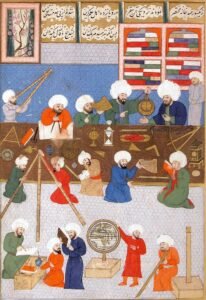
Ali Qushji also worked at Uluğ Bey’s observatory. There he contributed to the astronomical tables known as the Zîc-i Sultânî. His contribution belonged to a shared scholarly undertaking. Alongside his own treatise on the Moon, the tables formed part of his work in Samarkand.
Uluğ Bey’s killing in 1449 became a decisive break in that career. It helped bring Ali Qushji’s Samarkand working period to an end. His later route led through Tabriz, where the Akkoyunlu ruler Uzun Hasan provided patronage and employed him as an envoy.
How did Ali Qushji reach Istanbul?
Ali Qushji met Mehmed II as Uzun Hasan’s ambassador. The Ottoman ruler invited him to remain in Istanbul. Ali Qushji first returned to Tabriz to complete his diplomatic assignment and report to Uzun Hasan. His permanent move followed that return.
MacTutor dates his settlement in Istanbul to approximately 1472. He arrived with his family and students. Mehmed II appointed him as a teacher at the Ayasofya Madrasa. Among the students he trained in Istanbul was Molla Lutfi, connecting his own education in Samarkand with a later Ottoman teaching career.
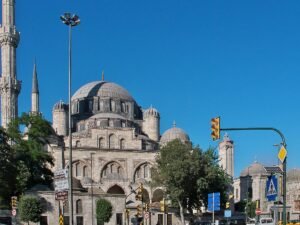
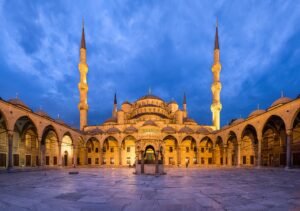
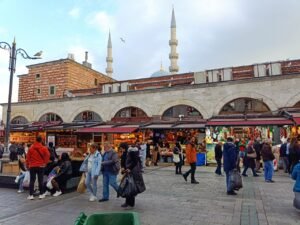
If you are visiting Istanbul, Ayasofya and Eyüp Sultan provide two geographical anchors for his story. The Ayasofya Madrasa was his teaching appointment. The Eyüp Sultan burial ground became his resting place after his death in 1474. Together, they locate his final years within the city.
Ali Qushji books: what did he write?
Ali Qushji’s writings included the lunar treatise Hallü eşkâli’l-kamer, the astronomy work er-Risâletü’l-Fethiyye, and the mathematics book er-Risâletü’l-Muhammediyye fi’l-hisâb. Their subjects show why his reputation encompasses both astronomy and mathematics. His scholarship also included a commentary on Tûsî’s Tecrîdü’l-i‘tikād.
He dedicated the Fethiyye to Mehmed II following the ruler’s victory over Uzun Hasan in 1473. The dedication links the astronomy book to the same rulers who shaped his diplomatic journey. Uzun Hasan had employed him as an envoy, while Mehmed later appointed him to teach in Istanbul.
The Muhammediyye was also presented to Mehmed II. It subsequently served as an intermediate mathematics textbook in Ottoman madrasas. Its calculation section covered decimal positional Indian arithmetic, the base-sixty arithmetic used by astronomers, and quadratic equations. These were distinct mathematical methods brought together within one teaching work.
Its second section examined surface areas and volumes. Subjects included spheres, portions of spheres, and cones. If you approach Ali Qushji only through astronomy, these chapters reveal another side of his work: the measurement of surfaces and solid bodies.
The book’s composition date has competing accounts. Kâtib Çelebi associated it with Ali Qushji’s first diplomatic journey. TDV instead supports Taşköprizâde’s dating to February 1473, drawing on the work’s introduction. February 1473 therefore has textual support beyond a later biographical claim.
Could the Earth rotate?
In his commentary on Tûsî’s Tecrîdü’l-i‘tikād, Ali Qushji argued that astronomy did not have to depend on Aristotelian natural philosophy. This concerned the foundations of astronomical reasoning. It also shaped his treatment of the question of whether the Earth must remain motionless.
Ali Qushji maintained that valid observational evidence did not conclusively establish the Earth’s immobility. He further argued that assuming the Earth’s rotation did not necessarily create a contradiction. His position left rotation open as a possibility. It did not amount to an observational demonstration that the Earth rotated.
Abdülalî el-Bircendî challenged this position in the early sixteenth century. He argued that natural philosophy could prove the Earth’s immobility. Their disagreement concerned both the Earth’s motion and the authority of philosophical arguments within astronomy.
Details you won’t find in guidebooks
One account reported by MacTutor describes a scientific discussion during Ali Qushji’s arrival in Istanbul. While crossing the Bosphorus, the participants discussed the causes of water movement. The crossing thus appears in the historical narrative as an occasion for scientific argument as well as travel.
The Muhammediyye supplies an everyday-life connection through its definition of number. Ali Qushji framed that definition to include one. When you count a single object before counting several, you can use that familiar act to approach the issue: his definition explicitly admitted one within the category of number.
The same book used the terms müsbet and menfi. Their origin remains a matter of interpretation. Ali Qushji’s own invention and transmission from Chinese mathematics are treated as separate possibilities. The vocabulary is documented; choosing one explanation as certain would go beyond that evidence.
The Fethiyye also had a later life in Turkish. It was translated in 1548 under the title Hulâsatü’l-hey’e and in 1824 as Mir’âtü’l-âlem. These translations carried an astronomy work dedicated in 1473 into later periods of readership.
Timeline
- Early fifteenth century: Probably born in Samarkand; the commonly cited year 1403 is uncertain.
- Studies and work before Istanbul: Studied in Samarkand, continued his work in Kirman, and worked at Uluğ Bey’s observatory in Samarkand.
- 1449: Uluğ Bey was killed, a decisive disruption to Ali Qushji’s working life in Samarkand.
- Diplomatic mission: Met Mehmed II as Uzun Hasan’s envoy.
- Around 1472: Settled permanently in Istanbul with his family and students.
- February 1473: Composed the Muhammediyye according to the dating TDV supports through its introduction.
- 1473: Dedicated the Fethiyye to Mehmed II following his victory over Uzun Hasan.
- December 1474: Died in Istanbul and was buried at Eyüp Sultan; sources differ on the day.
- 1548: The Turkish translation Hulâsatü’l-hey’e was prepared.
- 1824: The Turkish translation Mir’âtü’l-âlem was prepared.
- 2024: The 550th anniversary of his death entered UNESCO’s anniversary programme.
Death in Istanbul and later remembrance
Ali Qushji died in Istanbul in December 1474. TDV gives 15 December. Istanbul Medeniyet University gives 17 December, identifying the date as 7 Şaban 879. Both accounts place his death in 1474, and his burial was in the Eyüp Sultan burial ground.
His death’s 550th anniversary entered UNESCO’s 2024 Anniversaries Programme through a joint submission by Türkiye and Uzbekistan. The commemoration connected the countries associated with the beginning and end of his journey: his early life in Samarkand and his final teaching years in Istanbul.
FAQ
Who was Ali Qushji?
Ali Qushji was a fifteenth-century astronomer, mathematician, and language scholar. He trained in Samarkand and later taught at the Ayasofya Madrasa in Istanbul.
Which books did Ali Qushji write?
His works include the lunar treatise Hallü eşkâli’l-kamer, the astronomy work er-Risâletü’l-Fethiyye, and the mathematics textbook er-Risâletü’l-Muhammediyye fi’l-hisâb.
Did Ali Qushji argue that the Earth could rotate?
He argued that valid observational evidence did not conclusively establish the Earth’s immobility. He also maintained that assuming its rotation did not necessarily produce a contradiction.
Where is Ali Qushji buried?
He is buried in the Eyüp Sultan burial ground in Istanbul. He died in December 1474, although sources give different days.
Sources
- TDV İslâm Ansiklopedisi — Ali Kuşçu islamansiklopedisi.org.tr
- University of St Andrews, MacTutor — Ali Qushji mathshistory.st-andrews.ac.uk
- TDV İslâm Ansiklopedisi — er-Risâletü’l-Muhammediyye islamansiklopedisi.org.tr
- Istanbul Medeniyet University — Ali Kuşçu Kabri Başında Yad Edildi bilimtarihienstitu.medeniyet.edu.tr
- Turkish National Commission for UNESCO — Anma ve Kutlama Yıl Dönümleri unesco.org.tr
Image: Mirzo Ulughbek and Ali Kushchi in the observatory.jpg — Davide Mauro, CC BY-SA 4.0