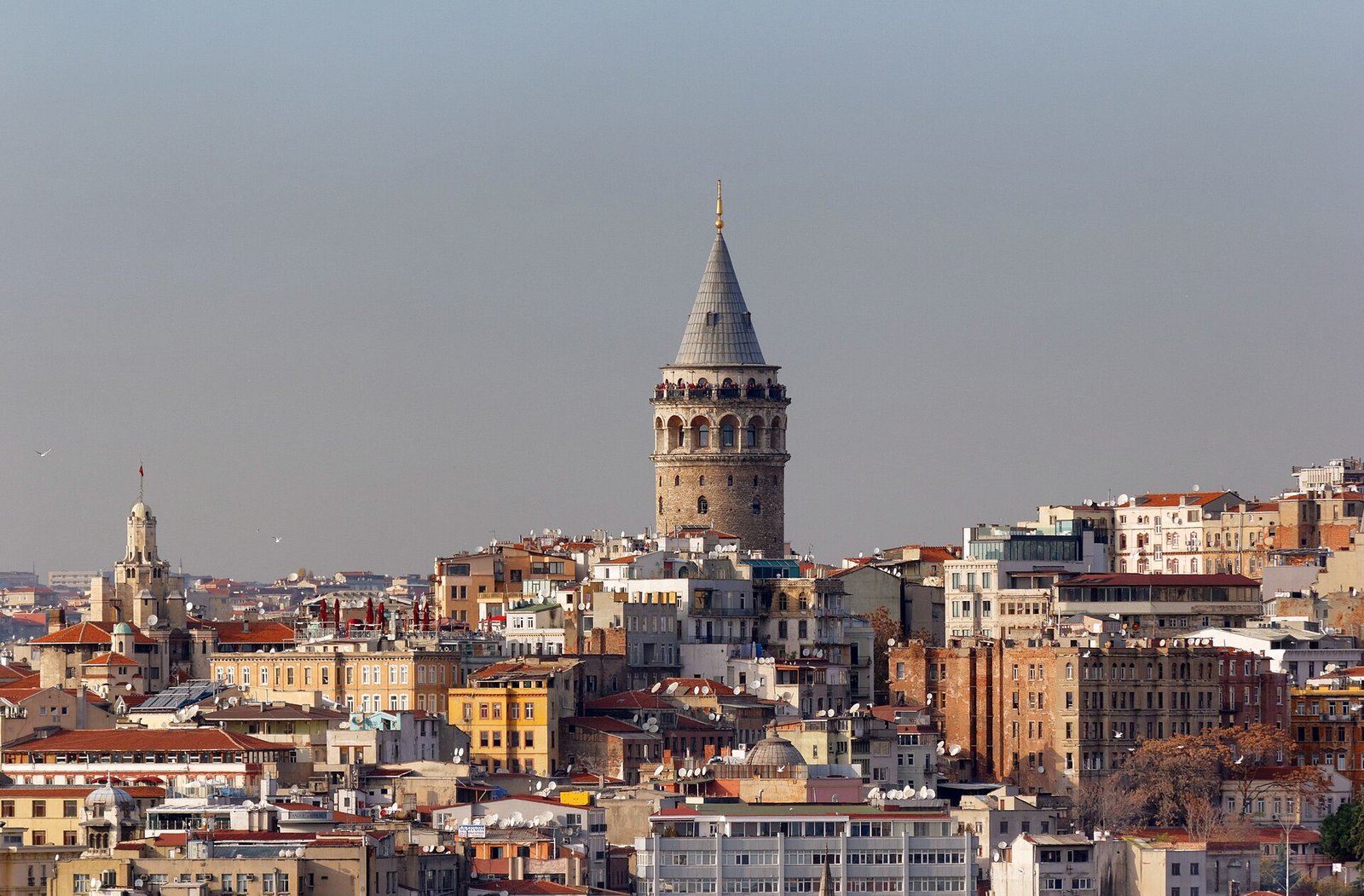
The Galata Tower is a stone tower that has served as a fortress lookout, a prison, a fire watch, a café and a museum. It also carries one of Istanbul’s best-known legends. This guide separates what the records show from what the stories add.
Where is the Galata Tower in Istanbul?
The tower stands on the European side of Istanbul. It is in the Bereketzade neighbourhood of the Galata district, which belongs to Beyoğlu, according to the Ministry of Culture and Tourism.
The Culture Portal lists two ways to reach it. You can walk uphill from Karaköy along Bankalar Caddesi. Or you can use the Tünel.
So if you search for “a Galata Tower legend, where is it located”, the answer is the same place. The legend and the tower share one address.
Galata Tower history: the Genoese colony
The story starts with an alliance. The Genoese were allied with the Byzantine Empire. Under that arrangement they founded the colony of Pera in Galata, north of the Golden Horn, in 1267.
A colony on the shore needed protection. Attackers could come by land. So the Genoese fortified the settlement with walls, and the Galata Tower was the main tower of that defence.
The tower you see today was built in 1348. The Ministry’s museum brochure describes it as a watchtower of the Galata walls. A lookout like this was a practical tool. From its top, guards could see trouble coming.
The Genoese had their own name for it: Turris Sancte Crucis. It means Tower of the Holy Cross. The name pointed to the cross on its top. Most guidebooks skip this detail.
Under the Ottomans: repairs, prisoners and fire watchers
On 29 May 1453, Istanbul was conquered. The Genoese of Pera handed the colony to the Ottomans without a fight. The tower passed into Ottoman hands with it.
The tower was damaged in the earthquake of 1509. Architect Hayreddin directed the repair, which was finished in mid-1510.
In the 16th century the tower took on a darker role. It and the other towers of the Galata walls housed and imprisoned Christian prisoners of war. These men worked in the Kasımpaşa shipyards.
From the 18th century the job changed again. The Mehterhâne Ocağı, the Ottoman military band corps, and professional fire watchers used the tower to watch for fires. Think of the smoke alarm in your own kitchen. The tower did the same job for a whole city, only with human eyes.
Fires, a storm and a coffeehouse
Fire was the tower’s business, and fire also changed the tower.
After the fire of 1794, the repair turned the upper part of the tower into a coffeehouse. A fire lookout became a place to drink coffee.
The fire of 2–3 August 1831 brought the next change. In the repair that followed, builders added a hall with 14 windows to the top. They also added a balcony with iron railings that wraps around the upper floor.
The tower’s south entrance carries an inscription about the 1831–1832 repair. It includes a poem by the poet Pertev. When you stand at the door, look up and find it.
Then came the weather. In 1875 a storm blew the roof off. Afterwards, two wooden floors were added to the top so that the fire watch could continue.
From restoration to museum
The 20th century turned the tower toward visitors. The restoration of 1965–1967 arranged it for tourist use. The roof was rebuilt to resemble its conical 19th-century look.
The 2020 restoration went further. It removed the reinforced-concrete elements added later, and it removed the cafeteria. The tower reopened with the function of a museum.
In 2013 the tower was placed on UNESCO’s World Heritage Tentative List. It was listed as part of a group of sites tied to Genoese trade routes in the Mediterranean and the Black Sea. A tentative listing is a first step and not a full inscription.
The Hezarfen story: legend, not record
This is the part most visitors come for.
The tale says Hezarfen Ahmed Çelebi flew from the Galata Tower in the 17th century. He supposedly landed at the Doğancılar Square in Üsküdar. The source is Evliya Çelebi, who tells it in his travel book.
Here is the catch. According to the TDV Islamic Encyclopedia, what we know about Hezarfen rests only on Evliya Çelebi’s Seyahatnâme. No independent historical record confirms the flight. So treat it as a story that was passed down, not as a proven event.
The author of that entry, Mustafa Kaçar, also does the arithmetic. The distance from Galata to Doğancılar is about 3,200 metres. He says a person could not cover that by flapping wings. A simple glider is only a possibility worth thinking about.
The story still left a mark. In 1950 the PTT issued a 20-kuruş commemorative stamp for the International Civil Aviation Congress in Istanbul. It shows Hezarfen’s flight from the Galata Tower.
What is inside the museum?
The Ministry’s brochure describes several things worth finding.
- On the 4th floor, the historic chain that once closed the entrance of the Golden Horn is on display.
- On the 7th floor, there is a model of Istanbul at a scale of 1/2500. Six tablets support it.
- The elevator runs up to the 6th floor. The panoramic viewing balcony on the 8th floor is reached by stairs.
The tower’s roofline height is 62.59 metres. Its outer diameter is 16.45 metres, and its inner diameter is 8.95 metres.
Galata Tower tickets, entrance fee and price
The official tariff of the Ministry’s DÖSİMM, checked on 24 October 2026, lists the entrance fee for foreign visitors as 30 euros.
The same tariff says holders of a Turkish ID card can enter with the Müzekart. The tower’s museum page announces a night-museum ticket for Müzekart holders with a Turkish ID number. It costs 200 TL on top of their existing entry rights.
Prices change. Look at the Ministry pages listed under Sources before you plan your day.
Galata Tower photos: where to find them
The Culture Portal’s Galata Tower page carries photos of the tower. They are credited to Gülcan Acar and to the General Directorate of Promotion. If you need images for a project, check the credit lines and the rules on that page first.
For your own photos, remember what the tower is: a lookout. The 8th-floor balcony is the viewpoint.
Details you won’t find in guidebooks
- The Genoese name, Turris Sancte Crucis, means Tower of the Holy Cross. It referred to the cross on the top.
- After the 1794 fire, the top of the tower became a coffeehouse.
- The 1875 storm blew the roof off, and two wooden floors were added so the fire watch could go on.
- The south entrance inscription about the 1831–1832 repair holds a poem by Pertev.
- A 1950 Turkish postage stamp of 20 kuruş shows Hezarfen’s flight, even though the flight itself is unproven.
- The model of Istanbul on the 7th floor is at 1/2500 scale and rests on six tablets.
Timeline
- 1267: The Genoese found the Pera colony in Galata.
- 1348: The present Galata Tower is built as part of the Genoese fortifications.
- 1453: After the conquest of Istanbul, Pera and the tower pass to Ottoman rule.
- 1509–1510: The earthquake-damaged tower is repaired.
- 16th century: The tower holds prisoners of war.
- 17th century: Evliya Çelebi records the Hezarfen flight story.
- 18th century: The tower is used for fire watching.
- 1794: After a fire, the top is turned into a coffeehouse.
- 1831–1832: After another fire, a 14-window hall and an iron-railed balcony are added to the top.
- 1875: A storm blows off the roof.
- 1950: A PTT stamp shows Hezarfen’s flight.
- 1965–1967: Restoration prepares the tower for tourists.
- 2013: UNESCO Tentative List.
- 2020: The tower reopens as a museum.
FAQ
Where is the Galata Tower?
It stands on the European side of Istanbul, in the Bereketzade neighbourhood of the Galata district, Beyoğlu. From Karaköy you can walk uphill along Bankalar Caddesi or use the Tünel.
How much is the Galata Tower entrance fee for foreigners?
The Ministry’s DÖSİMM tariff, checked on 24 October 2026, lists 30 euros for foreign visitors. Prices can change, so check the official page before you go.
Who built the Galata Tower?
The Genoese built the tower that stands today in 1348. It was the lookout of the walls around their Pera colony.
Did Hezarfen Ahmed Çelebi really fly from the Galata Tower?
It is not confirmed. The story comes from Evliya Çelebi’s Seyahatnâme, and the TDV Islamic Encyclopedia says no independent historical record verifies the flight.
Can you take the elevator to the top?
The elevator goes up to the 6th floor. The panoramic viewing balcony on the 8th floor is reached by stairs.
Sources
- Ministry of Culture and Tourism — İstanbul Galata Kulesi muze.gov.tr
- General Directorate of Cultural Heritage and Museums — Galata Tower Museum brochure muze.gov.tr
- Wikipedia — Galata Tower en.wikipedia.org
- Vikipedi — Galata Kulesi tr.wikipedia.org
- TDV İslâm Ansiklopedisi — Mustafa Kaçar, Hezarfen Ahmed Çelebi islamansiklopedisi.org.tr
- İstanbul Ansiklopedisi — Ahmed Çelebi (Hezarfen), Kadir Has University and SALT istanbulansiklopedisi.org
- General Directorate of Cultural Heritage and Museums — Google Arts & Culture artsandculture.google.com
- Culture Portal — Galata Kulesi kulturportali.gov.tr
Image: Istanbul Galata Tower IMG 8211 1920.jpg — Alexxx1979, CC BY-SA 4.0