You can smell the Spice Bazaar before you see it. Cinnamon, clove and sweet lokum drift out of its doors. But the name on the signs surprises many visitors. Why does a spice market in Istanbul carry the name of another country?
The short answer: the Turkish name, Mısır Çarşısı, means “Egyptian Bazaar.” It does not mean “Corn Bazaar.” The longer answer involves taxes, a mosque, a sultan’s mother and a few centuries of fires and repairs. This article walks through all of it.
Where is the Spice Bazaar of Istanbul?
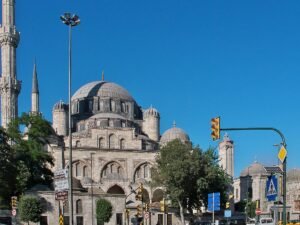
The bazaar is in Eminönü, in Istanbul’s Fatih district. It stands behind the New Mosque (Yeni Cami) and next to the Flower Market (Çiçek Pazarı). If you can find the mosque, you are almost there.
The address is given as Rüstem Paşa Mahallesi, 34116 Fatih/İstanbul. Type that into your map app.
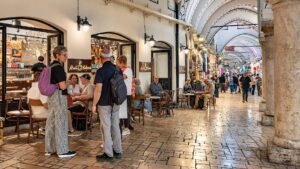
The building has an L-shaped plan and six gates. Keep that number in mind. Each gate had a job in the early years, as you will see below.
Why is it called the Egyptian Bazaar?
The Ministry of Culture and Tourism’s portal, Kültür Portalı, ties the name to two things:
- Taxes collected from Egypt, which helped finance the building.
- Goods and spices from Egypt, which were sold in the bazaar.
So the name carries both a money story and a trade story. Egypt paid for part of the construction, and Egypt supplied part of the stock.
The name came later than the building. According to Kültür Portalı, “Mısır Çarşısı” came into use only from the middle of the 18th century. Before that, historians of the 17th century wrote about the market under other names: the “New Bazaar” (Yeni Çarşı) and the “Valide Bazaar” (Valide Çarşısı). Valide is the Ottoman word for a sultan’s mother, and it points straight to the woman who ordered the market built.
Not “Corn Bazaar”
In modern Turkish, the word mısır can also mean corn. That is where a common mistake comes from. Some people translate the name as “Corn Bazaar.”
Wikipedia’s article on the Spice Bazaar says this translation is wrong. The Mısır in the name is the country. In English you will see the building called both the Spice Bazaar and the Egyptian Bazaar. Both names point to the same place.
Here is an everyday comparison. Think of a street in your own town named after a distant city. It may be named for the goods that came from there, not for anything growing on the street itself. The Egyptian Bazaar works the same way: the name points to where things came from.
Who built it, and why?
The bazaar was not built just to sell spices. It was built to pay for a mosque.
Kültür Portalı describes it as an arasta (a row of shops) built to cover the running costs of the New Mosque complex. Wikipedia adds that rent from the shops was set aside for the mosque’s upkeep.
You already know this logic from daily life. Think of a building where the monthly fees from tenants pay for the lift, the heating and the repairs. The bazaar was the same idea at a much larger scale. The shops earned money, and the money kept the mosque in working order.
The order came from Turhan Sultan, the mother of Mehmed IV. Work started in 1660. Kültür Portalı says the chief architect at the start was Hassa Baş Mimarı Kâzım Ağa. By the time the bazaar was finished in 1664, the architect was Mustafa Ağa.
Timeline
- 1660: On Turhan Sultan’s order, construction of the bazaar begins.
- 1664: Mustafa Ağa completes the building.
- Mid-18th century: The name “Mısır Çarşısı” comes into use.
- 1691: A major fire hits the bazaar.
- 1940: A second major fire follows.
- 1940-1943: The Istanbul Municipality restores the bazaar.
- 1941: A road cut through the New Mosque’s courtyard separates the mosque from the bazaar.
- From 1969: Jewellers, nut sellers and delicatessens begin opening shops.
- 2018: A restoration that included the Prayer Pulpit (Dua Kürsüsü) and the roof covering is completed.
Who sold what in the first years?
In its first period the bazaar was given to two trades: herbalists (aktar) and cotton sellers (pamukçu).
The six gates were split between them. According to the Istanbul Provincial Directorate of Culture and Tourism:
- The Balıkpazarı, Hasırcılar and Ketenciler gates went to the herbalists.
- The Yeni Cami, Haseki and Çiçek Pazarı gates went to the cotton sellers.
The same source gives numbers for the early period. Of 100 shops, 49 went to herbalists. The rest were given to cotton sellers and quilt makers (yorgancı).
The herbalists’ shops had a particular layout. In front stood a wooden bench, a peyk. Behind the shop were a storeroom and a workshop. The goods were stored and prepared right there, steps from the customer.
Fires, a road and restorations
The bazaar has not had a quiet history. Wikipedia lists two major fires, one in 1691 and one in 1940.
After the second fire, the Istanbul Municipality restored the bazaar between 1940 and 1943. During those same years, in 1941, a road was cut through the New Mosque’s courtyard. It separated the mosque from the bazaar built to support it.
The most recent big restoration finished in 2018. Anadolu Agency reported that the reinforced-concrete layer on top of the vaults was removed. In its place came a timber roof covered with lead. Think of it as taking a heavy modern lid off an old building and putting back a roof that suits it.
What you find there today
The trade has changed over time. The Anadolu Agency reported in 2018 that jewellers, nut sellers and delicatessens began opening shops in the bazaar from 1969. Kültür Portalı says that today you will find spice and Turkish delight sellers alongside jewellers and gift shops.
So expect more than spice stalls. Look at the signs before you commit to a shop, and compare a few before you buy.
Opening hours
The bazaar’s own website listed hours of 08.00-19.30, seven days a week, when it was checked on 25 October 2026. Wikipedia’s Turkish article also says the bazaar is open on Sundays. Hours can change, so check before a special trip.
Details you won’t find in guidebooks
Shops without signboards. Some shops were recognised by symbols hung from their eaves, such as an ostrich egg, a boat, a pair of scissors or a tassel. A customer could find a favourite shop by its symbol.
A court above a gate. The upper floor of the Haseki Gate held a court. Disputes among the tradesmen, and between tradesmen and the public, were settled there.
Paint over decoration. During the restoration finished in 2018, workers removed layers of paint from the Prayer Pulpit (Dua Kürsüsü). Anadolu Agency reported that original hand-painted decoration (kalem işi) came to light underneath.
A road between mosque and market. The 1941 road across the New Mosque’s courtyard is easy to miss today. But it cut apart two buildings that were planned as one pair, with the bazaar paying for the mosque.
FAQ
Why is the Spice Bazaar in Istanbul called the Egyptian Bazaar?
The Ministry of Culture and Tourism’s Kültür Portalı links the name both to taxes collected from Egypt, which helped finance the building, and to the Egyptian goods and spices sold there. Mısır here means the country Egypt.
Does ‘Mısır Çarşısı’ mean Corn Bazaar?
No. In Turkish, mısır can also mean corn, but the bazaar’s name refers to the country. Translating it as Corn Bazaar is a mistake.
Where is the Spice Bazaar in Istanbul?
It stands in the Eminönü neighbourhood of Istanbul’s Fatih district. It sits behind the New Mosque (Yeni Cami) and next to the Flower Market (Çiçek Pazarı). The address is given as Rüstem Paşa Mahallesi, 34116 Fatih/İstanbul.
Is the Spice Bazaar open on Sundays?
Yes. Wikipedia’s Turkish article says it is open on Sundays too. The bazaar’s own website listed hours of 08.00-19.30, seven days a week, when it was checked on 25 October 2026.
Who built the Spice Bazaar?
Construction began in 1660 on the order of Turhan Sultan, mother of Mehmed IV. The Kültür Portalı names Kâzım Ağa as chief architect at the start and Mustafa Ağa when it was finished in 1664.
Sources
- Kültür ve Turizm Bakanlığı — Kültür Portalı, “Mısır Çarşısı” kulturportali.gov.tr
- Vikipedi — “Mısır Çarşısı” tr.wikipedia.org
- Wikipedia — “Spice Bazaar” en.wikipedia.org
- İstanbul İl Kültür ve Turizm Müdürlüğü — “Çarşılar-Bedestenler” istanbul.ktb.gov.tr
- Anadolu Ajansı — “Restore edilen Mısır Çarşısı ve Nusretiye Camisi açılıyor” aa.com.tr
- Anadolu Ajansı — “351 yıldır tarçın ve karanfil kokan çarşı” aa.com.tr
Image: Spice Bazaar in Istanbul.jpg — Deckkohl, CC0