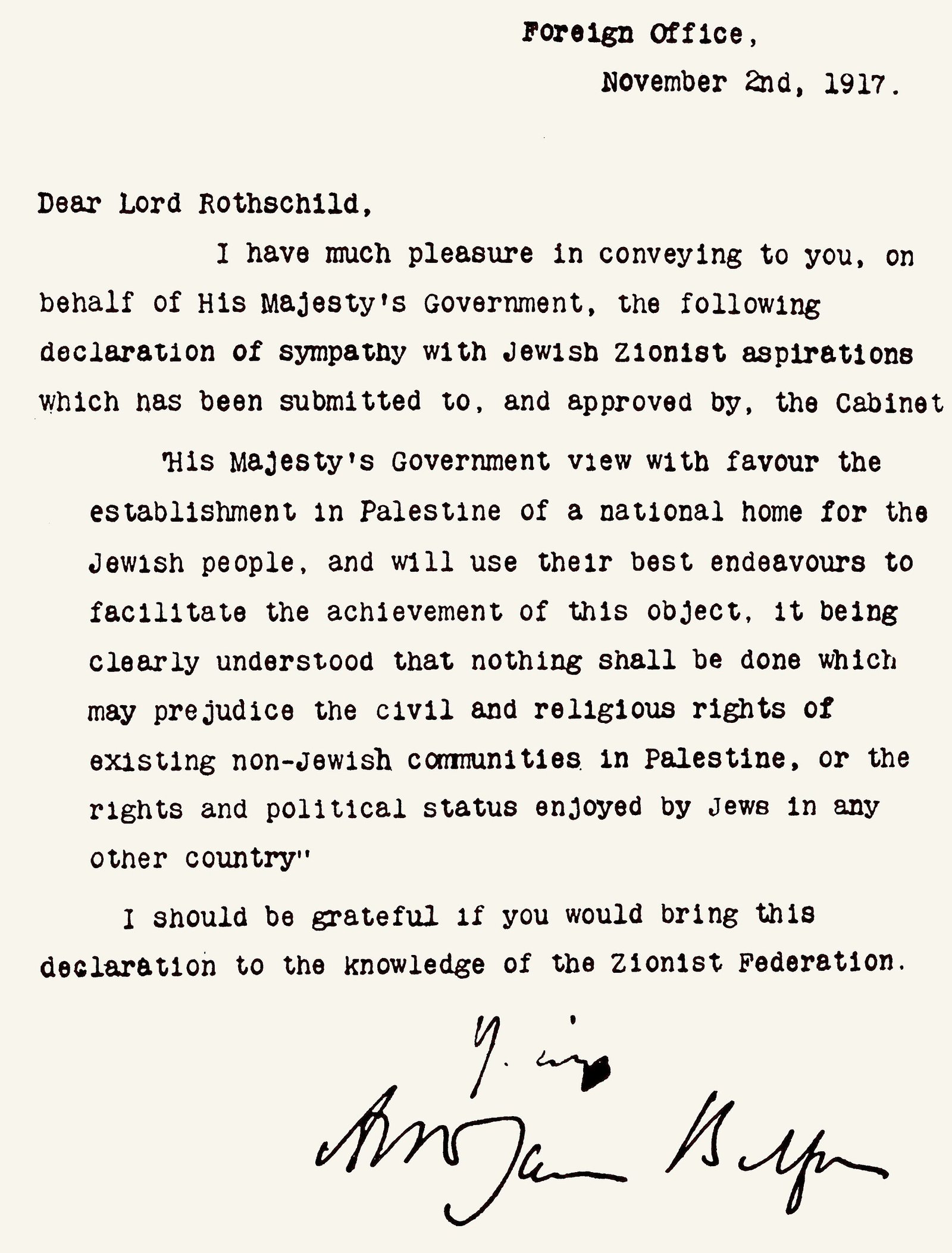
The Balfour Declaration was a British government statement dated 2 November 1917. It supported establishing a national home for the Jewish people in Palestine. Foreign Secretary Arthur James Balfour conveyed that policy in a letter to Lord Rothschild. The document was brief, but its provisions later entered the Palestine Mandate. Israel’s Declaration of Independence also referred to it in 1948.
If you approach this history through the Ottoman Empire, the setting matters. Palestine was still Ottoman territory when the declaration appeared, during the First World War. British forces were advancing there. The letter therefore announced a British policy about territory that belonged to the Ottoman Empire at the time.
What was the Balfour Declaration of 1917?
The declaration expressed the British government’s support for a Jewish national home in Palestine. It also committed the government to making its best efforts to help achieve that aim. Balfour signed as foreign secretary in David Lloyd George’s government. The statement carried the authority of that government, although its physical form was a letter to an individual.
It was not a treaty signed between two states. This distinction helps you understand what the document actually did. It announced a policy and attached safeguards to it. It did not define a state or draw borders. Its later incorporation into the Palestine Mandate gave the statement a place in a further governing framework.
Balfour Declaration date: when was the letter approved and published?
Three dates describe different stages of the declaration. The British War Cabinet approved its issue on 31 October 1917. Balfour’s letter was dated 2 November. The text appeared in the press on 9 November, one week after the letter’s date. Approval, correspondence, and public publication were separate steps.
That sequence resembles an everyday distinction between approving a message, sending it, and making it public. Here, the Cabinet’s decision came first. Balfour then sent the policy to Rothschild. Publication in the press followed. When you encounter different dates attached to the declaration, these stages explain why 2 November remains the date of the letter itself.
The Balfour Declaration letter: why Rothschild?
The recipient was Lionel Walter Rothschild, the second Baron Rothschild. He was a prominent figure in Britain’s Jewish community. At the end of the letter, Balfour asked him to bring the declaration to the attention of the Zionist Federation. Rothschild was therefore the named recipient of a government statement intended for wider communication.
The surviving correspondence also places Rothschild within the discussions before the final letter. On 6 October 1917, Maurice Hankey wrote to him seeking his views on the proposed declaration. During the drafting discussions, Zionist and anti-Zionist Jewish opinions were consulted. Palestine’s local Arab majority was not represented in those discussions.
Balfour Declaration text: what did it promise?
The central commitment concerned a national home for the Jewish people in Palestine. Britain expressed support for that objective and promised efforts to facilitate it. The phrase “national home” matters because the declaration did not expressly define a state. Reading a fully specified political settlement into those words goes beyond what the text itself established.
The first safeguard concerned the existing non-Jewish communities in Palestine. Their civil and religious rights were not to be harmed. The wording explicitly named those categories of rights. It did not explicitly mention their political or national rights. That difference is central to understanding the document’s treatment of Palestine’s population.
The second safeguard concerned Jews living in other countries. Their rights and political status were also to remain protected. The declaration thus addressed two different settings: communities within Palestine and Jewish populations elsewhere. You need both safeguards to read the commitment in its full form. The national-home policy did not stand alone in the sentence.
The meaning of the national-home formula has remained contested. Historian Norman Rose argued that the declaration’s principal architects expected a Jewish state to emerge over time. The Palestine Royal Commission of 1937 interpreted the wording as a compromise between ministers who wanted a state and ministers who did not. These are interpretations of the formula, rather than a state definition written into the letter.
Balfour Declaration map: what territory did it define?
The 1917 declaration supplied no map. It also drew no boundaries for Palestine or for the national home it supported. Its geographical reference was Palestine, without a territorial outline attached. A map of a later arrangement therefore cannot be treated as a map contained in Balfour’s letter.
This limits what the declaration alone can tell you about geography. It establishes the location named in the policy, but it does not assign borders within that location. Keeping that distinction in view helps when comparing the letter with the later Palestine Mandate. They are separate documents with different provisions.
Timeline
- 6 October 1917: Maurice Hankey asked Rothschild for his views on the proposed declaration.
- 31 October 1917: The British War Cabinet approved issuing the declaration.
- 2 November 1917: Arthur James Balfour sent Lord Rothschild the letter containing the declaration.
- 9 November 1917: The declaration’s text appeared in the press.
- 24 July 1922: The League of Nations Council approved the Palestine Mandate, incorporating the declaration’s provisions.
- 1924: Rothschild donated the declaration documents now held by the British Library.
- 14 May 1948: Israel’s Declaration of Independence appeared with an explicit reference to the Balfour Declaration.
How did the declaration enter the Palestine Mandate?
The League of Nations Council approved the Palestine Mandate on 24 July 1922. Its text incorporated the Balfour Declaration’s provisions. The Mandate’s preamble made Britain responsible for implementing the declaration of 2 November 1917. This provides a concrete connection between the wartime letter and the later administration of Palestine.
Article 6 addressed Jewish immigration and settlement on the land. It called for facilitating immigration under suitable conditions and encouraging settlement. It also required protection for the rights and position of other sections of the population. The Mandate therefore carried the national-home policy into provisions dealing with immigration and land settlement, alongside protections for others.
Balfour Declaration and 1948: what was the connection?
Israel’s Declaration of Independence was issued in Tel Aviv on 14 May 1948. It explicitly referred to the Balfour Declaration dated 2 November 1917. That reference shows the earlier statement’s place in the account presented by the independence declaration. The documents remain separate: one was a British policy letter, and the other was an independence declaration.
Their historical relationship is also interpreted differently. A House of Commons Library report from 2016 records that many Israelis regard the Balfour Declaration as a historic step toward statehood. It also describes the opposing view that the declaration helped lay foundations for future conflict in the region. The same letter therefore carries sharply different meanings in accounts of Palestine’s future.
Details you won’t find in guidebooks
The declaration embedded in Balfour’s letter consists of a single English sentence of 67 words. The complete letter also includes Balfour’s request to inform the Zionist Federation. This distinction explains why the declaration’s word count is shorter than the full letter containing it.
The British Library holds the original letter under the archive reference Add MS 41178 A. The letter is recorded on the third leaf. Its envelope survives as the fourth leaf. These catalogue details identify both the policy-bearing document and the envelope preserved with it.
The same archive file includes Hankey’s letter to Rothschild of 6 October 1917. The British Library catalogue records that Lionel Walter Rothschild donated the documents in 1924. The collection therefore preserves material from the discussion before approval as well as the final letter and its envelope.
Balfour Declaration PDF and text: where can you read them?
For a downloadable explanation, the House of Commons Library offers an eight-page research briefing in PDF format.
FAQ
What was the Balfour Declaration of 1917?
It was a British government statement supporting a national home for the Jewish people in Palestine. Foreign Secretary Arthur James Balfour conveyed it in a letter to Lord Rothschild dated 2 November 1917.
Sources
- Yale University, Avalon Project — Balfour Declaration avalon.law.yale.edu
- British Library — Add MS 41178 A searcharchives.bl.uk
- Wikipedia — Balfour Declaration en.wikipedia.org
- Vikipedi — Balfour Deklarasyonu tr.wikipedia.org
- United Nations Digital Library — Text of Mandate for Palestine, A/292 digitallibrary.un.org
- Yale University, Avalon Project — The Palestine Mandate avalon.law.yale.edu
- Yale University, Avalon Project — Declaration of Israel’s Independence avalon.law.yale.edu
- House of Commons Library — Balfour Declaration commonslibrary.parliament.uk
- House of Commons Library — Balfour Declaration, CBP-7766, PDF researchbriefings.files.parliament.uk
Image: Balfour declaration unmarked.jpg — United Kingdom Government signed by Arthur Balfour, Public domain