The Almohads were a religious reform movement that became a caliphate ruling North Africa and al-Andalus. They emerged under Ibn Tumart in Morocco’s Atlas Mountains and replaced Almoravid rule after Abd al-Mumin captured Marrakesh in 1147. Defeat at Las Navas de Tolosa in 1212, succession struggles, and regional revolts weakened their power before the Marinids took Marrakesh in 1269.
How did a movement based in mountain communities come to govern territories stretching from the Atlantic to Tripoli? Its story connects religious authority, military conquest, and struggles over succession. You can follow that expansion through Marrakesh and Seville, then trace its architectural ambitions in the surviving monuments of Rabat.
In what setting did Ibn Tumart’s movement emerge?
The name Almohad comes from the Arabic al-Muwahhidun. It expresses the movement’s emphasis on the oneness of God. Ibn Tumart began his reform movement among the Masmuda Amazigh communities of Morocco’s Atlas Mountains. He challenged the religious and legal practices of the ruling Almoravids.
The mountain setting helped his followers gather beyond effective central control. Steep terrain restricted the movement of Almoravid cavalry. Masmuda communities could therefore remain largely outside the authorities’ reach. Geography gave the religious movement room to establish itself.
Around 1121, Ibn Tumart’s followers recognized him as the mahdi. Around 1124, Tinmel became the movement’s base in the Nfis Valley of the High Atlas. It served as both a spiritual center and a military headquarters. Religious leadership and military organization developed around the same place.
Ibn Tumart died in 1130. Leadership then passed to Abd al-Mumin, an Amazigh leader of Zanata origin. The movement had begun among the Masmuda, but the man who directed its imperial expansion came from a different Amazigh background.
How did Abd al-Mumin replace Almoravid rule?
Abd al-Mumin turned the movement into a conquering power and proclaimed himself caliph. His forces captured Marrakesh in 1147. That conquest overthrew Almoravid rule and made the city the center of the new regime. Marrakesh remained the Almohads’ principal seat of power in North Africa.
Expansion continued eastward. In 1159, Abd al-Mumin launched a campaign that brought Tunis under his control. The local Banu Khurasan rulers refused to surrender, and he took the city by force. This campaign carried Almohad authority farther across North Africa.
Mahdia surrendered in January 1160. The Normans then withdrew to Sicily, and Tripoli subsequently recognized Almohad authority. These advances extended the reach of a movement whose early headquarters had stood in a High Atlas valley.
Abd al-Mumin ruled until 1163. Under his leadership, the Almohads displaced the Almoravids in Marrakesh and established authority across a much wider territory. His declaration as caliph also gave the movement a political leadership beyond its original mountain base.
Which territories in North Africa and al-Andalus did the Almohads govern?
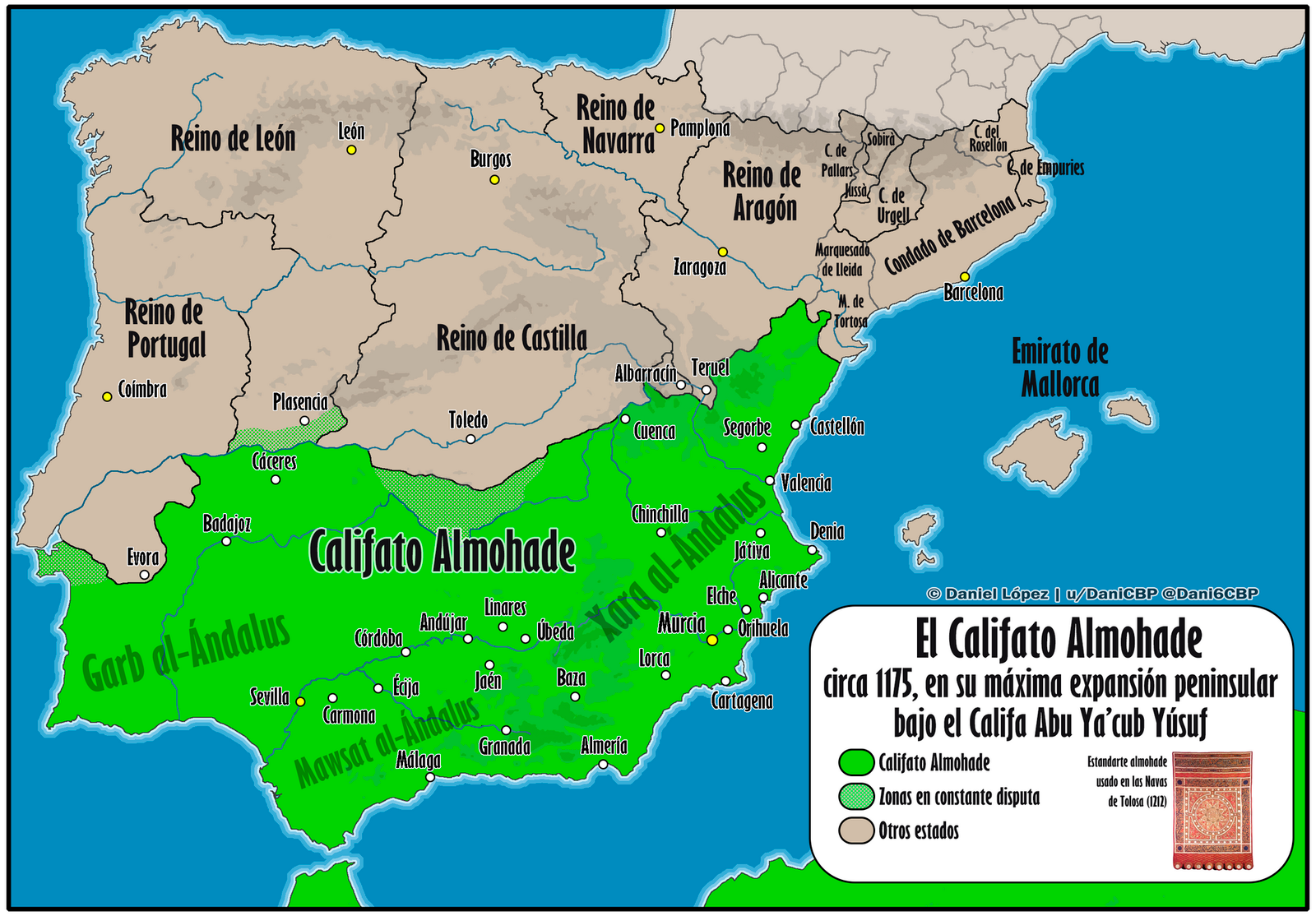
The Almohad Empire stretched across North Africa from the Atlantic Ocean to Tripoli, in present-day Libya. Across the water, it included Muslim-governed parts of present-day Spain and Portugal. These territories formed the Almohad domain in al-Andalus.
By 1150, the Almohads had taken Morocco as well as Seville, Córdoba, Badajoz, and Almería, according to the Metropolitan Museum of Art’s period overview. Their expansion therefore included major cities in al-Andalus before Abd al-Mumin’s eastern campaign of 1159.
Marrakesh and Seville anchored this geography of power. The Almohads kept their North African center in Marrakesh while making Seville their capital in al-Andalus. If you picture the caliphate through these cities, its reach becomes clearer: authority operated across territories in both North Africa and the Iberian lands under Muslim rule.
What role did the defeat at Las Navas de Tolosa in 1212 play in their decline?
On 16 July 1212, forces from Castile, Aragon, and Navarre defeated the Almohad army at Las Navas de Tolosa in the Jaén region. The defeat became a turning point in the collapse of Almohad supremacy in al-Andalus. It accelerated fragmentation into smaller principalities paying tribute.
The caliphate’s decline also involved a crisis within the ruling dynasty. Caliph al-Mustansir died young in 1224 without an heir. His death triggered succession struggles in both the Maghreb and al-Andalus. Rival leaders competed for authority across an already weakening empire.
Some Almohad contenders formed alliances with Christian kings to the north. Local uprisings in al-Andalus further undermined central rule. Ferdinand III, ruler of Castile-León, exploited this political fragmentation. He conquered Córdoba in 1236 and Seville in 1248.
North Africa experienced its own tribal and regional revolts. The rise of the Marinids gathered pace from 1215 as Almohad authority weakened. In 1269, the Marinids captured Marrakesh. That conquest ended Almohad rule in the western Maghreb.
Las Navas de Tolosa thus belongs within a longer sequence of losses. The defeat damaged Almohad supremacy in al-Andalus, while succession disputes and revolts deepened the breakdown. The capture of Marrakesh in 1269 marked the end of their rule in the western Maghreb.
What architectural traces survive in Marrakesh, Rabat, and Seville?
Large minarets with square shafts are a defining feature of Almohad mosque architecture in Marrakesh, Rabat, and Seville. This architectural form continued in later centuries. You can use these towers as a starting point for recognizing the dynasty’s surviving building traditions.
In Marrakesh, the Kutubiyya Mosque’s minaret rises 77 meters. Each side of its main square shaft measures approximately 13 meters. Its proportions offer a concrete measure of the scale of Almohad mosque building.
The relationship between the Kutubiyya’s two mosque buildings remains debated. One explanation holds that the second corrected the first building’s prayer orientation. Yet the second orientation was less accurate, weakening that argument. Other researchers have proposed expansion to accommodate population growth.
In Rabat, Yaqub al-Mansur commissioned the Hassan Mosque as the empire’s principal Friday mosque. It remained unfinished when he died in 1199. Later rulers did not complete it. UNESCO identifies the mosque, Almohad walls, and gates as surviving elements of a project to create a great capital.
In Seville, construction of the Great Mosque began in 1172 under Caliph Abu Yaqub Yusuf. Its surviving minaret, the Giralda, later became part of the Gothic cathedral. The Court of Oranges and the Gate of Forgiveness were also incorporated into that later building.
Details you won’t find in guidebooks
Abd al-Mumin adopted an Arab genealogy when proclaiming his caliphate, despite his Amazigh origins. His claimed ancestry therefore differed from his own background. This detail belongs alongside his assumption of the caliphal title.
The new ruler also reused an object associated with the dynasty he displaced. Abd al-Mumin transferred the carved wooden minbar from the mosque of the Almoravid ruler Ali ibn Yusuf to his own Kutubiyya Mosque. A furnishing from the previous regime continued to serve under Almohad patronage.
Rabat’s Hassan Mosque was designed on a rectangular plan measuring 180 by 140 meters. Those dimensions give substance to its intended role as the empire’s principal Friday mosque. The unfinished project preserves evidence of that ambition.
Inside the Giralda, ramps run between a central square core and the outer walls. They were wide enough for a horse to ascend. The tower’s internal arrangement is therefore as revealing as its external square form.
Almohad coins carried a formula acknowledging God as Lord, Muhammad as prophet, and Ibn Tumart as the mahdi and imam. If you think of the money you handle in everyday life, these coins offer a direct connection between a familiar object and the movement’s religious claims.
Timeline
- Around 1121: Ibn Tumart’s followers recognize him as the mahdi.
- Around 1124: Tinmel becomes the movement’s spiritual and military base.
- 1130: Ibn Tumart dies; Abd al-Mumin assumes leadership.
- 1147: Almohad forces capture Marrakesh and overthrow Almoravid rule.
- 1159: Abd al-Mumin captures Tunis.
- January 1160: Mahdia surrenders; the Normans withdraw to Sicily.
- 1163: Abd al-Mumin’s reign ends.
- 1172: Construction begins on Seville’s Great Mosque.
- 1199: Yaqub al-Mansur dies with the Hassan Mosque unfinished.
- 16 July 1212: The Almohad army loses at Las Navas de Tolosa.
- 1224: Al-Mustansir dies without an heir, triggering succession struggles.
- 1236: Ferdinand III conquers Córdoba.
- 1248: Ferdinand III conquers Seville.
- 1269: The Marinids capture Marrakesh, ending Almohad rule in the western Maghreb.
FAQ
Who founded the Almohad movement?
Ibn Tumart founded the religious reform movement among the Masmuda Amazigh communities of Morocco’s Atlas Mountains. After his death in 1130, Abd al-Mumin led its expansion into a caliphate.
Where did the Almohads rule?
Their empire extended across North Africa from the Atlantic Ocean to Tripoli. It also included Muslim-governed territories in present-day Spain and Portugal, with Seville serving as their capital in al-Andalus.
Did the battle of Las Navas de Tolosa end the caliphate?
The defeat in 1212 accelerated the breakdown of Almohad supremacy in al-Andalus. Their rule continued in North Africa until the Marinids captured Marrakesh in 1269.
Which Almohad monuments survive?
Major traces include the Kutubiyya Mosque in Marrakesh, the unfinished Hassan Mosque and Almohad walls and gates in Rabat, and Seville’s Giralda, Court of Oranges, and Gate of Forgiveness.
Sources
- Wikipedia — Almohad Caliphate en.wikipedia.org
- Maribel Fierro — Oxford Bibliographies: Almohads academic.oup.com
- The Metropolitan Museum of Art — The Art of the Almoravid and Almohad Periods metmuseum.org
- Universidad de Navarra — 1212: Las Navas de Tolosa unav.es
- Archnet — Timeline: Almohad archnet.org
- Archnet — Jami’ al-Kutubiyya archnet.org
- Archnet — Jami’ al-Hassan archnet.org
- UNESCO World Heritage Centre — Rabat whc.unesco.org
- Archnet — Cathedral/Mosque of Seville archnet.org
- Catedral de Sevilla — La Giralda catedraldesevilla.es
- Maribel Fierro — The New Cambridge History of Islam: The Almohads and the Hafsids cambridge.org
Image: Almohades Iberia.png — DaniCBP, CC BY 4.0