The Papal States were a state centered on Rome, covering much of present-day Lazio, Umbria, Marche and Romagna in central Italy at their wider extent. The popes lost most of these territories to Piedmont-Sardinia in 1860, then lost Rome to the Italian army on 20 September 1870, ending the state.
Yet the loss of Rome did not end the Holy See or its diplomacy. If you follow the story from early church property to the Lateran Treaty of 1929, you can see why the Papal States, the Holy See and Vatican City mean different things. The key is to separate ownership of land, territorial government and leadership of the Catholic Church.
Where were the Papal States?
Rome was the capital of a state in which the pope exercised political and military sovereignty on the Italian peninsula. Its territories extended across central Italy. At their wider extent, they included much of the regions now called Lazio, Umbria, Marche and Romagna.
If you locate only Vatican City on a map, you miss the scale of that earlier state. Vatican City occupies approximately 44 hectares within Rome. The Papal States governed territories across central Italy, with Rome serving as their political center as well as the seat of papal religious authority.
How did the papal territories emerge?
The story began with property, before it became a story of sovereignty. Constantine’s law of 321 allowed the Church to acquire property. Those early church lands were private possessions, however. Owning them did not initially make the Church the sovereign government of a state.
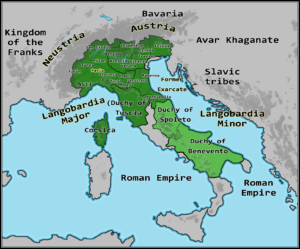
A further step came in 728. The Lombard king Liutprand made the Donation of Sutri to Pope Gregory II. This gift was an early turning point in the formation of papal territories, preceding the Frankish donations that strengthened the pope’s territorial position.
In April 754, the Frankish king Pepin the Short promised land at Quierzy. That pledge prepared the way for his donation to Pope Stephen II in 756. The donation established a foundation for papal temporal sovereignty in central Italian territories, including the Exarchate of Ravenna and the Pentapolis.
The distinction matters when you trace the state’s beginnings. The law of 321 concerned the Church’s ability to own property. Pepin’s donation in 756 concerned the foundations of territorial sovereignty. These were different steps in the development of a pope’s authority over Italian lands.
How did popes exercise territorial government alongside religious authority?
The pope’s responsibilities extended beyond governing the Catholic Church. As ruler of the Papal States, he also raised armies, conducted wars and signed peace treaties. Religious leadership and the practical powers of a territorial ruler belonged to the same office.
That did not mean every place was governed through an identical system. Irene Fosi’s study of 1500–1800 describes the Papal States as a composite structure. Strong local governments and feudal powers remained part of its organization. Papal sovereignty existed alongside these established forms of local authority.
The territory also grew through changes in ruling families. Ferrara and Urbino were among the duchies that entered papal government after their ruling dynasties died out. Their incorporation was another route by which lands came under papal rule, alongside the earlier donations.
During 1500–1800, papal governing bodies in Rome corresponded with governors and legates. Through those exchanges, they adapted financial administration and public order to local conditions. A connection to everyday life lies here: governing these territories involved money and order, alongside the pope’s religious duties.
How did the Napoleonic era and Italian unification change the territories?
French intervention interrupted papal government in February 1798. General Louis-Alexandre Berthier proclaimed a Roman Republic. This removed papal territorial government in Rome for a period, but it was not yet the permanent end of the Papal States.
Napoleon imposed another major break on 17 May 1809. He annexed the remaining papal territories, including Rome, to the French Empire. The pope’s Italian state was therefore directly absorbed into another empire during the Napoleonic era.
The settlement at the Congress of Vienna in 1814–1815 restored the papal territories in Italy. That restoration explains why the annexation of 1809 should not be confused with the final loss of 1870. Papal territorial government returned after the Napoleonic interruption.
Another republic was proclaimed in Rome in February 1849. French intervention ended it that same year. France thus played different roles at different moments: French action had interrupted papal government in 1798, while French intervention ended the later republic in 1849.
Italian unification brought a more lasting territorial loss. In 1860, Piedmont-Sardinia took most of the papal lands, including Umbria and Marche. Rome and the surrounding territory of Lazio remained under the pope. The state survived, but with a much smaller territorial base.
The Kingdom of Italy was proclaimed on 17 March 1861. Its ruling House of Savoy had governed Piedmont-Sardinia. The pope still held Rome and its surrounding territory, so the establishment of the kingdom preceded the final disappearance of the Papal States.
Why was the capture of Rome in 1870 a turning point?
French troops had provided a military obstacle to an Italian takeover of Rome. In 1870, Napoleon III withdrew his soldiers from Italy because of the Franco-Prussian War. Their departure removed that protection and changed the military circumstances around the remaining papal territory.
The Italian army captured Rome on 20 September 1870. This ended the Papal States. After a plebiscite in early October, Rome and the remaining papal territories were annexed to the Kingdom of Italy. Military capture and formal annexation were successive parts of the final loss.
Rome then became the kingdom’s capital. In the summer of 1871, Italy transferred its capital there from Florence. The city that had served as the capital of papal territorial government now served as the capital of the Italian kingdom.
The Holy See rejected Italy’s Law of Guarantees, dated 13 May 1871. Its objections included the law’s unilateral character and provisions granting only rights of use over certain properties. The capture of Rome therefore ended papal territorial rule without settling the relationship between Italy and the Holy See.
Timeline
- 321: Constantine’s law allowed the Church to acquire property.
- 728: Liutprand made the Donation of Sutri to Gregory II.
- 754–756: Pepin’s territorial promise and donation strengthened papal sovereignty.
- 1798: Berthier proclaimed a Roman Republic.
- 1809: Napoleon annexed Rome and the remaining papal territories.
- 1814–1815: The Vienna settlement restored papal territories in Italy.
- 1849: French intervention ended another Roman Republic.
- 1860: Piedmont-Sardinia took most papal territories.
- 17 March 1861: The Kingdom of Italy was proclaimed.
- 20 September 1870: The Italian army captured Rome.
- October 1870: Annexation followed a plebiscite.
- 1871: Italy passed the Law of Guarantees and moved its capital to Rome.
- 11 February 1929: The Lateran Treaty was signed.
- 7 June 1929: The treaty entered into force.
How do the Papal States, the Holy See and Vatican City differ?
The Papal States were the Italian territories governed by the pope as a political and military sovereign. The Holy See means the Catholic Church’s central government, headed by the pope. It is an institution distinct from Vatican City State, which was created in 1929.
The interval between 1870 and 1929 makes that distinction clear. During those years, Vatican City did not exist, but the Holy See maintained diplomatic relations with other states. The end of the Papal States therefore did not end the Holy See’s international activity.
On 11 February 1929, Cardinal Pietro Gasparri signed the Lateran Treaty for the Holy See. Benito Mussolini signed for Italy. The treaty created Vatican City State to guarantee the Holy See’s independence. It entered into force on 7 June, when the instruments of ratification were exchanged.
Article 26 recorded the Holy See’s recognition of Rome as Italy’s capital and declared the Roman Question definitively resolved. Vatican City’s approximately 44 hectares within Rome were a different geographical unit from the former central Italian state. The agreement secured independence through this new state rather than restoring the earlier territories.
Details you won’t find in guidebooks
The Vienna restoration had limits. Although the settlement of 1814–1815 returned papal territories in Italy, it did not return Avignon or Comtat Venaissin. The restoration therefore did not recover every former papal possession.
The financial convention of 1929 specified concrete payments. Italy was to give the Holy See 750 million lire in cash and government bonds with a nominal value of one billion lire, bearing five percent interest.
Article 3 of the Lateran Treaty also provided an unusual arrangement for St Peter’s Square. The square was Vatican territory, but Italian authorities would ordinarily exercise police powers there. Territorial ownership and the exercise of policing authority were thus addressed separately in the agreement.
FAQ
Where were the Papal States?
The Papal States were centered on Rome in central Italy. At their wider extent, they covered much of present-day Lazio, Umbria, Marche and Romagna.
How did the popes lose their Italian territories?
Piedmont-Sardinia took most papal territories in 1860. After French troops withdrew in 1870, the Italian army captured Rome on 20 September, and annexation followed a plebiscite in early October.
Did the Holy See disappear when the Papal States ended?
No. The Holy See continued its diplomatic relations with other states throughout 1870–1929, when Vatican City did not yet exist.
Is Vatican City the same as the Papal States?
No. The Papal States covered extensive territories in central Italy. Vatican City was created by the Lateran Treaty in 1929 and occupies approximately 44 hectares within Rome.
Sources
- Wikipedia — Papal States en.wikipedia.org
- Vikipedi — Papalık Devleti tr.wikipedia.org
- Wikipedia — Donation of Pepin en.wikipedia.org
- Cambridge University Press — Popes and the Papal States, 1500–1800 cambridge.org
- United States Department of State, Office of the Historian — Papal States history.state.gov
- Holy See — Holy See / State of Vatican City: General Information vatican.va
- Holy See — Patti lateranensi, treaty and financial convention vatican.va
- Vatican City State — History vaticanstate.va
Image: Italy Papal States 1689-I Quadrupla Scudo d'Oro.jpg — Antonio Travani, Public domain