Where is Koza Han in Bursa, Turkey?
Koza Han stands in Bursa’s Osmangazi district, between Ulu Cami and Orhan Camii. It belongs to the Hanlar Bölgesi, the city’s historic commercial district. If you are looking for Bursa’s silk trading center, these two mosques provide the clearest geographical reference. The building is an Ottoman han commissioned by Sultan Bayezid II and opened in 1491.
Its setting matters as much as its address. Bursa’s commercial district began taking shape in the 14th century. It completed its development in the 16th century with hans, a bedesten, and bazaars. Koza Han entered this district while its network of commercial buildings was still developing. It formed part of a larger trading landscape.
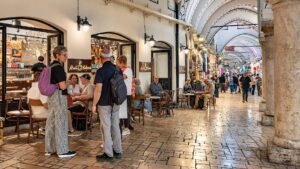
Today, Koza Han continues to function as a place of commerce. Silk and cotton textiles are sold there, while the inner courtyard serves as a café and tea garden. You can connect its history with an everyday activity: browsing fabric, then sitting down for tea. Trade and a courtyard break remain part of the same visit.
Koza Han history: who built it, and why?
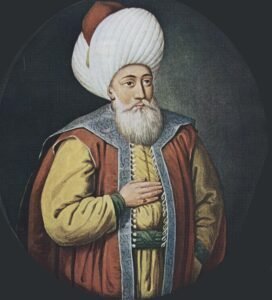
Sultan Bayezid II commissioned Koza Han at the end of the 15th century. Museum With No Frontiers dates the construction order to February–March 1490. It records a ceremonial opening on 29 September 1491. The TDV İslâm Ansiklopedisi identifies the architect as Abdülalî bin Puladşah.
The Ministry of Culture and Tourism explains the project through its financial purpose. Koza Han was built to provide income for Bayezid II’s mosque and madrasa in Istanbul. This connects the Bursa trading building with religious and educational institutions in another city. Its commercial activity had a purpose beyond the business conducted inside its rooms.
One document has prompted disagreement over that connection. Rıfkı Melûl Meriç argued that the caravanserai mentioned in a 1505 endowment deed was Pirinç Han. The more widely accepted interpretation connects the same record with Koza Han and the Bayezid complex in Istanbul. The disagreement concerns the identification of the building in that document.
Koza Han also carried several earlier names. These included Yeni Han, Hân-ı Cedîd-i Evvel, Beylik Han, Simkeş Han, and Sırmakeş Han. Its familiar name comes from the silkworm cocoons traded within it. The name therefore preserves a direct link to the goods that helped define the building’s history.
Why was the Koza Han silk market important?
Around 1500, Bursa was an important destination for caravans carrying silk from the region around the Caspian Sea. Ingrid Houssaye Michienzi’s 2019 study examines this trade through Florentine business archives. Company account books and correspondence show representatives buying silk from caravans arriving in Bursa. These records place the city’s silk market within an international commercial network.
That evidence describes Bursa’s wider market. A more specific connection places a Florentine business presence inside Koza Han itself. English Wikipedia reports that a trading representative of the Medici family had an office there in the early 16th century. The office connects the han’s rooms with the merchants participating in that wider silk trade.
The building supported several parts of a merchant’s working day. Silk traders renting rooms one above the other used the upper room for accommodation and business. The lower room held their goods. Living space, commercial work, and storage were brought together within the same building. This arrangement helps explain why the rooms matter as much as the courtyard.
The phrase Koza Han silk bazaar also describes a continuing commercial function. The Ministry of Culture and Tourism identifies it as a place where silk and cotton textiles are still sold. Its historical association with cocoons and its present textile business belong to different stages of the same building’s commercial life.
What can you see in Koza Han photos?
The main building consists of two levels of rooms around a rectangular courtyard. Arcaded walkways run in front of the rooms. In photographs, those repeated openings reveal the structure’s basic arrangement. They show how the courtyard connects the spaces once used for accommodation, trading, and storage.
The courtyard measures approximately 45.90 by 37.50 meters. At its center stands an octagonal pavilion mosque raised on eight stone supports. An ablution fountain sits beneath it. If you are examining Koza Han photos, look for this raised mosque first. It provides a clear reference point for understanding the surrounding courtyard.
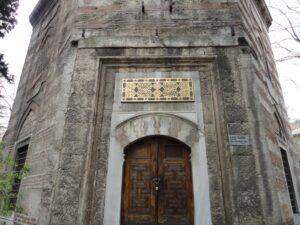
The northern monumental entrance is decorated with turquoise tiles. Elsewhere, the exterior walls alternate courses of cut stone and brick. These are two different architectural details to notice: tile decoration at the entrance and the repeated stone-and-brick pattern across the walls. Together, they give you more to examine than a broad courtyard view.
Its central mosque, arcades, and northern entrance are useful features to recognize across different images. The eastern section also deserves attention. Known as İç Koza Han, it is a single-story courtyard building originally used as a stable.
Details you won’t find in guidebooks
Koza Han has no surviving construction inscription. Its dating therefore draws on written evidence, including Bursa’s şer‘iyye court registers. The precise opening date comes through documentary records rather than a surviving foundation text on the building. That distinction matters when you compare the visible monument with its recorded history.
Even the room count varies between institutions. The Bursa Governor’s Office gives 95 rooms. The Culture Portal gives 101, while Museum With No Frontiers records 104. These are published counts from different sources. A description of the building should acknowledge that variation instead of presenting one total as universally agreed.
The paired rooms used by silk merchants offer another revealing detail. The upper room served both lodging and commercial work, while the lower room stored merchandise. Looking at the two floors with that arrangement in mind gives the architecture a practical meaning. The rooms held both the traders and the goods on which their business depended.
İç Koza Han adds another part of the trading establishment to that picture. Its original use as a stable places animals within the building’s working history. The eastern courtyard section belonged to the same complex as the merchants’ rooms and central courtyard. The commercial setting extended beyond the spaces now most closely associated with textile shopping.
Timeline
- 14th century: Bursa’s historic commercial district began to form.
- February–March 1490: Construction of Koza Han was ordered under Bayezid II.
- 29 September 1491: Koza Han opened with a ceremony.
- Early 16th century: A Medici family trading representative had an office in Koza Han, according to English Wikipedia.
- 1671–1672: The han underwent repairs.
- 1785: Another repair campaign took place, as recorded by the TDV İslâm Ansiklopedisi.
- 1946: The courtyard mosque was repaired.
- Toward the 1950s: Extensive restoration removed later additions and converted the rooms into modern commercial premises.
- 2007: The courtyard mosque underwent another repair.
- 2014: The Hanlar Bölgesi containing Koza Han became part of the Bursa and Cumalıkızık World Heritage property.
Koza Han reviews: what is the historical setting today?
Koza Han’s present appearance includes the results of repeated repairs. The TDV İslâm Ansiklopedisi records work in 1671–1672 and 1785. The han also underwent extensive restoration toward the 1950s. Later additions were removed, and rooms were adapted as modern commercial premises. The building you encounter has continued to change through maintenance and commercial use.
The courtyard mosque has its own repair history. The Culture Portal inventory records work in 1946 and 2007. Its raised position above the fountain remains a defining feature of the courtyard. The repair dates show that this central structure also required care across different periods.
For a visit centered on history, the textile shops and tea garden provide concrete points of interest. The shops continue the building’s commercial use. The courtyard offers a place to sit within the two-story arrangement of rooms and arcades. You can read the architecture while taking part in the everyday uses that occupy it today.
Koza Han also belongs to the Hanlar Bölgesi within the Bursa and Cumalıkızık property inscribed on UNESCO’s World Heritage List in 2014. UNESCO connects Bursa’s historic commercial center with the endowment system and the economic organization of the early Ottoman capital. This places the han within the history of the city as well as the history of silk.
FAQ
Where is Koza Han in Bursa, Turkey?
Koza Han is in the Hanlar Bölgesi, Bursa’s historic commercial district, in Osmangazi. It stands between Ulu Cami and Orhan Camii.
When was Koza Han built?
Construction was ordered in February–March 1490 under Sultan Bayezid II. Koza Han opened with a ceremony on 29 September 1491.
Why is Koza Han associated with silk?
Its name comes from the silkworm cocoons traded there. Silk merchants used its rooms for accommodation, business, and storage.
What is Koza Han used for today?
Koza Han continues to sell silk and cotton textiles. Its inner courtyard serves as a café and tea garden.
Sources
- Ministry of Culture and Tourism — Koza Han kulturportali.gov.tr
- Museum With No Frontiers — Koza Han islamicart.museumwnf.org
- TDV İslâm Ansiklopedisi — Koza Hanı islamansiklopedisi.org.tr
- Ministry of Culture and Tourism — Hanlar Bölgesi kulturportali.gov.tr
- Ingrid Houssaye Michienzi, Turcica — The Silk Market in Bursa around 1500 as it Appears in the Florentine Business Archives poj.peeters-leuven.be
- English Wikipedia — Koza Han en.wikipedia.org
- Bursa Governor’s Office — Kozahan bursa.gov.tr
- Ministry of Culture and Tourism — Koza Han Mescidi kulturportali.gov.tr
- UNESCO World Heritage Centre — Bursa and Cumalıkızık whc.unesco.org
- Ministry of Culture and Tourism — Bursa İpekli Dokumaları kulturportali.gov.tr
Image: Koza Han, Bursa1.jpg — Jocelyn Erskine-Kellie, CC BY-SA 2.0