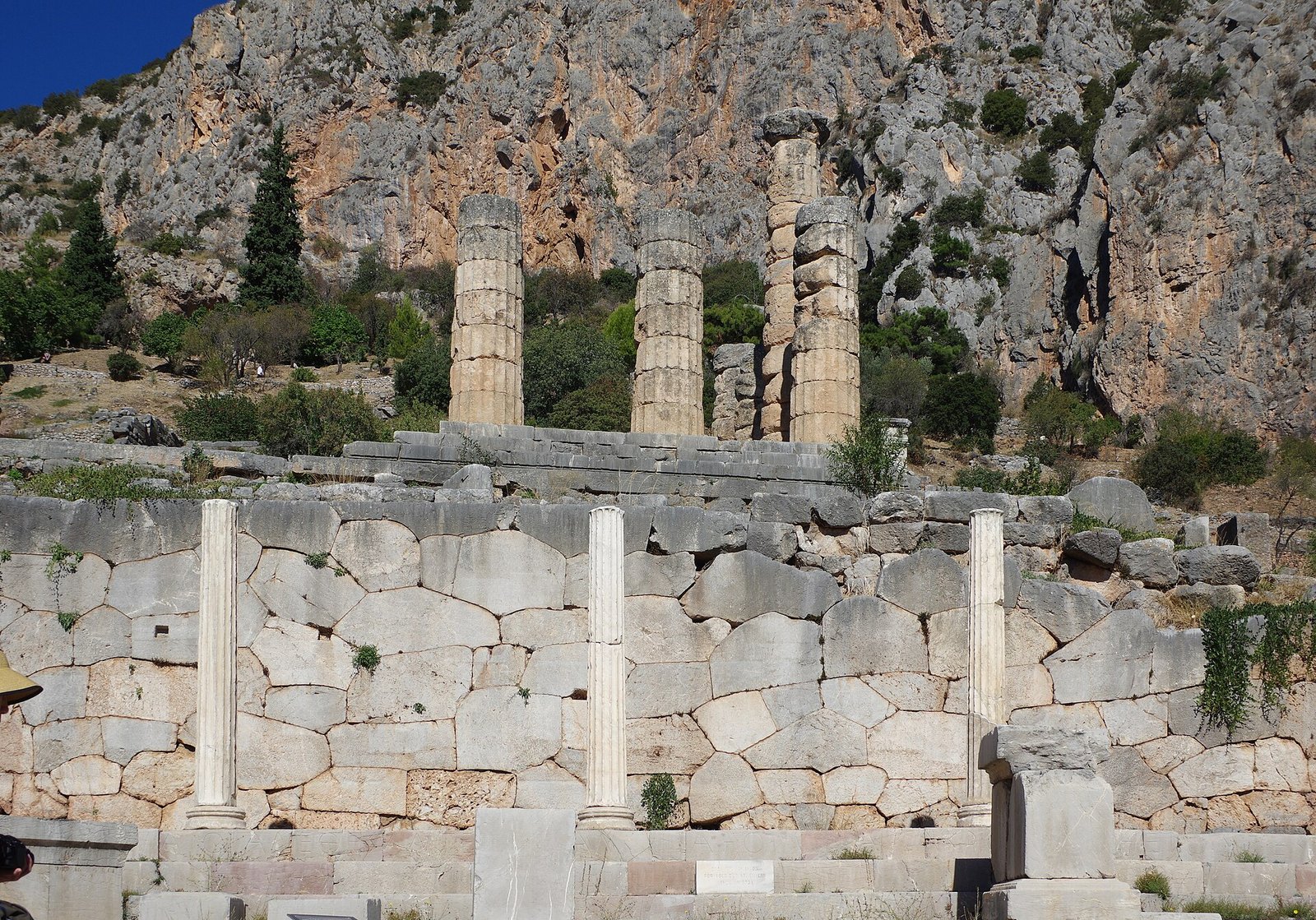
Delphi is an ancient sanctuary and archaeological site on the southwestern slope of Mount Parnassos in central Greece. Apollo’s oracle operated through the Pythia, a priestess who delivered responses from a tripod seat inside the temple, while consultations involved purification, offerings and rules governing priority.
Why did Greek cities place valuable offerings along the approach to this oracle? If you follow Delphi from the Castalian spring to its treasuries, temple and stadium, you encounter a sanctuary where religious consultation, public prestige and shared administration met. Its story also has a connection with Constantinople through the bronze Serpent Column.
Why was Delphi regarded as the centre of the world?
According to ancient Greek myth, Zeus sent two eagles from the east and west. They met above Delphi, identifying the place as the world’s centre. This was a religious explanation of Delphi’s position, rooted in a story about the god’s birds.
A stone monument called the omphalos gave that idea a physical form. Its name means “navel” in Greek. If you encounter the term at Delphi, it refers to this symbol of the world’s centre.
The site’s history reaches back beyond the development of Apollo’s oracle. Mycenaean remains indicate settlement between 1500 and 1100 BCE. The sanctuary of Apollo and its oracle began developing in the eighth century BCE. Delphi’s religious and political influence increased during the sixth century BCE.
These dates distinguish settlement from the growth of the sanctuary. The Mycenaean remains belong to an earlier period, while the later development of Apollo’s sanctuary marks the emergence of the religious centre associated with the Pythia.
Who was the Pythia, and how were oracular consultations conducted?
Pythia was a title, rather than the personal name of a single woman. Apollo’s high priestesses were selected from Delphic families and held office for life. Each served as the god’s accepted spokesperson at the sanctuary.
Consultation followed a restricted calendar. Accounts based on ancient sources place the earliest consultations on one annual occasion: the seventh day of the month of Bysios. Later, consultations took place on the seventh day of each month, excluding the three winter months.
Those approaching the oracle underwent ritual preparation. Purification at the Castalian spring formed part of the process. Consultation therefore involved actions outside the temple before the encounter with the Pythia inside it.
Offerings also supported the sanctuary financially. Consultants bought a small sacrificial cake, called a pelanos, from the Delphians. It was burned on the altar. This transaction connected the visitor’s ritual obligations with income for the oracle.
Access also depended on privileges. Promanteia allowed particular people or cities to receive priority within their consultation groups. You can compare this with priority access in everyday life: a recognised privilege affected someone’s place in the order. At Delphi, that advantage concerned access to Apollo’s oracle.
The Pythia delivered her responses while seated on a tripod in the temple’s inner area, the adyton. Her position inside Apollo’s temple and her role as his spokesperson were central to the consultation. The tripod was therefore part of the setting in which divine authority was expressed.
The complete sequence remains debated. Michael Scott points out that no surviving ancient account clearly describes the entire ceremony. The spring, offerings, consultation privileges and tripod provide concrete elements, but a seamless reconstruction of every stage goes beyond what the surviving accounts establish.
What might explain the Pythia’s trance?
A proposed explanation connects the Pythia’s trance with gases emerging naturally from the ground. In 2002, Spiller, Hale and de Boer argued for inhaled ethylene, or a mixture of ethylene and ethane, from a geological emission.
Foster and Lehoux challenged that explanation. They argued that the ethylene-intoxication hypothesis depended on problematic scientific and textual evidence. The gas theory should therefore be understood as a disputed interpretation, rather than an established explanation of how the oracle worked.
The debate concerns a proposed physical cause of the trance. The consultation also had documented social and ritual elements: purification, purchased offerings and priority privileges. These remain essential to understanding how people approached the oracle, whatever explanation is proposed for the Pythia’s condition.
What do the cities’ treasuries and dedications reveal?
Greek cities placed treasury buildings, dedications and monumental sculpture groups along both sides of the Sacred Way. The approach through Apollo’s sanctuary thus displayed offerings associated with different communities. Religious devotion had a visible civic presence.
The Athenians stored valuable dedications and war booty in their treasury. On official celebration days, they displayed these objects publicly on the triangular terrace beside the building. Storage and public presentation were both part of the treasury’s use.
The Siphnian Treasury connected dedication with mining income. Built around 530–525 BCE, it was financed through an offering to Apollo of one-tenth of the island’s mining revenues, according to the accounts of Herodotus and Pausanias. Its funding made a portion of that income part of the sanctuary.
A collective victory dedication followed the victory at Plataea in 479 BCE. The 31 Greek cities that had fought against the Persians dedicated a golden tripod to Apollo at Delphi. It was made using one-tenth of the war booty.
Together, these examples show different sources of sacred wealth. Mining revenues financed the Siphnian Treasury. The Athenians kept war booty among their offerings. The Plataea dedication represented a shared victory through a collective gift to Apollo.
How were the Pythian Games connected with the sanctuary’s administration?
The Delphic Amphictyony, composed of 12 communities, played an important role in administering the sanctuary. It met twice a year: at Delphi in spring and at Thermopylae in autumn. Its responsibilities linked Delphi with a wider group of communities.
After the First Sacred War, the reorganised Pythian Games took place every four years. Officials called hieromnemones supervised them under Amphictyonic administration. The games therefore belonged within the sanctuary’s governing arrangements.
Preparations began six months in advance. Nine Delphic theoroi travelled to Greek cities to announce the competitions and the sacred truce. The festival required advance communication beyond Delphi itself.
Violating the truce could affect both competition and religious consultation. Citizens of an offending city could be excluded from the Pythian Games and barred from consulting the oracle. These penalties connected participation in the festival with access to Apollo’s sanctuary.
The competitions occupied different parts of Delphi. Musical contests took place in the theatre. Athletic contests were held in the stadium above the temple. If you picture these spaces together, the sanctuary’s activities extend from consultation inside the temple to performances and contests elsewhere on the site.
Details you won’t find in guidebooks
A goat could determine whether consultation proceeded. In the ritual described by Michael Scott, priests sprinkled cold water on the animal. Its trembling was interpreted as a sign that Apollo accepted consultations that day.
The Siphnian Treasury’s sculpture was once strongly coloured. Its ancient decoration included blue, red, gold and green. The building’s sculptural display therefore included colour as well as carved forms.
For readers travelling to Turkey, the Plataea dedication provides a direct historical connection. Constantine moved its bronze Serpent Column to Constantinople; in December 2015, a bronze replica was erected at its original position in Delphi.
Excavations around Delphi’s western fortifications uncovered Doric architectural fragments belonging to a sanctuary, together with sixth- and fifth-century BCE votive remains. Elsewhere, excavations revealed several hundred metres of the Late Antique city wall and two gates. That wall was built between the fourth and sixth centuries CE.
Timeline
- 1500–1100 BCE: Mycenaean remains indicate settlement at Delphi.
- Eighth century BCE: Apollo’s sanctuary and oracle begin developing.
- Sixth century BCE: Delphi’s religious and political influence increases.
- Around 530–525 BCE: The Siphnian Treasury is built.
- 479 BCE: Following the Plataea victory, 31 Greek cities dedicate a golden tripod.
- 373 BCE: An earthquake destroys Apollo’s temple.
- Mid-fourth century BCE: The Phocian commander Philomelos captures and fortifies Delphi to retain control of the sanctuary.
- Around 330 BCE: The replacement temple is completed with money collected again from Greek cities.
- Fourth–sixth centuries CE: Delphi’s Late Antique city wall is built.
- 1987: The Archaeological Site of Delphi enters the UNESCO World Heritage List.
- December 2015: A bronze replica of the Serpent Column is installed at its original location.
FAQ
Where is Delphi?
Delphi is an ancient sanctuary and archaeological site on the southwestern slope of Mount Parnassos in central Greece.
Was the Pythia one woman?
Pythia was a title held by Apollo’s high priestesses at Delphi. They were selected from Delphic families and served for life.
Could people consult the oracle every day?
Accounts based on ancient sources describe consultations initially taking place annually on the seventh day of Bysios. Later, they took place on the seventh day of each month except the three winter months.
Did natural gas cause the Pythia’s trance?
The explanation remains disputed. Spiller, Hale and de Boer proposed an ethylene or ethylene–ethane explanation, while Foster and Lehoux challenged its scientific and textual evidence.
Sources
- Wikipedia — Delphi, Turkish edition tr.wikipedia.org
- UNESCO — Archaeological Site of Delphi whc.unesco.org
- Wikipedia — Delphi en.wikipedia.org
- Delphi Archaeological Museum — Mythological Versions of the Foundation of the Oracle delphi.culture.gr
- Visit Greece — The Archaeological Site of Delphi visitgreece.gr
- Princeton University Press — Michael Scott, Delphi, Chapter 1: Oracle assets.press.princeton.edu
- Spiller, Hale and de Boer — The Delphic Oracle: A Multidisciplinary Defense of the Gaseous Vent Theory tandfonline.com
- Foster and Lehoux — The Delphic Oracle and the Ethylene-Intoxication Hypothesis tandfonline.com
- Delphi Archaeological Museum — The Archaeological Site of Delphi delphi.culture.gr
- Delphi Archaeological Museum — The Athenian Treasury delphi.culture.gr
- Delphi Archaeological Museum — The Siphnian Treasury delphi.culture.gr
- Delphi Archaeological Museum — The Tripod of Plataea delphi.culture.gr
- Delphi Archaeological Museum — History of Delphi delphi.culture.gr
- French Ministry of Culture — Les fortifications de Delphes archeologie.culture.gouv.fr
Image: Delphi BW 2017-10-08 11-25-43.jpg — Berthold Werner, CC BY-SA 3.0