Caesarion became Egypt’s last Ptolemaic pharaoh when he was made co-ruler with his mother, Cleopatra VII, in 44 BCE. Cleopatra retained governing power throughout their shared reign. After conquering Egypt in 30 BCE, Octavian ordered Caesarion’s execution because his claimed descent from Julius Caesar made him a rival to Caesar’s adopted heir.
The puzzle is how a child king’s disputed fatherhood became a reason to kill him at about seventeen. You can follow that connection through ancient accounts of Caesar, the Donations of Alexandria, and inscriptions naming Caesarion beside Cleopatra. His story also asks you to distinguish a documented kingship from the uncertain identities of surviving royal sculptures.
What evidence supports the claim that Julius Caesar was Caesarion’s father?
Caesarion was Ptolemy XV, the son of Cleopatra VII. University College London dates his birth to 23 June 47 BCE. His familiar nickname means “Little Caesar” in Greek. That name expressed an association with Caesar, but a name alone cannot settle biological paternity.
Suetonius preserves several statements behind the claim. In his Life of Julius Caesar, section 52, he reports that Caesar allowed Cleopatra to give the child his name. This supports the existence of an acknowledged association between Caesar and Cleopatra’s son. It does not establish Caesarion’s legal position as an heir.
Suetonius also reports that Marcus Antonius, usually called Antony, raised the matter in the Roman Senate. Antony asserted that Caesar had acknowledged Caesarion as his son. He further claimed that Gaius Matius and Gaius Oppius knew about that acknowledgment. These are claims transmitted by Suetonius, rather than a surviving declaration by Caesar himself.
The same passage preserves opposition. According to Suetonius, Caesar’s friend Gaius Oppius published a book arguing that Caesarion was not Caesar’s son. Ancient testimony therefore records disagreement. It cannot be treated as a single, consistent account of his parentage.
Caesar did not formally recognize Caesarion as his legitimate heir under Roman law. An everyday comparison helps you keep the distinction clear: sharing someone’s name and inheriting from them are separate questions. In Caesarion’s case, the claim of fatherhood and the legal succession to Caesar must be considered separately.
How did Ptolemy XV become co-ruler with Cleopatra?
Caesarion became co-ruler after the death of Ptolemy XIV in 44 BCE. He was only three. The Turkish encyclopedia account dates his proclamation as joint king to 2 September that year. His accession placed Cleopatra’s young son beside her on the throne.
The shared kingship lasted from 44 to 30 BCE. Actual governing authority remained with Cleopatra. Calling Caesarion a king is therefore accurate, but it should not suggest that a small child directed the state. His royal status and his mother’s control existed together.
The distinction also matters when you encounter images of the pair. Caesarion’s appearance beside Cleopatra reflects his recognized place in the monarchy. It does not, by itself, demonstrate independent decision-making. The inscriptions and royal scenes document a shared throne whose effective ruler remained Cleopatra.
How did the Donations of Alexandria affect his position?
The Donations of Alexandria in 34 BCE gave Caesarion’s claimed parentage a sharper political purpose. Antony publicly recognized him as Caesar’s true son. Caesarion had already been Cleopatra’s co-ruler for years. The ceremony promoted his connection to Caesar before an audience in Alexandria.
Plutarch describes Cleopatra being proclaimed queen of Egypt, Cyprus, Libya, and Coele Syria. Caesarion was announced as sharing her throne. His place in the ceremony joined the Egyptian monarchy to the claim that he was Caesar’s son.
Bruce W. Frier identifies the central political consequence for Caesarion: proclaiming him Caesar’s legitimate son and heir challenged Octavian, whom Caesar had adopted through his will. The issue reached beyond Cleopatra’s succession. It concerned which claimant could invoke Caesar’s name and inheritance.
Some historians interpret the Donations as an attempt to create a new political arrangement between Rome and the Hellenistic East. On that reading, the ceremony carried a larger purpose than public display. Caesarion’s promoted status formed part of that proposed arrangement.
Why was he killed after Octavian’s victory?
Antony and Cleopatra lost to Octavian at the naval Battle of Actium on 2 September 31 BCE. In 30 BCE, Octavian conquered Egypt. Caesarion’s royal title and claimed fatherhood then placed him at the mercy of the victorious rival to whom those claims mattered most.
Peter Nadig’s account gives the reason for the execution directly. Octavian did not want another person said to be Caesar’s son to survive. Caesarion’s danger lay in that identity. The claim that had strengthened his public position at Alexandria also supplied a reason to eliminate him.
Ancient accounts differ over the events leading to his death. Plutarch says Cleopatra tried to send Caesarion toward India through Ethiopia with substantial treasure. His tutor Rhodon persuaded him to return by promising that he would receive the kingdom. In this version, the prospect of kingship drew him back.
Cassius Dio gives a different account. He writes that Caesarion was caught and killed while escaping toward Ethiopia. These versions should remain distinct. Combining the promised return in Plutarch with the capture during flight in Dio would create a smoother story than the surviving accounts support.
Caesarion was killed on Octavian’s orders in 30 BCE, at about seventeen. Dio records that Octavian imposed tribute on Egypt and entrusted its administration to Cornelius Gallus. The last Ptolemaic king’s death thus belongs to the same conquest that placed Egypt under Roman administration.
What do statues and inscriptions reveal about his brief reign?
Inscriptions provide direct evidence that Cleopatra and Caesarion were recognized together. University College London records a stela from Memphis that names them both. Such a record supports the joint monarchy without requiring a disputed portrait identification.
A pink granite stela from Karnak offers another example. Now catalogued by Museo Egizio as Cat. 1764, it dates to 39 BCE and honors Kallimachos, an administrator of the Theban region. Cleopatra and Caesarion appear side by side. The monument places their shared royal image within a dated local dedication.
At Dendera, Caesarion appears with Cleopatra as an Egyptian ruler on the south wall of the Temple of Hathor. If you are comparing royal images, this scene provides a clear context for his status. It represents him within the monarchy he shared with his mother.
Other objects require more caution. A colossal head recovered from Alexandria’s Eastern Harbour has been attributed to Caesarion. Its hairstyle has also prompted associations with Augustus or the Roman period. The proposed identification is a theory, rather than a settled portrait label.
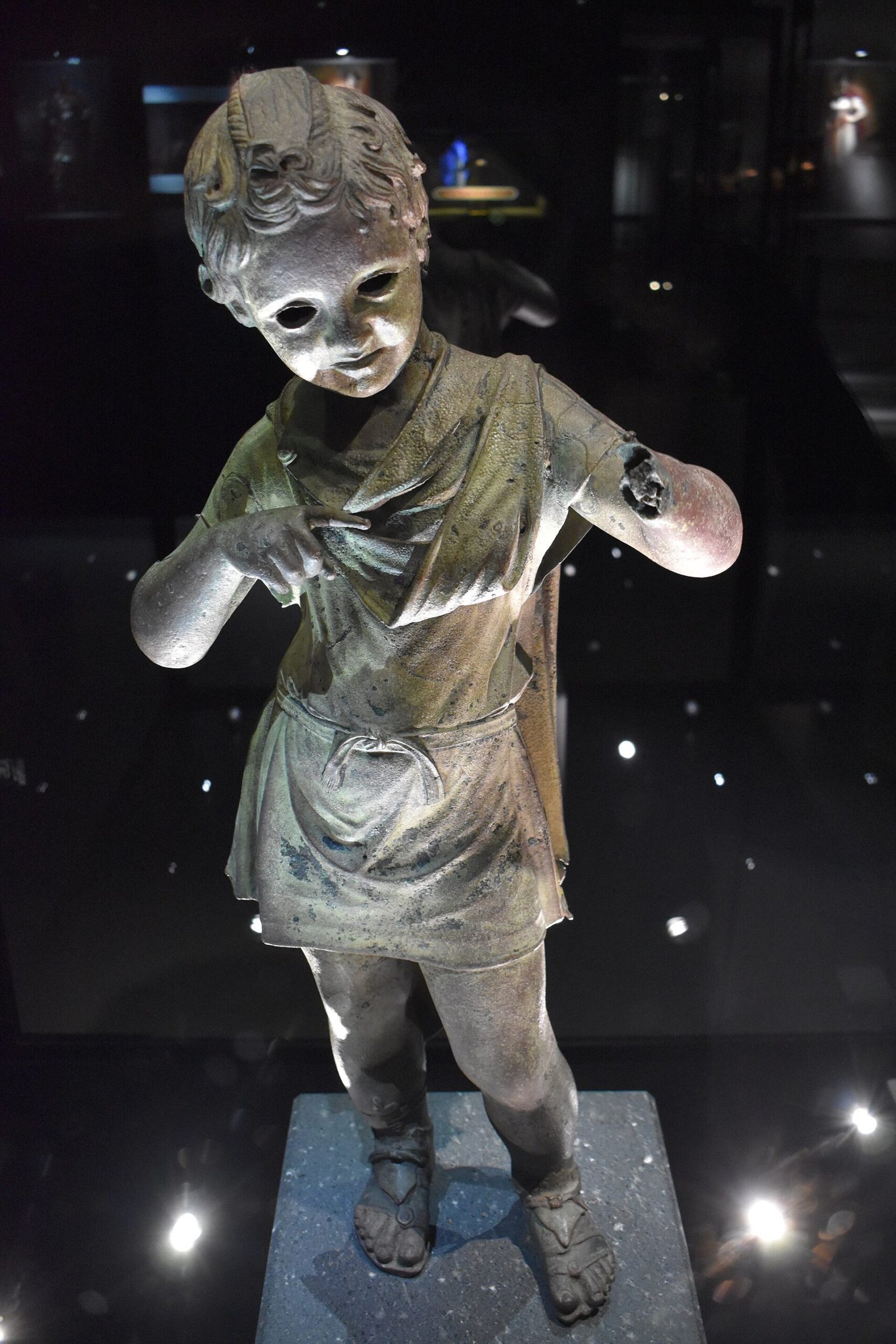
Brooklyn Museum’s Ptolemaic Prince, numbered 54.117 and dated to 51–30 BCE, has an uninscribed back support. The museum describes it as a possible image of one of Cleopatra’s sons. It does not identify the figure conclusively as Caesarion.
Even an inscription may leave room for doubt. The Metropolitan Museum of Art’s publication The Year One observes that the cartouche names on royal torso 1981.224.1 are known for both Ptolemy XII and Ptolemy XV. Its Notable Acquisitions 1981–1982 catalogue describes the basalt statue as Ptolemy XII or a successor, dating it to 80–30 BCE.
Details you won’t find in guidebooks
The Kallimachos stela preserves an older scene of Amun and Montu, probably from the Twenty-fifth Dynasty. Its Greek and Demotic inscriptions replaced earlier texts. The object therefore combines a surviving religious scene with a later dedication honoring Kallimachos under Cleopatra and Caesarion.
Caesarion’s Egyptian royal names included the Horus name Hunu, meaning “young.” Alongside the Greek nickname “Little Caesar,” it shows how different names presented different aspects of the same king: his youth and his claimed connection to Caesar.
The harbour head attributed to Caesarion by the Bibliotheca Alexandrina measures 80 centimetres high, 60 centimetres wide, and 50 centimetres deep. Those dimensions belong to the head alone. Its substantial size does not resolve the disputed identity of the ruler represented.
The Met’s royal torso, also associated with Caesarion, stands 93 centimetres high. According to the museum’s current record, it was returned to Italy in June 2025. Its return and its uncertain identification are separate parts of the object’s history.
Timeline
- 47 BCE: Caesarion was born. UCL gives the date as 23 June.
- 44 BCE: After Ptolemy XIV’s death, three-year-old Caesarion became Cleopatra’s co-ruler.
- 39 BCE: The Kallimachos stela depicted Cleopatra and Caesarion together.
- 34 BCE: At the Donations of Alexandria, Antony promoted Caesarion’s claim to be Caesar’s true son.
- 2 September 31 BCE: Octavian defeated Antony and Cleopatra at Actium.
- 30 BCE: Octavian conquered Egypt and ordered Caesarion’s execution at about seventeen.
- 30 BCE: Cornelius Gallus received responsibility for Egypt’s administration under Roman authority.
FAQ
Was Caesarion really Julius Caesar’s son?
His paternity was disputed in antiquity. Suetonius records statements supporting the claim and a book by Gaius Oppius rejecting it. Caesar did not formally recognize Caesarion as his legitimate heir under Roman law.
How old was Caesarion when he became pharaoh?
He was three when he became Cleopatra’s co-ruler in 44 BCE, following the death of Ptolemy XIV. Cleopatra retained actual governing authority.
Why did Octavian have Caesarion killed?
Caesarion’s claimed identity as Caesar’s son threatened Octavian’s position as Caesar’s adopted heir. Octavian ordered his execution in 30 BCE, when Caesarion was about seventeen.
Are any surviving statues certainly Caesarion?
Several sculptures have been associated with him, but their identifications remain disputed. Inscriptions and his depiction beside Cleopatra at Dendera provide firmer evidence of his royal position.
Sources
- University College London — Ptolemy XV Caesarion ucl.ac.uk
- Peter Nadig — Ptolemy XV Caesar doi.org
- Suetonius — Life of Julius Caesar, 52 penelope.uchicago.edu
- Wikipedia — Caesarion en.wikipedia.org
- Vikipedi — Kaisarion tr.wikipedia.org
- Plutarch — Life of Antony, 54, 65–68, 81 penelope.uchicago.edu
- Bruce W. Frier — Making History Personal lsa.umich.edu
- Cassius Dio — Roman History, 51 penelope.uchicago.edu
- Museo Egizio — Stela in Honor of the General Callimachos collezioni.museoegizio.it
- IEASM / Franck Goddio — Colossal Head of Caesarion franckgoddio.org
- Bibliotheca Alexandrina Antiquities Museum — Colossal Royal Head antiquities.bibalex.org
- Brooklyn Museum — Ptolemaic Prince, Google Arts & Culture artsandculture.google.com
- The Metropolitan Museum of Art — The Year One: Art of the Ancient World East and West resources.metmuseum.org
- The Metropolitan Museum of Art — Notable Acquisitions 1981–1982 resources.metmuseum.org
- The Metropolitan Museum of Art — Torso of a Ptolemaic King metmuseum.org
Image: Musée de l'Éphèbe – Statue de l'enfant royal 01.jpg — Tylwyth Eldar, CC BY-SA 4.0