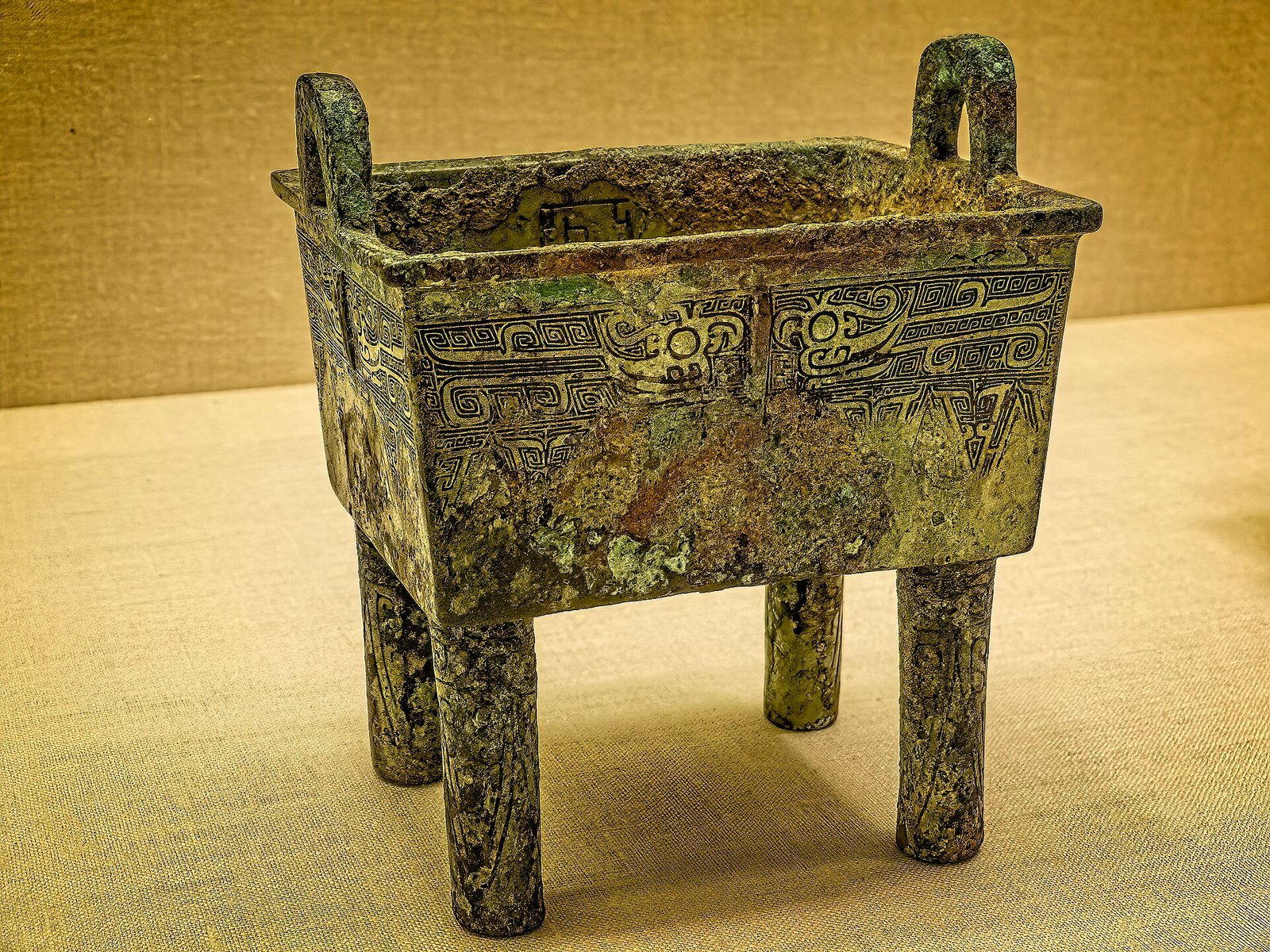
The Shang dynasty was a Chinese Bronze Age dynasty that ruled approximately 1600–1046 BCE, centred on the Yellow River in present-day Henan. It is the first Chinese dynasty with surviving contemporary written records. Its oracle bones preserve divinations about warfare, farming, childbirth and illness, illuminating early Chinese history through the concerns of the royal court.
A royal toothache and a military mobilisation could both become subjects for Shang divination. If you follow these records alongside Anyang’s buildings, bronzes and burials, you can examine how kings exercised authority and what troubled their court. The evidence also explains why the Zhou conquest ended Shang rule without ending all its ritual traditions.
Where and approximately when did the Shang dynasty rule?
The Shang political and military centre lay around the Yellow River in what is now Henan province. The widely used modern chronology places the dynasty between approximately 1600 and 1046 BCE. These dates describe the dynasty as a whole. They should be distinguished from the later period represented by its capital near Anyang.
UNESCO identifies Yin Xu, near Anyang and about 500 kilometres south of Beijing, as the late Shang capital of approximately 1300–1046 BCE. Its palace remains, ancestral temples and royal tombs provide an archaeological setting for the written evidence. When you encounter the names Yin Xu and Yinxu, both refer here to this archaeological site.
Shang dates have been debated. Liu Xin’s traditional calculation placed the dynasty in 1766–1122 BCE. The Xia–Shang–Zhou Chronology Project combined archaeology, radiocarbon evidence and astronomical data to propose approximately 1600–1046 BCE. The difference matters when comparing accounts: their starting dates may follow different chronological schemes.
David Keightley describes the Shang as China’s first historical dynasty because written sources from the dynasty survive. Their value lies in that connection between surviving writing and the people whose concerns it recorded.
What do oracle bones reveal about kings, warfare and daily life?
Shang diviners commonly used cattle shoulder blades and the underside shells of turtles. They prepared these surfaces and heated them to produce cracks. Royal diviners then interpreted the fractures. Columbia University describes a hot bronze rod being applied to hollows in the bone or shell, with the issue often expressed as two possible outcomes.
The resulting inscriptions preserve selected concerns of the kingdom’s elite. They address royal hunts, the birth of sons and the mobilisation of people for warfare, agriculture or public works. These subjects connect royal decisions with the organisation of labour. A record about farming could therefore concern both a practical task and the court’s ability to summon people.
Shang kings combined military command with religious authority. They directed divination ceremonies and held a privileged role in making offerings to royal ancestors. Warfare and ritual consequently appear within the same system of royal power. The ruler who commanded people also participated in seeking answers through divination.
The bones do not contain straightforward lists of kings. Instead, the sequence of sacrifices offered to earlier rulers has allowed researchers to reconstruct a royal succession. That reconstruction largely agrees with later historical accounts. Individual ritual records can therefore help answer a broader historical question: which rulers preceded those making the offerings?
These inscriptions require careful reading because they form a selective court record. Columbia University stresses that they reflect events and anxieties important to the elite. If you read them as a complete account of everyday Shang society, you would give the court’s priorities too much weight. Their evidence is strongest for the concerns they actually record.
How are Anyang’s finds, bronze vessels and burials interpreted?
Yin Xu’s palace and royal ancestral temple area contains more than 80 building foundations. UNESCO regards its palaces, ancestral temples and royal tombs as early examples for later Chinese palace architecture and rulers’ burial grounds. The surviving foundations show the built setting in which royal residence, ancestry and burial were expressed.
Bronze vessels add evidence about craft production and ritual. Shang makers used a casting method involving separate clay mould sections. After firing, the sections were reassembled around an inner core that formed the vessel’s hollow space. A finished vessel thus preserves the result of a carefully arranged mould and core.
Fu Hao’s tomb provides an especially substantial group of burial objects. Zheng Zhenxiang discovered it at Yinxu in 1976, and its contents were excavated unlooted. The inventory included 755 jade objects and 468 bronze objects. More than 200 of the bronzes were ritual vessels, linking a large part of the burial assemblage directly with ritual equipment.
The tomb also contained the remains of six dogs and 16 human skeletons. These have been interpreted as evidence of sacrificial practices associated with the burial. Alongside the jade and bronze objects, those remains show why a royal tomb must be examined as evidence for ritual actions as well as material wealth.
Oracle inscriptions attracted scholarly attention in 1899. Large-scale scientific excavation at Yinxu began in 1928 under Academia Sinica’s Institute of History and Philology. These two developments brought written records and excavated remains into the study of the Shang. Yinxu entered the UNESCO World Heritage List in 2006.
Details you won’t find in guidebooks
A childbirth inscription preserves an outcome as well as a divination. The result recorded in inscription 15A states that Fu Hao gave birth to a girl 31 days after the divination. The birth was judged unfavourable. This small record makes the court’s preference visible within a specific account of childbirth.
Wu Ding’s toothache offers an everyday-life connection. You may recognise the discomfort, but the royal response involved divination to identify which ancestor had caused it. The aim was to make a soothing sacrifice to that ancestor. A familiar physical problem was understood through the king’s relationship with the royal dead.
Human skeletons from Yinxu show cavities, abscesses and periodontal disease. Those findings establish dental problems among people represented in the excavated remains. They do not allow researchers to diagnose Wu Ding’s particular complaint directly. His written toothache and the skeletal evidence answer related but separate questions.
An inscribed oracle bone need not be a large object. The Ashmolean Museum’s example EAX.512 measures only 11.2 × 2 × 0.8 centimetres. The museum dates it to the Anyang period, approximately 1200–1050 BCE. Its dimensions give you a concrete sense of how small a surviving written object can be.
Fu Hao’s burial also held approximately 6,900 cowrie shells, which served as money during the Shang period. That total adds another measure of the tomb’s wealth alongside its jade and bronze inventory. The shells belong in the interpretation of the burial just as much as its more conspicuous ritual vessels.
How did Shang rule end and the Zhou dynasty rise?
Around 1046 BCE, Zhou ruler Wu defeated the forces of Di Xin, the last Shang king, at the Battle of Muye. The Zhou originated in the western Yellow River basin, in present-day Shaanxi. Their victory ended Shang dynastic rule and established a new ruling dynasty.
Zhou rulers used Tianming, the authority to rule granted by Heaven, to justify overthrowing the Shang. Military victory and political legitimacy were therefore connected in their explanation of the conquest. The concept provided a reason why authority could pass from the defeated dynasty to its conquerors.
The settlement after Muye did not immediately remove Di Xin’s family from power. Wu allowed Di Xin’s son, Wu Geng, to remain as a subordinate ruler. After Wu’s death, Shang supporters participated in the Rebellion of the Three Guards. The rebellion was suppressed after three years.
Zhou rule continued the use of bronze ritual vessels and divination. It also placed extensive territories under relatives and other nobles appointed by the ruler. The conquest changed the dynasty and the organisation of government, while practices familiar from the Shang remained part of the new political order.
Timeline
- Approximately 1600 BCE: The Shang dynasty begins under the widely used modern chronology.
- Approximately 1300–1046 BCE: Yin Xu serves as the late Shang capital in UNESCO’s dating.
- Approximately 1046 BCE: Zhou Wu wins at Muye, ending Shang dynastic rule.
- 1899: Oracle-bone inscriptions attract scholarly attention.
- 1928: Academia Sinica’s Institute of History and Philology begins scientific excavations at Yinxu.
- 1976: Zheng Zhenxiang discovers Fu Hao’s unlooted tomb.
- 2006: Yinxu joins the UNESCO World Heritage List.
FAQ
What was the Shang dynasty?
The Shang was a Chinese Bronze Age dynasty that ruled approximately 1600–1046 BCE, with its political and military centre around the Yellow River in present-day Henan. It is the first Chinese dynasty with surviving contemporary written records.
What were oracle bones used for?
Royal diviners interpreted cracks made by heating prepared animal bones and turtle shells. Inscriptions recorded concerns including warfare, farming, childbirth, royal hunts and illness.
Why is Fu Hao’s tomb important?
Zheng Zhenxiang discovered Fu Hao’s unlooted tomb in 1976. Its contents included 755 jade objects, 468 bronze objects and about 6,900 cowrie shells.
How did the Shang dynasty end?
Around 1046 BCE, Zhou ruler Wu defeated the forces of the last Shang king, Di Xin, at Muye. Bronze ritual vessels and divination continued under Zhou rule.
Sources
- Metropolitan Museum of Art — Shang and Zhou Dynasties: The Bronze Age of China metmuseum.org
- Cambridge University Press, David Keightley — The Shang: China’s First Historical Dynasty cambridge.org
- English Wikipedia — Shang dynasty en.wikipedia.org
- UNESCO World Heritage Centre — Yin Xu whc.unesco.org
- Penn Museum — Oracle Bone 49-14-7B collections.penn.museum
- Columbia University — Oracle-Bone Inscriptions: On Childbearing afe.easia.columbia.edu
- New York University, Institute for the Study of the Ancient World — From Oracle to Human Bones isaw.nyu.edu
- Ashmolean Museum — Oracle bone EAX.512 jameelcentre.ashmolean.org
- Academia Sinica — Approaching National Treasures: Inscribed Deer Skull museum.sinica.edu.tw
- Henan Provincial Government — Tomb of Fu Hao english.henan.gov.cn
- Smithsonian National Museum of Asian Art — Zhou dynasty asia.si.edu
- English Wikipedia — Yinxu en.wikipedia.org
Image: Bronze Rectangular Caldron (Fangding) Shang dynasty 12th-11th century BCE China.jpg — Mary Harrsch, CC BY-SA 4.0