Nebuchadnezzar II was the Babylonian king who ruled from 605 to 562 BCE after succeeding his father, Nabopolassar. He strengthened the Neo-Babylonian kingdom through military campaigns, tribute, and population transfers, while rebuilding Babylon. His forces captured Jerusalem in 597 BCE and destroyed it in a later campaign dated to 587/586 BCE.
How could the same king celebrate temple repairs while becoming associated with Jerusalem’s destruction? You can approach that question through his campaigns, the rulers he installed, and the inscriptions placed inside his buildings. These records connect imperial expansion with construction, while biblical accounts preserve the impact of conquest and exile.
How did Nebuchadnezzar II strengthen the Neo-Babylonian kingdom?
Nebuchadnezzar’s victory at Carchemish in 605 BCE opened the way to Babylonian dominance over Syria and Palestine. He defeated the army of the Egyptian pharaoh Necho II. In the same year, he succeeded Nabopolassar on Babylon’s throne. His accession therefore coincided with a major military success.
Under Nabopolassar and Nebuchadnezzar, Babylonian rule covered much of the former Assyrian territory between the Persian Gulf and the Mediterranean. Campaigns helped establish that reach. Tribute and the appointment of dependent rulers helped maintain it. Jerusalem would experience both methods after its capture in 597 BCE.
Ashkelon shows the destructive side of expansion. According to the Babylonian Chronicle, Nebuchadnezzar captured it in 604 BCE. He took its king to Babylon, plundered the city, and destroyed it. Military defeat could therefore mean the removal of a ruler as well as the destruction of his city.
Babylonian expansion also met resistance. Nebuchadnezzar’s invasion of Egypt failed in 601 BCE. The Babylonian Chronicle records heavy losses on both sides. This setback forms an essential part of the circumstances surrounding Judah’s challenge to Babylonian authority.
Nebuchadnezzar also continued the Assyrian practice of moving large populations within the empire. These transfers supplied labor and dispersed potential centers of resistance.
What circumstances led to the Jerusalem campaigns and Babylonian exile?
Judah’s position was shaped by the struggle between Babylon and Egypt. Around 601 BCE, King Jehoiakim began challenging Babylonian authority while expecting Egyptian support. Nebuchadnezzar’s failed Egyptian campaign belongs to this setting. Babylon’s power was extensive, but its hold over subordinate kingdoms still faced challenges.
The first capture of Jerusalem discussed here occurred in 597 BCE. The Babylonian Chronicle tablet BM 21946 records that Nebuchadnezzar seized the city and its king on the second day of the month of Adar. The tablet is held in the British Museum. Its account gives the conquest a specific place in Babylonian political recordkeeping.
The chronicle also records the settlement imposed after the capture. Nebuchadnezzar installed a king of his own choosing and took tribute to Babylon. The biblical account in 2 Kings 24:10–17 names the deported king as Jehoiachin. It identifies his replacement as his uncle Mattaniah, renamed Zedekiah.
Zedekiah later challenged the arrangement. In 589 BCE, he refused to pay tribute to Nebuchadnezzar. That refusal supplied the political reason for another Babylonian campaign against Judah. The ruler installed after the earlier conquest had himself become a source of resistance.
The final campaign brought a much more destructive outcome. Jerusalem was plundered and destroyed, the Kingdom of Judah ended, and part of the population was deported to Babylon. The destruction of Jerusalem and Solomon’s Temple is dated to either 587 or 586 BCE. The combined form 587/586 BCE keeps that dating debate visible.
If you remember one distinction, separate the capture of 597 BCE from the destruction of 587/586 BCE. The earlier event brought a replacement king and tribute. The later event ended the kingdom and brought further deportations. Treating them as a single conquest hides the sequence of submission, renewed resistance, and destruction.
How do royal inscriptions document his building projects in Babylon?
Babylon was the Neo-Babylonian capital from 626 to 539 BCE. Its remains lie about 85 kilometers south of Baghdad.
A clay cylinder in the Metropolitan Museum of Art provides direct evidence for his defenses. Catalogued as 86.11.60, it describes the construction of a new outer wall at Babylon. Nebuchadnezzar states that he used bitumen and baked brick. The inscription records both the project and its building materials.
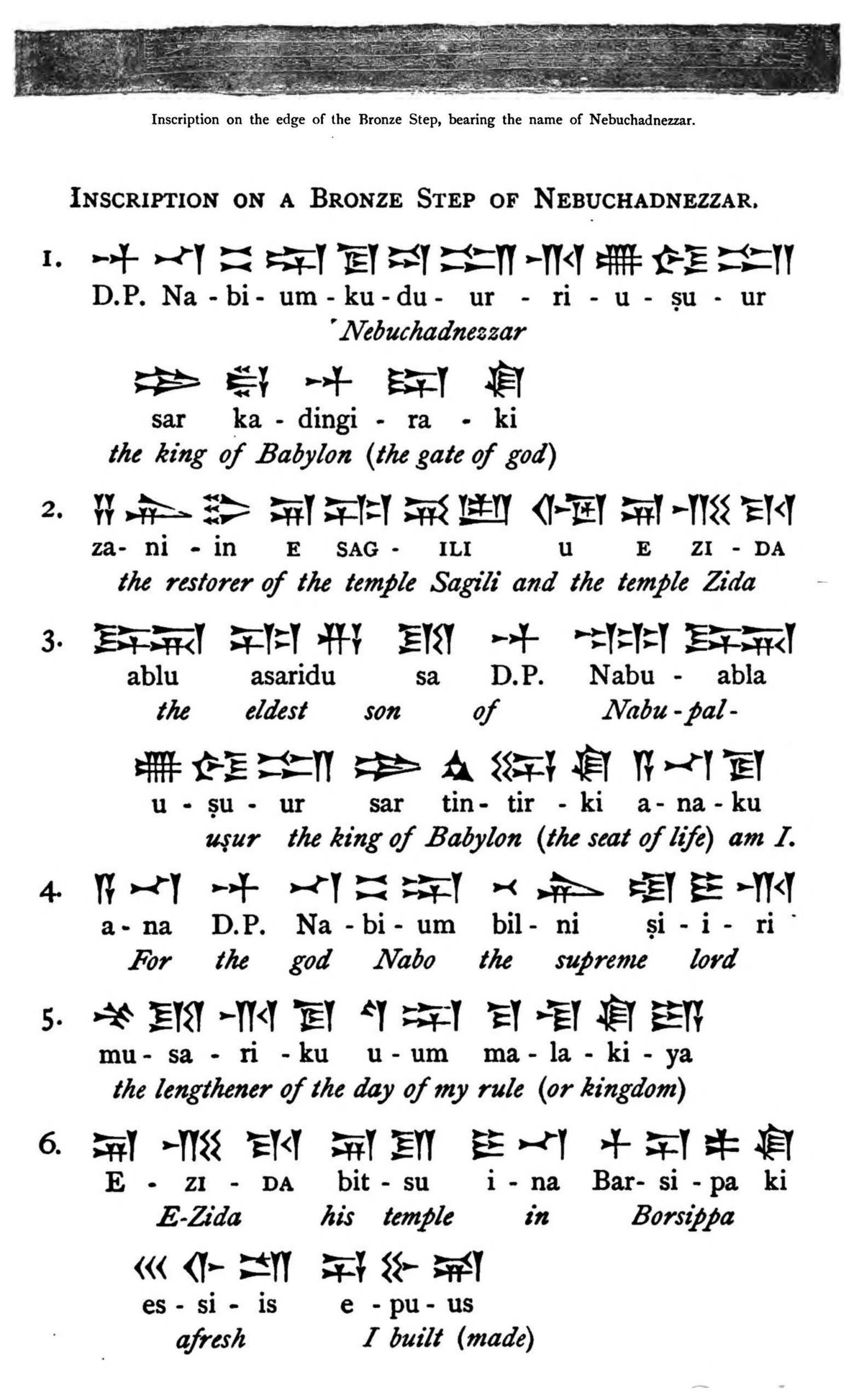
His royal texts also emphasized temple repairs. These accounts presented him as a pious ruler who maintained sacred buildings. The intended audience matters. Foundation cylinders primarily addressed the gods, while also asking future kings to preserve Nebuchadnezzar’s name when they discovered the texts during repairs.
The Ishtar Gate offers another view of construction under Nebuchadnezzar. It was one of eight entrances to Babylon’s inner city. Bulls and dragons decorated its blue glazed bricks. Defenses, religious buildings, and monumental entrances all formed part of the capital he developed.
You can make an everyday-life connection through building maintenance. Nebuchadnezzar’s foundation texts anticipated later repairs, much as a building record can connect one repair project with the next. His cylinders gave that continuity a royal purpose: future kings carrying out repairs were meant to encounter and preserve his name.
How do cuneiform records differ from biblical portrayals?
Cuneiform records served different purposes. The Babylonian Chronicle documented political and military events, including Jerusalem’s capture in 597 BCE. Royal building inscriptions emphasized construction and temple restoration. An administrative tablet from Nebuchadnezzar’s reign belongs to another category again. Sharing a writing system did not make these documents interchangeable.
The contrast becomes clear in the accounts of Jerusalem. BM 21946 records the capture, the king’s removal, the installation of a replacement, and tribute. The biblical passage supplies the names Jehoiachin, Mattaniah, and Zedekiah. Reading the accounts together connects the chronicle’s political sequence with named participants.
Nebuchadnezzar’s inscriptions projected an image of religious devotion through temple repairs. Biblical portrayals were shaped by Jerusalem’s destruction and the experience of exile. The contrast reflects the different concerns of royal self-presentation and accounts of a conquered community.
Details you won’t find in guidebooks
Nebuchadnezzar’s foundation cylinders were deliberately hidden. They were baked for durability and buried in building foundations during construction or repair. Their placement helps explain why a text intended to preserve a king’s name could remain out of ordinary sight.
The same tension appears in Babylon’s bricks. Millions carried stamps bearing Nebuchadnezzar’s name and titles. Yet the stamps lay on the bricks’ upper surfaces. Once the bricks entered a wall, the writing became invisible. Repetition across the building materials did not mean that visitors could read the finished walls.
The East India House Inscription also challenges the assumption that these records were all clay tablets. CDLI identifies it as an Akkadian inscription from Babylon, held in the British Museum as BM 129397. It is limestone and measures 565 × 502 × 95 millimeters.
The tablet BM.36579 offers a different kind of detail. The electronic Babylonian Library classifies it as an administrative document. It dates to the ninth month of Nebuchadnezzar’s thirty-fifth year, approximately 9 December 570 to 6 January 569 BCE. It is therefore evidence from administration rather than a building dedication.
Babylon’s ceremonial route also had a specific setting and use. The Processional Way, called Ay-ibur-shabum, has been exposed for about one kilometer. It carried 120 glazed-brick lions and served a procession on the eighth day of the New Year festival.
What about the Hanging Gardens?
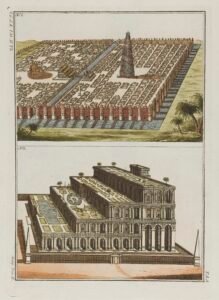
The traditional story credits Nebuchadnezzar with building the Hanging Gardens at Babylon for his wife. That attribution remains disputed. Babylonian royal inscriptions contain no description of a garden identifiable as monumental planted terraces. The gardens therefore require different treatment from his documented outer wall.
Stephanie Dalley proposed an alternative in 2013. She placed the gardens at Nineveh and attributed them to the Assyrian king Sennacherib in the early seventh century BCE. This is an alternative theory, while Nebuchadnezzar’s Babylonian wall remains documented by a surviving royal inscription.
Timeline
- 626 BCE: Beginning of Babylon’s period as the Neo-Babylonian capital.
- 605 BCE: Nebuchadnezzar wins at Carchemish and succeeds Nabopolassar.
- 604 BCE: Babylonian forces capture and destroy Ashkelon.
- 601 BCE: The invasion of Egypt fails; both armies suffer heavy losses.
- 597 BCE: Jerusalem falls, Jehoiachin is taken to Babylon, and Zedekiah becomes king.
- 589 BCE: Zedekiah refuses to pay Babylonian tribute.
- 587/586 BCE: Jerusalem and Solomon’s Temple are destroyed; further deportations follow.
- 570/569 BCE: Administrative tablet BM.36579 dates to Nebuchadnezzar’s thirty-fifth year.
- 562 BCE: Nebuchadnezzar dies and his son Amel-Marduk succeeds him.
FAQ
When did Nebuchadnezzar II rule Babylon?
Nebuchadnezzar II ruled from 605 to 562 BCE. He succeeded his father, Nabopolassar, and was followed by his son, Amel-Marduk.
Why did Nebuchadnezzar II attack Jerusalem?
The campaigns followed challenges to Babylonian authority amid rivalry with Egypt. Jehoiakim expected Egyptian support, while Zedekiah later refused to pay tribute in 589 BCE.
Did Jerusalem fall in 597 or 587/586 BCE?
These dates refer to different events. Babylon captured Jerusalem in 597 BCE; the city’s final destruction and further deportations followed in 587/586 BCE.
Did Nebuchadnezzar II build the Hanging Gardens?
The attribution is disputed. Babylonian royal inscriptions contain no garden description identifiable as monumental planted terraces, and an alternative theory places the gardens at Nineveh under Sennacherib.
Sources
- Wikipedia — Nebuchadnezzar II, Turkish tr.wikipedia.org
- Wikipedia — Nebuchadnezzar II, English en.wikipedia.org
- UNESCO — Babylon whc.unesco.org
- The Metropolitan Museum of Art — Babylon metmuseum.org
- Center for Online Judaic Studies — The Babylonian Chronicle cojs.org
- The Metropolitan Museum of Art — Cylinder Inscription of Nebuchadnezzar II, 86.11.60 metmuseum.org
- Cuneiform Digital Library Initiative — P522992 cdli.earth
- LMU München, electronic Babylonian Library — BM.36579 ebl.uni-muenchen.de
- French Ministry of Culture — La Porte d’Ishtar et la Voie Processionnelle archeologie.culture.gouv.fr
- University of Hamburg, CSMC — The Hanging Gardens of Babylon were at … Nineveh! csmc.uni-hamburg.de
Image: Nebuchadnezzar II bronze step inscription.jpg — Ernest Alfred Wallis Budge (1884), Public domain