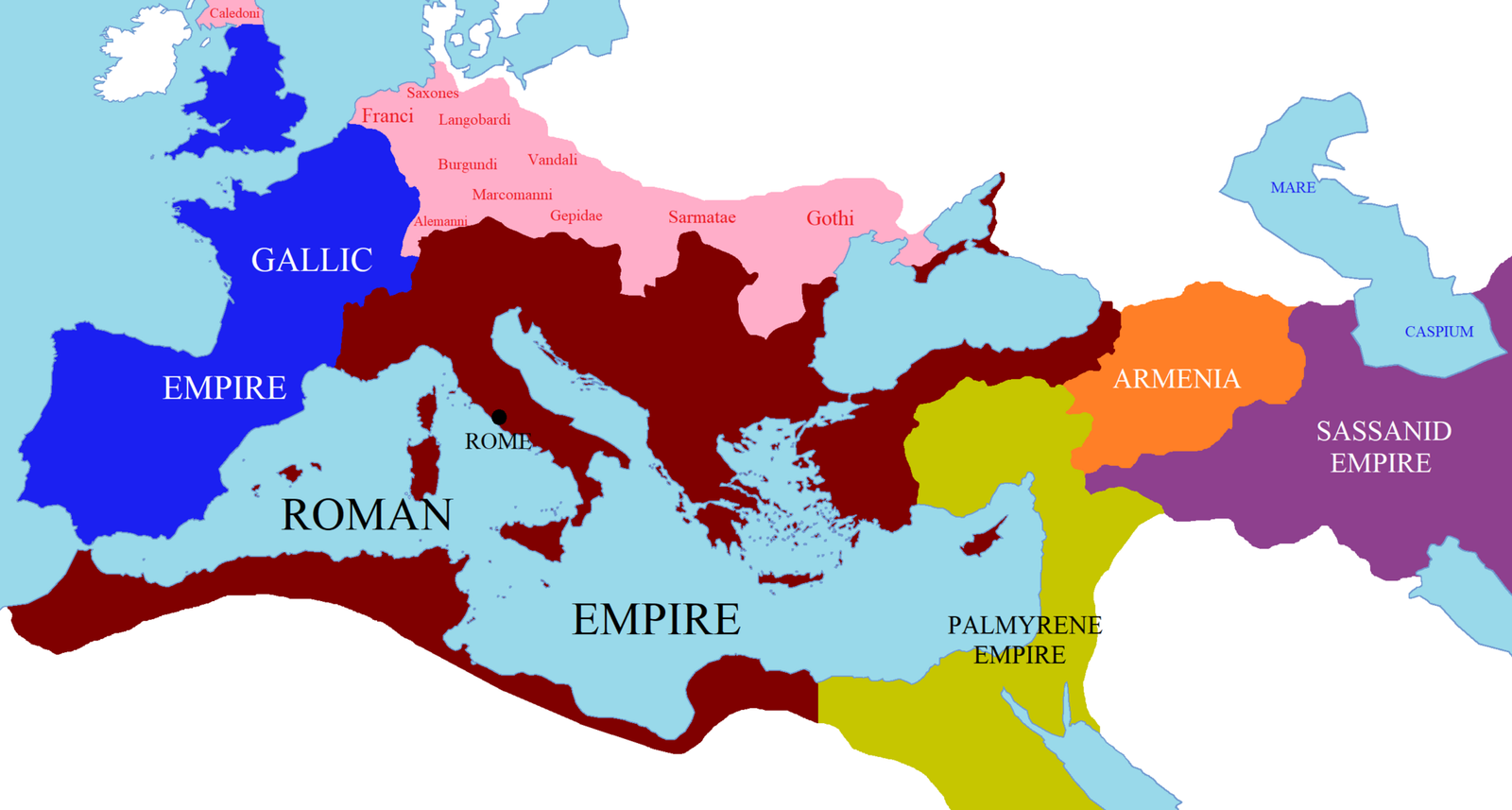
The Crisis of the Third Century was a period of invasions, civil wars, and economic disruption in the Roman Empire, traditionally dated to AD 235–284. Rome nearly fragmented because military struggles for the throne and attacks on its frontiers strained its armies and finances, while separate regimes emerged around Gaul and Palmyra.
The sharpest turning point came around 260, when the Persian capture of Emperor Valerian coincided with the emergence of a separate government in Gaul. If you follow these events through Anatolia, Syria, and Egypt, you can see how frontier defense became regional power. The route also explains why Aurelian’s reunification and Diocletian’s later reforms were different stages of recovery.
Why is 235 considered the beginning of the crisis?
In 235, soldiers murdered Emperor Severus Alexander and his mother, Julia Mamaea, near Mainz. Their deaths ended the Severan dynasty. The soldiers proclaimed Maximinus Thrax emperor, making military power decisive in this transfer of the throne.
That event provides a concrete starting point for the conventional chronology. The crisis then extended across roughly fifty years of repeated attacks and struggles over imperial authority. Its traditional endpoint, 284, marks the beginning of Diocletian’s reign, rather than the date of Aurelian’s territorial reunification.
The speed of political turnover became especially clear in 238. Maximinus, Gordian I, Gordian II, Pupienus, Balbinus, and Gordian III all made imperial claims within that year. It is consequently known as the Year of the Six Emperors.
How did soldier emperors and civil wars affect imperial government?
The accession of Maximinus showed how soldiers could determine who became emperor. The competing claims of 238 exposed the instability of that arrangement. Imperial government faced repeated contests over who could exercise its authority, alongside the continuing demands of frontier defense.
Civil wars also consumed military manpower. Replacing those losses required further recruitment, increasing pressure on the population engaged in production. Fighting over the throne therefore affected more than the competing emperors: it drew additional people into military service.
The financial burden increased as more soldiers fought invasions. Taxes rose to support the army. Inflation added another strain, and the state increasingly demanded revenue in products or services instead of cash. Military and economic pressures thus reached the same communities from several directions.
You can connect this to an everyday household budget: a larger bill becomes harder to meet when money also loses purchasing power. In the Roman case, rising military costs and inflation were accompanied by demands for goods or services. The burden extended beyond a cash payment.
Egypt provides a further concrete view of the century’s economy. Tenant farming became more widespread, while wealth concentrated in cities including Alexandria and Antinoopolis. These developments belong alongside taxation and recruitment when considering how the period affected people beyond imperial courts.
What were the consequences of Sasanian attacks and frontier pressures?
Rome faced a new eastern imperial power after Ardashir I defeated the Parthians around 224 and founded the Sasanian dynasty. During the decades after 235, Franks, Alamanni, Goths, and Persians attacked Roman territory. Pressure came from several frontiers during the same period of internal warfare.
Dura-Europos illustrates the consequences for a frontier settlement. This Roman city on the Euphrates fell after a Sasanian siege around 256 and was subsequently abandoned. Here, frontier conflict ended in the loss of an inhabited city.
An even greater political shock followed in 260. Shapur I captured Emperor Valerian in battle near Edessa. The crisis reached its height around this time, as the eastern military disaster coincided with a major break in imperial authority in the west.
After Valerian’s capture, much of the responsibility for defending Rome’s eastern frontier fell to the ruler of Palmyra in Syria. This shift gave a regional ruler substantial responsibility within the Roman world. It created the setting in which Palmyrene power expanded.
How did the Palmyrene and Gallic breakaway regimes emerge?
The western rupture centered on Postumus. Around 260, his soldiers proclaimed him emperor. After having Gallienus’s son Saloninus killed at Cologne, he established a separate government based in Gaul. The Gallic Empire lasted from 260 to 274.
At its greatest extent, this regime included Gaul, Britannia, and Hispania. Rome’s fragmentation therefore involved a substantial group of western territories under a separate imperial claimant. It was more than a succession dispute confined to one city.
Palmyra followed a different course. Between 260 and 267, its ruler Odaenathus exercised considerable freedom of action while maintaining allegiance to Rome. He issued coins in the name of Gallienus. Regional autonomy and an expressed Roman loyalty existed together.
In 267, the child Vaballathus succeeded Odaenathus, with his mother Zenobia acting as regent. Her forces took control of Egypt late in 270. That territory mattered to Italy’s grain supply, giving Palmyrene expansion consequences beyond the eastern frontier.
In 271, Zenobia’s forces controlled much of Anatolia. If you are exploring Turkey’s Roman past, this is where the crisis becomes directly relevant to the peninsula. Anatolia lay within Palmyra’s expanding sphere before becoming the route of Aurelian’s advance into Syria.
The two regional regimes should therefore be distinguished. Postumus established a separate imperial government around Gaul. Palmyra’s rulers moved from substantial autonomy under Odaenathus to territorial expansion under Zenobia. Both developments weakened the unity of imperial rule, but their paths differed.
How did the empire recover under Aurelian and Diocletian?
Aurelian advanced through Anatolia into Syria in 272. He captured Palmyra and restored Roman control in the east. In 274, he also ended the separate government based in Gaul, bringing the empire back under one administration.
Territorial recovery did not immediately settle the struggle over imperial power. Aurelian was murdered in 275. His death shows why reunification in 274 and the conventional end of the crisis in 284 are separate milestones: short reigns and contests for the throne continued.
Diocletian began his reign in 284 and ruled until 305. During that period, he reorganized government by creating smaller provinces and separating the duties of military commanders from those of civilian governors. Recovery involved changes to administration as well as the restoration of territory.
In 293, the Tetrarchy established two augusti and two caesars. Its rulers were Diocletian, Maximian, Galerius, and Constantius. This arrangement came after the crisis’s traditional endpoint, showing that the administrative response continued beyond 284.
Timeline
- Around 224: Ardashir I defeated the Parthians and founded the Sasanian dynasty.
- 235: Severus Alexander was murdered; soldiers proclaimed Maximinus Thrax emperor.
- 238: Competing claims produced the Year of the Six Emperors.
- Around 256: Sasanian forces captured Dura-Europos.
- 260: Shapur I captured Valerian; Postumus’s separate government emerged in Gaul.
- 267: Vaballathus became ruler, with Zenobia as regent.
- Late 270: Palmyrene forces took control of Egypt.
- 272: Aurelian captured Palmyra.
- 274: The Gallic regime ended, restoring territorial unity.
- 275: Aurelian was murdered.
- 284: Diocletian’s reign began.
- 293: The Tetrarchy established two augusti and two caesars.
Details you won’t find in guidebooks
At Dura-Europos, the Sasanian siege involved substantial engineering. The attackers constructed an assault ramp approximately 40 meters long and 10 meters high to reach the walls. Those dimensions give you a physical measure of the effort involved in taking the frontier city.
Palmyrene coins reveal changing claims to authority. After Aurelian became emperor in 270, the administration issued coins bearing the Roman emperor on one side and Vaballathus on the other. Portraits of Zenobia appeared on coins only in 272. An Alexandrian tetradrachm gave her the title Sebaste, meaning empress.
A bronze statue of Trebonianus Gallus, dated to 251–253, survives in the Metropolitan Museum of Art. It is among the few Roman bronze statues from the third century to reach the present nearly complete. The object provides a surviving imperial portrait from within the crisis years.
Was the crisis the beginning of inevitable collapse?
The restoration of unity in 274 and Diocletian’s subsequent reorganization complicate a simple story of inevitable collapse. Andrea Giardina’s discussion of the transition to Late Antiquity identifies scholarship that treats the third century as a period of transformation. That interpretation gives administrative change a place alongside invasion and fragmentation.
FAQ
When was the Crisis of the Third Century?
It is traditionally dated to 235–284, from the murder of Severus Alexander to the beginning of Diocletian’s reign.
Why did Rome nearly fragment?
Military struggles for the throne, civil wars, frontier attacks, and economic disruption weakened central authority. Separate regimes emerged around Gaul and Palmyra.
How did the crisis affect Anatolia?
Zenobia’s forces controlled much of Anatolia in 271. Aurelian advanced through Anatolia into Syria in 272 and captured Palmyra.
Who reunited the Roman Empire?
Aurelian restored Roman control in the east in 272 and ended the Gallic breakaway regime in 274. Diocletian subsequently reorganized imperial government.
Sources
- Wikipedia, “Crisis of the Third Century” en.wikipedia.org
- Cambridge Ancient History, “Maximinus to Diocletian and the ‘crisis’” cambridge.org
- The Metropolitan Museum of Art, “The Sasanian Empire” metmuseum.org
- Yale University Art Gallery, “Dura-Europos: Excavating Antiquity” duraeuropos.artgallery.yale.edu
- Encyclopaedia Iranica, “Dura Europos: Archaeology and History” iranicaonline.org
- The Metropolitan Museum of Art, “The World between Empires” resources.metmuseum.org
- The Metropolitan Museum of Art, “Roman Art: A Resource for Educators” metmuseum.org
- The Metropolitan Museum of Art, “Egypt, 1–500 A.D.” metmuseum.org
- The Metropolitan Museum of Art, “The Roman Empire” metmuseum.org
- The Metropolitan Museum of Art, “Bronze statue of the emperor Trebonianus Gallus” metmuseum.org
- Andrea Giardina, “The Transition to Late Antiquity,” Cambridge University Press cambridge.org
Image: Rome 3rd Century.png — Doll91939, CC BY-SA 4.0