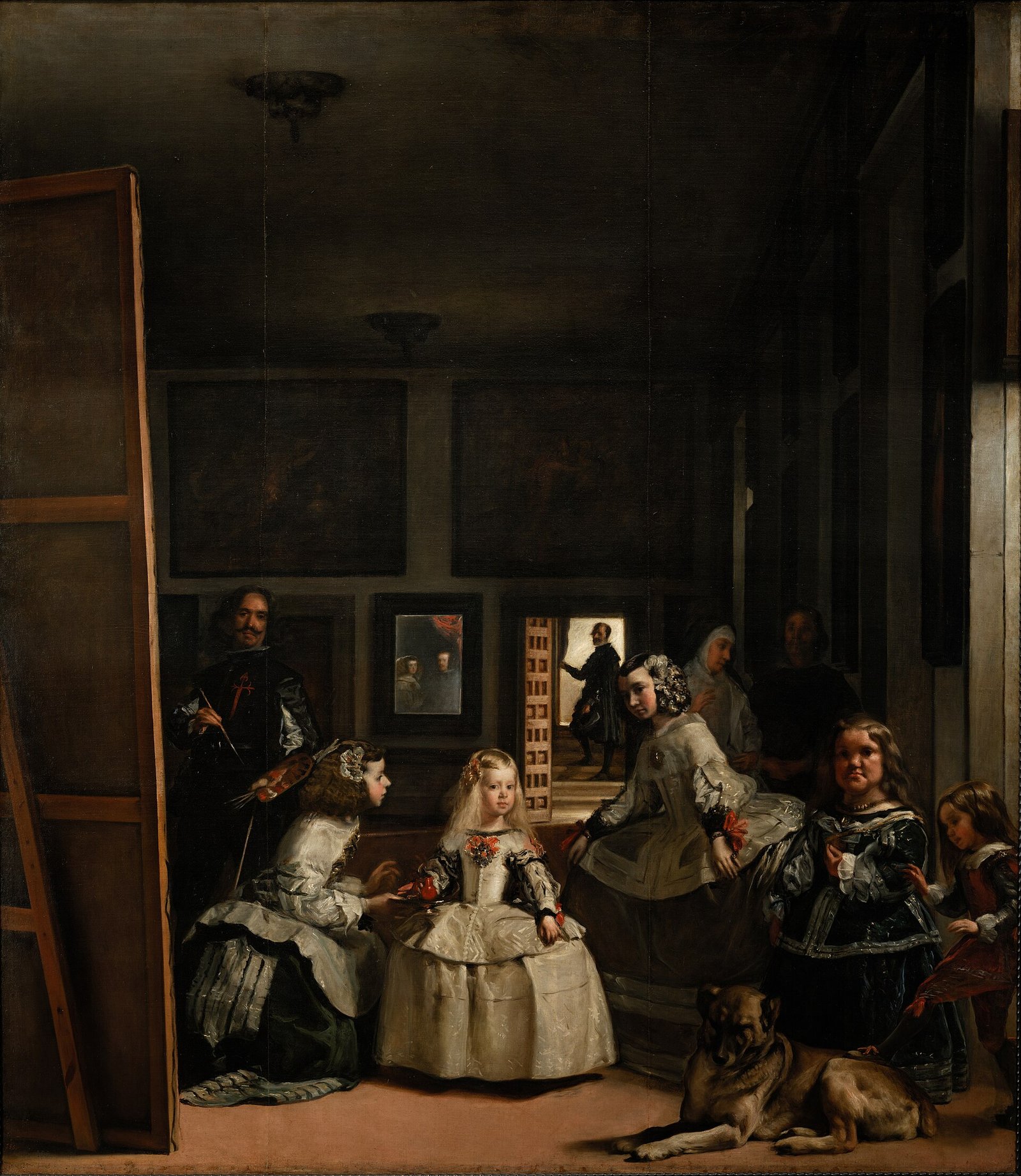
Las Meninas shows the young princess Margarita Teresa surrounded by her attendants in Madrid’s Alcázar Palace, with Diego Velázquez painting at the left. Made in 1656, it also shows her parents, Philip IV and Mariana of Austria, in a mirror on the back wall. Whether that mirror reflects the royal couple directly or their painted portraits remains disputed.
The mirror is only one part of the puzzle. A kneeling attendant offers a red vessel, a courtier nudges a dog, and another figure stands in a bright doorway. If you follow these details before returning to the royal reflection, you can see how the painting connects a court gathering with questions about looking and representation.
Las Meninas by Diego Velázquez: what is the painting?
Velázquez painted Las Meninas in oil on canvas in 1656. The Prado records its dimensions as 320.3 centimetres high and 279.1 centimetres wide. Its setting is a room in the Cuarto del Príncipe, a section of Madrid’s Alcázar Palace.
The artist appears within that setting. At the left, Velázquez portrays himself working beside a large canvas. We see its back rather than the painted surface. That concealed surface matters because one explanation of the mirror depends on what he might be painting there.
At the centre stands Margarita Teresa, the daughter of Philip IV and Mariana of Austria. Born in 1651, she was about five when Velázquez painted the scene. Her parents appear elsewhere in the composition, through the reflection on the rear wall.
Las Meninas meaning: who are the ladies-in-waiting?
The Spanish title Las Meninas refers to the ladies-in-waiting who accompanied princesses at court. Here, the two attendants are María Agustina Sarmiento and Isabel de Velasco. The title names their role, although Margarita Teresa occupies the centre of the scene.
María Agustina Sarmiento kneels before Margarita and offers a red búcaro vessel on a tray. Isabel de Velasco stands beside the princess, shown preparing to curtsy. Their different gestures give you concrete actions to follow: one presents an object, while the other prepares a formal greeting.
The familiar title came later than the painting. In the Alcázar inventory of 1666, the work was described as a portrait of the empress with her ladies-in-waiting and a female dwarf. Las Meninas first appeared as its title in the Prado catalogue prepared by Pedro de Madrazo in 1843.
Who else appears around the royal family?
On the right are the court figures Mari Bárbola and Nicolasito Pertusato. Behind them stand Marcela de Ulloa and an attendant. These figures extend the gathering beyond the princess and the two women whose court role supplies the painting’s title.
Nicolasito Pertusato nudges the mastiff in the foreground with his foot. It is a small action beside the presentation of the vessel and the preparation to curtsy. Looking at the dog helps you distinguish an informal gesture from the more formal actions surrounding Margarita.
The person in the bright doorway at the back is José Nieto, an official of the queen’s household. His position provides another specific place to look after the foreground group. The doorway and the mirror both occupy the rear of the room, but they contain different people: Nieto in one, the royal couple in the other.
What does the mirror in Las Meninas show?
The identities in the mirror are clear: Philip IV and his wife, Mariana of Austria. The disagreement concerns the source of their reflected image. Are they standing before the scene, or does the mirror show portraits on the canvas whose front remains hidden?
In a common interpretation, the mirror directly reflects the king and queen. They stand in front of the depicted space, in a position close to the viewer’s. Under this reading, the royal parents belong to the gathering even though their bodies are outside the visible room.
H. W. Janson and Joel Snyder argued for another explanation. They held that the mirror reflects the royal couple’s painted portraits on Velázquez’s canvas. In this account, the small image at the back depends on the larger painted surface that the viewer cannot see.
An everyday comparison helps separate these possibilities. When you look into a mirror in a room, it might show a person or a picture of that person. Both involve reflection, but the reflected object differs. That distinction lies at the centre of the two readings of Philip and Mariana’s appearance.
The Prado interprets Velázquez’s mirror as an invitation to consider seeing, representation, and the boundary between painting and reality. You can connect that interpretation to visible features: the artist at work, the concealed canvas, and the royal image on the back wall. The mirror’s meaning depends on their relationship.
Las Meninas: where is it, and where in the Prado?
Las Meninas is displayed in Room 012 of the Museo Nacional del Prado in Madrid. This identifies both the museum and the room for anyone searching for its location. The setting shown within the canvas, however, is the Cuarto del Príncipe in the Alcázar Palace.
The work entered the Prado collection in 1819, the year the museum was founded. Before that, it survived the fire that destroyed the Alcázar in 1734. The painting suffered damage and was subsequently repaired by the court painter Juan García de Miranda.
A later restoration took place in 1984. John Brealey cleaned the painting. Prado restorers Clara Quintanilla, Rocío Dávila, and Maite Dávila then carried out the retouching. Its conservation history therefore includes both repairs after the palace fire and this later treatment.
Details you won’t find in guidebooks
The red cross of the Order of Santiago on Velázquez’s chest was added after the painting’s original completion. Velázquez received the order in 1659, three years after the date of Las Meninas. The cross therefore belongs to a later stage in the canvas’s history.
Infrared examination revealed another change within the artist’s self-portrait. Velázquez initially painted his head tilted in a different direction from the final version. The figure now visible preserves the outcome of that revision, while the examination exposed an earlier arrangement beneath it.
The current wooden frame also has its own date and maker. It was commissioned in 1928 from the Madrid workshop Hijos de José Cano. The frame surrounding Las Meninas thus belongs to a much later moment than the palace scene painted in 1656.
Las Meninas by Picasso: how does it relate to Velázquez?
Pablo Picasso produced a series of 58 oil paintings inspired by Las Meninas in 1957. He worked in the upstairs studio of La Californie, his home near Cannes.
The 58 paintings reached Barcelona’s Picasso Museum in May 1968. Picasso donated the series in memory of his friend Jaume Sabartés. This gives the two bodies of work distinct museum locations: Velázquez’s canvas is in Madrid’s Prado, while Picasso’s series went to Barcelona.
Timeline
- 1651: Margarita Teresa, the child at the centre of the painting, was born.
- 1656: Velázquez painted Las Meninas.
- 1659: Velázquez received the Order of Santiago; the red cross in his self-portrait cannot predate this year.
- 1666: The Alcázar inventory recorded the painting as a portrait of the empress with her ladies-in-waiting and a female dwarf.
- 1734: The painting was damaged in the Alcázar fire and repaired afterward.
- 1819: Las Meninas entered the Prado collection.
- 1843: The title Las Meninas first appeared in the Prado catalogue.
- 1928: The current frame was commissioned from the Cano workshop.
- 1957: Picasso produced his Las Meninas series.
- 1968: Picasso’s series reached the Barcelona museum through his donation.
- 1984: John Brealey and Prado restorers cleaned and restored the painting.
FAQ
What does Las Meninas mean?
The Spanish title refers to the ladies-in-waiting who accompanied princesses at court. In the painting, Margarita Teresa’s two attendants are María Agustina Sarmiento and Isabel de Velasco.
Who appears in the mirror in Las Meninas?
The mirror shows Philip IV and Mariana of Austria. One interpretation treats it as their direct reflection; another argues that it reflects their painted portraits on Velázquez’s unseen canvas.
Where is Las Meninas in the Prado?
Velázquez’s Las Meninas is displayed in Room 012 of the Museo Nacional del Prado in Madrid.
Did Picasso paint Las Meninas?
Picasso produced a series of 58 oil paintings inspired by Las Meninas in 1957. The series reached Barcelona’s Picasso Museum in May 1968 through his donation in memory of Jaume Sabartés.
Sources
- Museo Nacional del Prado — Las Meninas museodelprado.es
- Wikipedia — Las Meninas en.wikipedia.org
- [Museo Nacional del Prado — Meninas, Las [Velázquez]](https://www.museodelprado.es/aprende/enciclopedia/voz/meninas-las-velazquez/296ac38f-8bf6-439d-b13c-ed22de8c39de)
- Museo Nacional del Prado — Marco de Las meninas museodelprado.es
- Museo Nacional del Prado — We Restored Practically the Entire Velázquez Collection museodelprado.es
- Museu Picasso Barcelona — Forgetting Velázquez: Las Meninas museupicassobcn.cat
- Museu Picasso Barcelona — Museu Picasso, 50 años en Barcelona: La colección museupicassobcn.cat
Image: Las Meninas, by Diego Velázquez, from Prado in Google Earth.jpg — Diego Velázquez, Public domain