What does the Bayeux Tapestry show?
The Bayeux Tapestry shows William, Duke of Normandy, conquering England in 1066. Its embroidered narrative follows the struggle for the throne, the Channel crossing and the Battle of Hastings. The story takes a Norman viewpoint. If you follow its scenes closely, you encounter both a military campaign and an argument about who should rule England.
Bayeux Museum divides the narrative into 58 scenes. They begin in 1064 and continue to the fighting in October 1066. Harold Godwinson stands near the centre of the story. He travels to Normandy, swears an oath to William and later becomes king of England.
The object measures about 70 metres long and 50 centimetres high. Despite its familiar name, it is embroidery: wool thread stitched onto linen. A woven tapestry forms its designs during weaving. Here, the figures, captions and coloured surfaces were worked onto an existing fabric.
How do you read the Bayeux Tapestry?
You generally read the main narrative from left to right. Stylised trees separate many scenes. Latin inscriptions identify people, places and events. Together, these features help you follow a story spread along a narrow strip of cloth.
An everyday comparison is following a sequence of pictures with short captions. In the embroidery, however, those captions do not explain every action. Harold’s oath is a crucial example. The scene establishes that he swears before William, but its brief inscription does not spell out the promise.
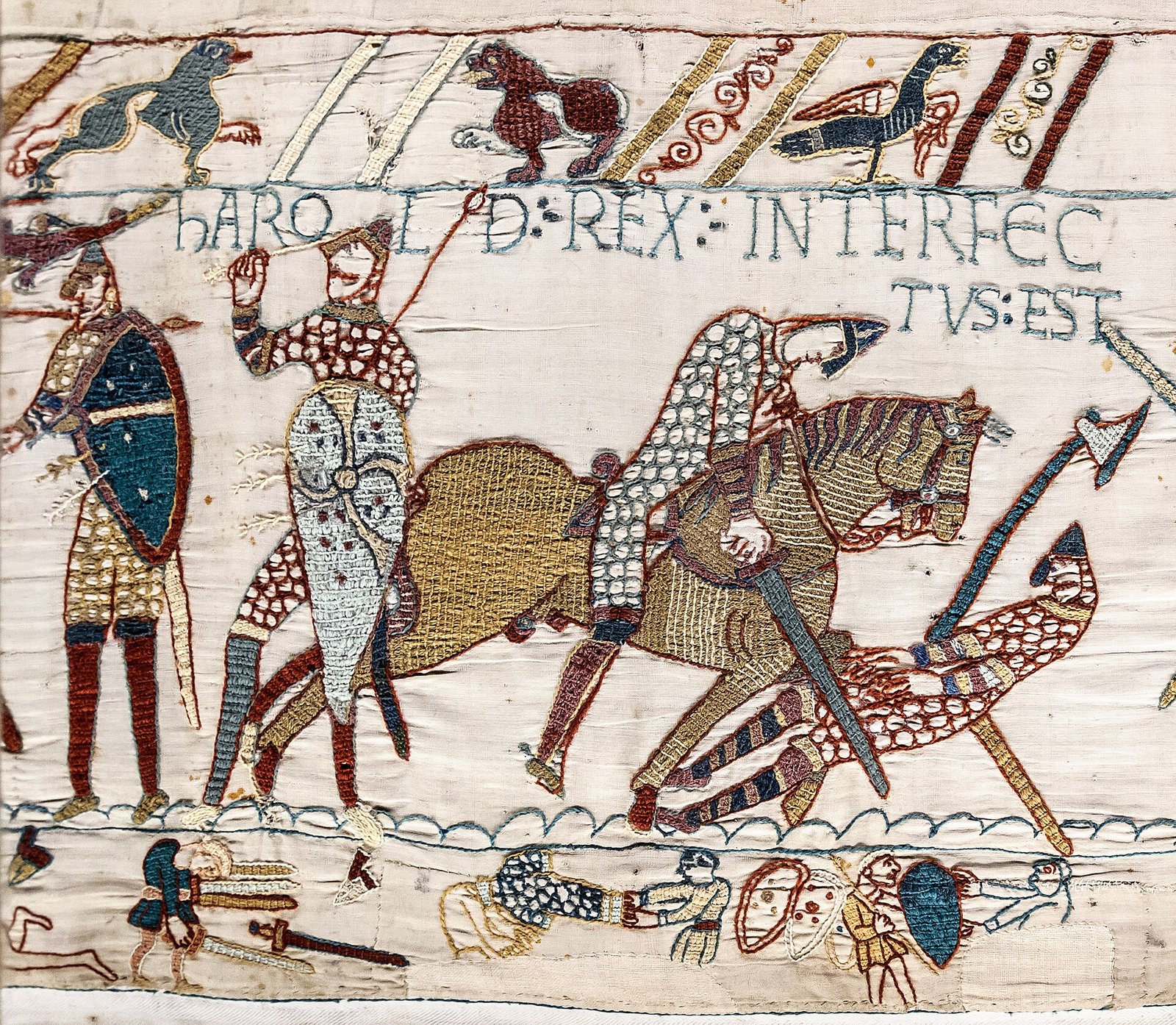
The upper and lower borders also deserve attention. Each is about seven centimetres deep. They contain animals, fabulous creatures and material that differs from the central action. During the closing battle scenes, the lower border includes dismembered bodies and war dead alongside animal decoration.
From Harold’s oath to his coronation
Harold is shown swearing to William over sacred relics at Bayeux before returning to England. In the Norman interpretation, this oath supported William’s claim to the throne. That interpretation matters because Harold subsequently accepts the crown himself. The embroidered words do not explicitly define the oath’s content.
After King Edward’s death, Harold is crowned king of England on 6 January 1066. The sequence places his earlier encounter with William before his accession. It therefore gives the oath a prominent role in the story of the disputed throne, even though its precise terms remain unstated.
The narrative also includes a celestial object with a trailing form. It is now recognised as Halley’s Comet. The Latin caption beside it calls it only a star. The difference between that short label and its present identification is a useful reminder to examine the wording as well as the picture.
What does the Battle of Hastings look like?
William’s fleet crosses the Channel and reaches Pevensey in Sussex. The embroidered story then leads towards Hastings. Ships and the sea passage occupy a clear place in this account: the Norman army must reach England before the battle can occur.
At Hastings on 14 October 1066, Norman archers and cavalry confront English infantry behind a shield wall. The different fighting roles make the scene easier to read. Look for bows, mounted soldiers and the shields protecting the English troops. These are concrete details within the larger account of William’s victory.
William lifts his helmet to show his soldiers that he is alive. Bishop Odo appears encouraging the troops with a club in his hand. These actions bring named figures into the fighting. William’s gesture, in particular, makes his continued presence visible within the battle narrative.
Harold’s death is harder to identify with certainty. The traditional reading associates him with a figure struck in the eye by an arrow. Some historians identify him instead with the adjacent figure killed by a sword. The arrow may also have been altered during later repairs.
The surviving final scene shows English soldiers fleeing. Harold dies and William’s army wins at Hastings, but the embroidery’s ending is missing. What survives therefore closes with flight from the battlefield. It cannot show you the complete conclusion originally attached to the narrative.
What does the embroidery leave out?
The Battle of Stamford Bridge does not appear in the Bayeux Tapestry. It took place less than three weeks before Hastings. Its absence matters when you use the embroidery to understand 1066: the surviving sequence selects events for its account of the Norman conquest.
That selection belongs alongside the work’s Norman viewpoint. Harold’s oath receives attention, as do William’s crossing and battlefield leadership. The embroidery offers evidence for how the conquest was presented. Its short captions and missing ending also place limits on what individual scenes can establish.
Where was the Bayeux Tapestry made?
The embroidery is thought to have been commissioned in the 1070s and made in Kent, England. Neither the exact date nor the production location is documented. Its name connects it with Bayeux, but that connection does not establish where its makers worked.
A tradition credits Queen Matilda and her attendants with stitching the work. Most historians instead consider William’s half-brother, Bishop Odo of Bayeux, the likely commissioner. These are different questions: commissioning the embroidery and physically making it are separate activities.
The earliest known written record is a 1476 inventory of Bayeux Cathedral’s treasury. This establishes a documented point in the object’s history. It does not settle the earlier questions about its workshop, exact date or commissioner.
Details you won’t find in guidebooks
Nine linen panels, sewn together, form the embroidery’s ground. Its makers used four techniques: stem stitch, chain stitch, split stitch and laid-and-couched work. The last technique fills coloured areas. The long narrative therefore depends on both joined fabric and several ways of securing wool to its surface.
The wool’s blue shades came from woad. Madder supplied red shades, while weld supplied yellow. When you inspect a horse, garment or ship, its colour is also evidence of the materials used to make the embroidered image.
Griffins, centaurs and Aesop’s Fox and Crow appear in the borders. These details reward looking beyond the named figures in the central strip. The lower border changes markedly in the final fighting scenes, where bodies and battlefield deaths become part of its imagery.
Some threads added during nineteenth-century repairs have faded more than the original threads. Bayeux Museum notes that these replacements can appear whitish, especially in the final scenes. A pale area may therefore reflect the history of repair as well as the embroidery’s present appearance.
Where is the Bayeux Tapestry? British Museum, London and UK tickets
The announced dates for the British Museum’s London exhibition are 10 September 2026 to 11 July 2027. For a UK visit during that period, the standard adult prices announced for the exhibition are £33 at peak times and £27 at off-peak times.
According to France’s Ministry of Culture, the embroidery left Bayeux on 9 July 2026 for its British Museum loan. It travelled in a specially climate-controlled, vibration-protected crate. The transport arrangements concerned the original embroidered object.
The tapestry had been displayed in Bayeux’s former major seminary since 1983. That museum closed for renovation, with reopening planned for autumn 2027. The London exhibition dates and the Bayeux reopening schedule therefore belong to different parts of its museum history.
Where can you see the full Bayeux Tapestry online or in Reading?
Bayeux Museum offers a free digital panorama of the entire surviving embroidery. You can enlarge details and read English or French translations of the Latin inscriptions. This is useful for returning to Harold’s oath, comparing battle figures or examining a small border creature.
Reading Museum holds a full-size replica. Thirty-five women embroidered it in 1885–1886 through Elizabeth Wardle’s initiative. It came to Reading in 1895. When searching for “Bayeux Tapestry Reading,” distinguish this copy from the original associated with Bayeux and the London loan.
Timeline
- 1064: The narrative begins.
- 6 January 1066: Harold is crowned king of England.
- 1066: William’s fleet crosses the Channel and lands at Pevensey.
- 14 October 1066: Harold dies at Hastings, where William’s army wins.
- 1070s: The embroidery is thought to have been commissioned.
- 1476: It appears in Bayeux Cathedral’s treasury inventory.
- 1885–1886: The full-size replica now in Reading is embroidered.
- 1983: The original goes on display in Bayeux’s former major seminary.
- 2 August 2007: It enters UNESCO’s Memory of the World Register.
- 9 July 2026: It leaves Bayeux for the British Museum loan.
- 10 September 2026–11 July 2027: Announced London exhibition dates.
- Autumn 2027: Planned reopening of the renovated Bayeux Tapestry Museum.
FAQ
What does the Bayeux Tapestry show?
It shows Harold’s journey to Normandy, his oath to William, his coronation, the Norman Channel crossing and the Battle of Hastings. The narrative presents the conquest from a Norman viewpoint.
Where is the Bayeux Tapestry being exhibited?
The announced British Museum exhibition in London runs from 10 September 2026 to 11 July 2027. The renovated museum in Bayeux is scheduled to reopen in autumn 2027.
How much are Bayeux Tapestry tickets at the British Museum?
The announced standard adult ticket prices for the 2026–2027 exhibition are £33 at peak times and £27 at off-peak times.
Where was the Bayeux Tapestry made?
It is thought to have been embroidered in Kent, England, during the 1070s. Its exact production date and place are not documented.
Can you see the full Bayeux Tapestry online?
Bayeux Museum’s free digital panorama shows the entire surviving embroidery. You can zoom into scenes and read English or French translations of its Latin captions.
Sources
- Bayeux Museum — Discover the Bayeux Tapestry bayeuxmuseum.com
- Bayeux Museum — Tapestry or embroidery? bayeuxmuseum.com
- Bayeux Museum — What is the Bayeux Tapestry about? bayeuxmuseum.com
- Bayeux Museum — 2025 Press Kit bayeuxmuseum.com
- Reading Museum — The History of Britain’s Bayeux Tapestry readingmuseum.org.uk
- English Wikipedia — Bayeux Tapestry en.wikipedia.org
- Turkish Wikipedia — Bayeux İşlemesi tr.wikipedia.org
- British Museum Research Repository — The significance of Halley’s Comet in the Bayeux Tapestry britishmuseum.iro.bl.uk
- France’s Ministry of Culture — Tapisserie de Bayeux : un prêt historique culture.gouv.fr
- The Art Newspaper — British Museum reveals ticket prices for Bayeux Tapestry exhibition theartnewspaper.com
- Bayeux Museum — Explore the Bayeux Tapestry online bayeuxmuseum.com
- English Wikipedia — Bayeux en.wikipedia.org
Image: Bayeux Tapestry scene57 Harold death.jpg — Myrabella, Public domain