Where was Joseph Stalin born?
Joseph Stalin was born on 18 December 1878 in Gori. Today Gori is in Georgia. Back then it sat inside the Russian Empire.
He grew up with a Georgian identity, and Georgian was his native language. His father was a cobbler. His mother was a laundress. The family lived in poverty in Gori.
If you travel to Georgia, Gori is where his story begins, and it is where this article begins too.
Joseph Stalin’s real name
Stalin was not born with that name. His Georgian birth name was Ioseb Besarionis dze Jughashvili. The Russianized version was Iosif Vissarionovich Dzhugashvili.
He collected nicknames the way some people collect hobbies. Soso was his childhood name. Soselo, a diminutive of Soso, was the pen name he used on some of the five poems that appeared in the newspaper Iveria in 1895. In his revolutionary years he went by Koba. That name came from a fictional outlaw hero in Georgian literature.
The name Stalin came last. He used it from 1912, and it comes from the Russian word stal, meaning steel.
Joseph Stalin’s birthday: two dates
There are two birthdays on record. Birth records give 18 December 1878. During the Soviet era, however, his official birthday was celebrated on 21 December 1879.
Think of a family where the date on the paperwork and the date on the cake do not match. Stalin’s case was the same, only the cake was a state holiday.
The 1878 date is the one used for his age at death.
Joseph Stalin as a young man
Stalin began at the Gori Church School in 1888. In 1894 he won a scholarship to study at the Tiflis Spiritual Seminary.
It did not end well. In 1899 he was expelled from the seminary. The official reason was that he had not sat his exams. Stalin himself linked his removal to spreading Marxist propaganda.
After 1903 the Russian Social Democratic Labour Party split. Stalin took his place in Lenin’s Bolshevik wing. In 1912 Lenin promoted him to the Bolshevik Central Committee, which moved him into the top leadership of the party.
Joseph Stalin’s books
His best-known theoretical work on the national question is Marxism and the National Question, published in 1913. It deals with how nations and peoples fit into Marxist thinking.
The topic was not only academic. After the Bolshevik government formed in November 1917, Stalin became its People’s Commissar for Nationalities.
His poems are an odd corner of his writing. They appeared in Iveria in 1895, long before any of this.
How Stalin rose to power
On 3 April 1922, Stalin was appointed General Secretary of the Communist Party. He held the post of leader of the Soviet Union until his death in 1953.
Lenin died in 1924. Between then and 1929, Stalin built alliances and used them to neutralize his rivals inside the party one after another. By the end of the 1920s he held personal power.
He then launched two huge programs. Five-Year Plans aimed at rapid industrialization. At the same time, agriculture was forcibly collectivized. Both reshaped Soviet life, and both came with heavy costs.
The Great Terror
The numbers from 1937 and 1938 are among the most cited in Stalin’s record. Historian Nicolas Werth reports figures from the Pospelov Commission. According to them, the NKVD arrested 1,548,366 people in 1937–1938. It shot 681,692 of them.
Overall death tolls for the Stalin era are disputed and depend on what is counted. Research on Soviet repression cites roughly 3.3 million recorded deaths from executions, camps and exile. Older estimates that also include famines reach 20 million or more.
When you read a single figure for Stalin’s victims, check what it includes. The range is wide because the definitions differ.
War and the postwar order
In 1939, the Soviet Union under Stalin signed a non-aggression pact with Nazi Germany.
In 1941 Stalin became chairman of the Council of People’s Commissars. After Germany attacked the Soviet Union, he took over the running of the war.
In 1945 he attended the Yalta and Potsdam conferences. There he played a part in shaping the European order after the war.
Joseph Stalin’s death and age
Stalin died on 5 March 1953 at his dacha near Moscow. He was 74, going by the 1878 birth date.
His body was kept in Lenin’s Mausoleum from 1953 to 1961. It was then moved to the Kremlin Wall Necropolis in Red Square, Moscow, where he was buried.
Cause of death
The most credible answer is a stroke. A 2023 medical assessment points to a brain hemorrhage linked to long-term high blood pressure.
Some biographies suggest that people close to him poisoned him with warfarin. The same 2023 review calls that theory low in probability. It finds a natural bleed caused by hypertension far more likely.
How tall was Stalin?
English-language Wikipedia gives his adult height as 1.70 metres. That is a single reference figure, so treat it as a reference point.
Joseph Stalin’s net worth
No reliable figure exists, so none is given here. What matters about Stalin is the power he held, not a bank balance.
Timeline
- 18 December 1878: born in Gori.
- 1888: began at the Gori Church School.
- 1894: entered the Tiflis Spiritual Seminary on a scholarship.
- 1895: poems published in Iveria.
- 1899: expelled from the seminary.
- 1903: joined Lenin’s Bolshevik wing.
- 1912: rose to the Bolshevik Central Committee.
- 1913: Marxism and the National Question published.
- November 1917: became People’s Commissar for Nationalities.
- 3 April 1922: appointed General Secretary of the Communist Party.
- 1924–1929: neutralized party rivals after Lenin’s death.
- 1937–1938: mass arrests and executions in the Great Terror.
- 1939: non-aggression pact with Nazi Germany.
- 1941: took over the government and the war effort.
- 1945: attended the Yalta and Potsdam conferences.
- 5 March 1953: died aged 74.
- 1961: body moved from Lenin’s Mausoleum to the Kremlin Wall Necropolis.
- 2010: a room on the repression era added to his museum in Gori.
Visiting the Stalin Museum in Gori
The Stalin Museum in Gori has six main exhibition halls with more than 40,000 objects. The third hall is devoted to photographs of historical events.
In 2010 a seventh room was added. It tells of the repressions of Stalin’s era and the experiences of the victims. If you visit, read that room as part of the whole story and not as an afterthought.
Details you won’t find in guidebooks
- Two birthdays. The recorded date is 18 December 1878. The Soviet-era celebration used 21 December 1879.
- A poet’s pen name. Soselo, the pen name on some of his five 1895 poems in Iveria, was a diminutive of his childhood name Soso.
- A death mask in bronze. The fourth hall of the Gori museum displays a bronze death mask of Stalin.
- A copy of his study. The sixth hall holds a copy of the study he used from 1918 to 1922.
FAQ
Where was Joseph Stalin born?
He was born in Gori, a town in what is now Georgia. At the time it lay inside the Russian Empire.
What was Joseph Stalin’s real name?
His Georgian birth name was Ioseb Besarionis dze Jughashvili. The Russianized form was Iosif Vissarionovich Dzhugashvili. The name Stalin, from the Russian word for steel, came into use from 1912.
How old was Stalin when he died?
He was 74. He died on 5 March 1953 at his dacha near Moscow, counting from his recorded birth date of 18 December 1878.
What caused Stalin’s death?
A 2023 medical assessment attributes it to a stroke from a brain hemorrhage linked to long-term high blood pressure. The same review finds the warfarin poisoning theory unlikely.
How tall was Stalin?
English-language Wikipedia gives his adult height as 1.70 metres.
Sources
- Wikipedia — Joseph Stalin en.wikipedia.org
- HISTORY — Joseph Stalin history.com
- PBS — Commanding Heights: Joseph Stalin pbs.org
- Deutsches Historisches Museum — Josef W. Stalin dhm.de
- Ronald Grigor Suny — Stalin: Passage to Revolution (excerpt), Los Angeles Review of Books lareviewofbooks.org
- Nicolas Werth — Les opérations de masse de la Grande terreur en URSS, Persée persee.fr
- Tyrant’s End: Did Joseph Stalin Die From Warfarin Poisoning? — Cureus / PMC pmc.ncbi.nlm.nih.gov
- Georgia National Tourism Administration — The Stalin Museum in Gori georgia.travel
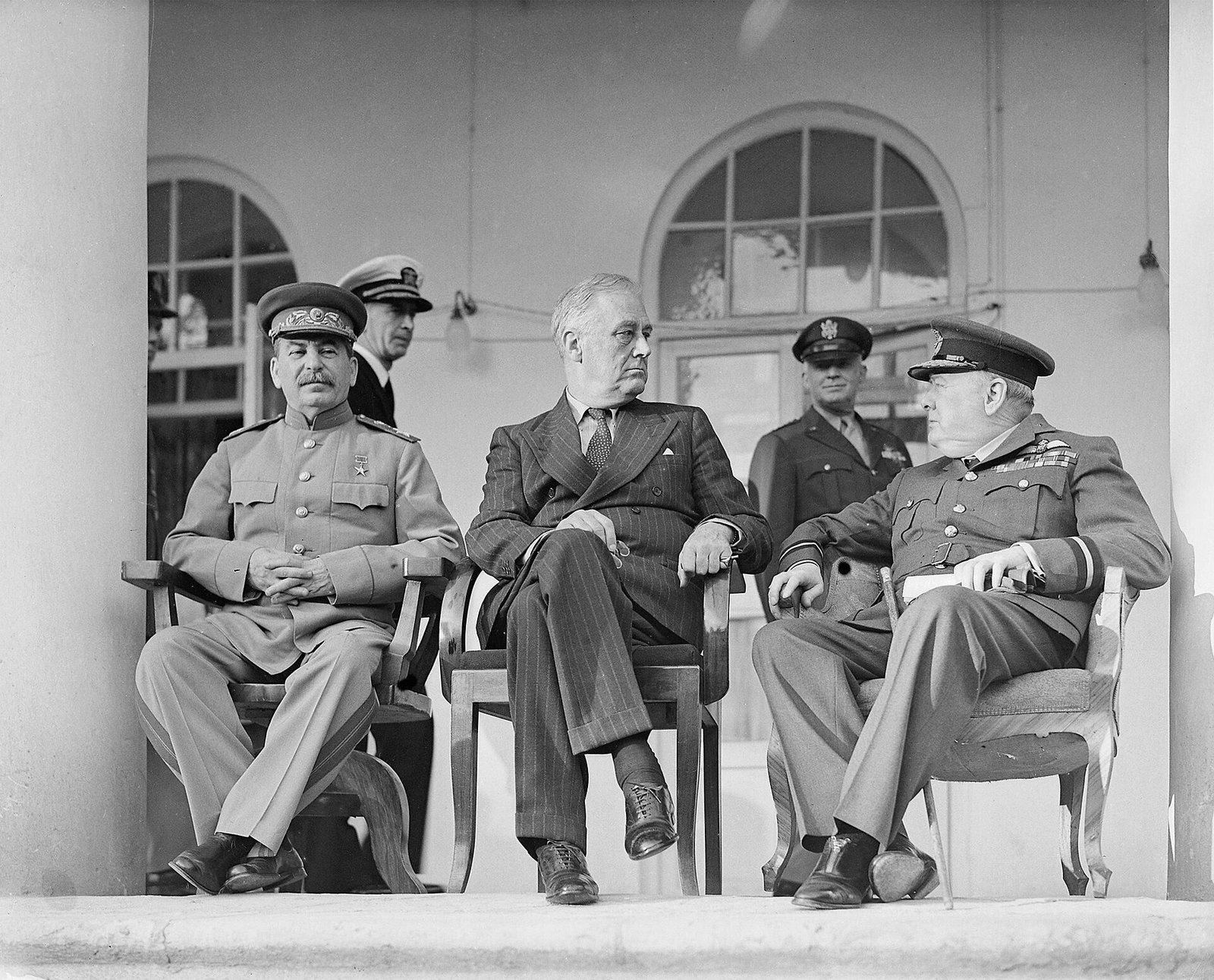
Image: Joseph Stalin, Franklin D Roosevelt and Winston Churchill, in Teheran, 1943, edit.jpg — Dennis Charles Oulds, Public domain